
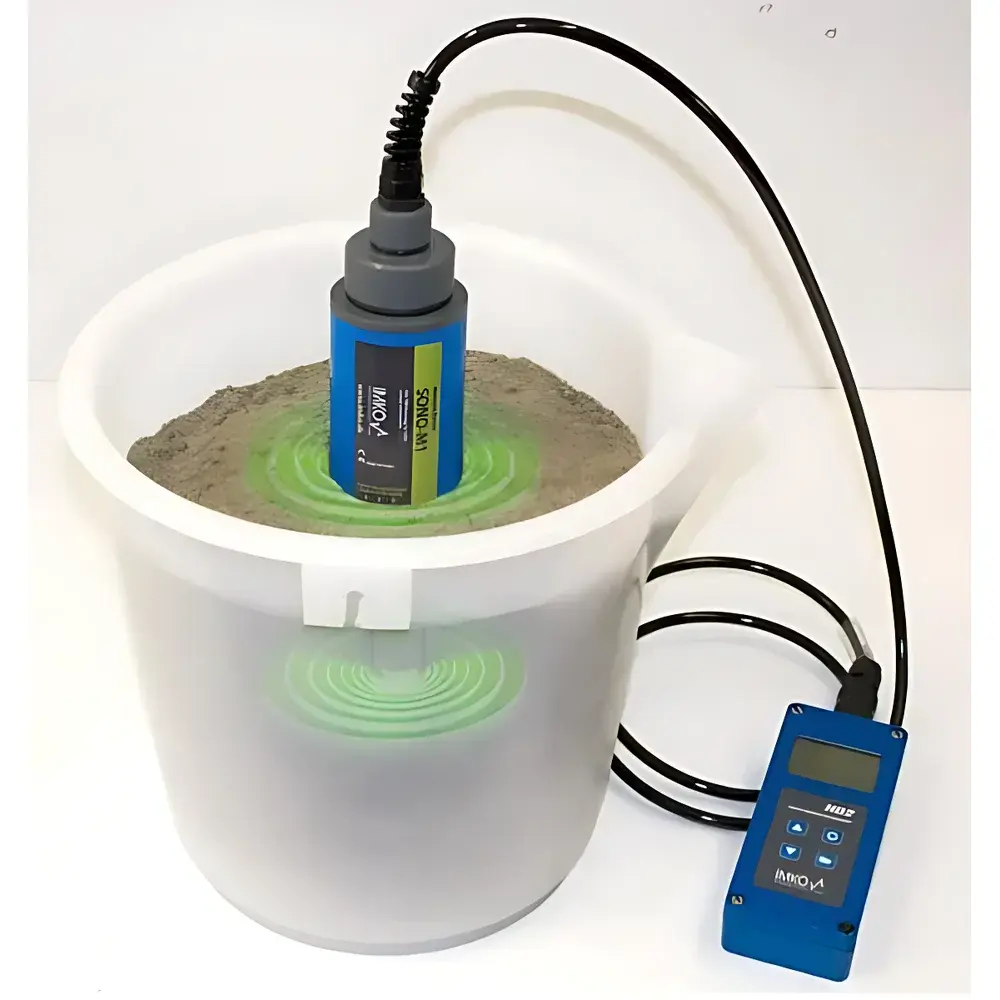
IMKO SONO-M1/M1C Rapid Aggregate Moisture Analyzer
| Brand | IMKO |
|---|---|
| Origin | Germany |
| Model | SONO-M1/M1C |
| Instrument Type | Moisture Analyzer for Aggregates |
| Measurement Principle | TDR (Time-Domain Reflectometry) |
| Moisture Range | 0–100% w/w |
| Accuracy | ±0.1–0.2% |
| Repeatability | ±0.3% |
| Conductivity Range | 0–5 dS/m |
| Temperature Range (Operation) | −15°C to +50°C |
| Temperature Accuracy | ±0.5°C |
| Measurement Volume | ~1.0 L (Ø100 mm × 130 mm) |
| Probe Diameter | 64 mm (M1), Coated Probe Ø6 mm × 100 mm (M1C) |
| Enclosure Rating | IP68 |
| Power Supply | 7–24 V DC |
| Current Draw | 100 mA @ 12 V DC |
| Interface | 7-pin connector, 1.5 m cable |
| Calibration | Pre-loaded aggregate-specific curves |
Overview
The IMKO SONO-M1/M1C Rapid Aggregate Moisture Analyzer is an industrial-grade, field-deployable moisture measurement system engineered for high-reliability quantification of water content in coarse and fine construction aggregates—including sand, gravel, crushed stone, expanded clay, slag, and heterogeneous soil–sand mixtures. Unlike conventional oven-drying or capacitance-based methods, the SONO-M1/M1C employs Time-Domain Reflectometry (TDR), a physically grounded electromagnetic technique that measures the dielectric permittivity of the bulk material in situ. Because the dielectric constant of water (~80) is significantly higher than that of dry mineral solids (~3–5), even trace moisture levels—down to fractions of a percent—induce measurable shifts in signal propagation velocity and reflection amplitude along the probe’s transmission line. The instrument’s TDR waveform analysis yields volumetric water content with metrological traceability, independent of salinity-induced polarization effects that compromise traditional impedance sensors. Designed specifically for pre-mix batching environments and ready-mix concrete production facilities, it delivers real-time, non-destructive moisture assessment without sample preparation, enabling immediate correction of water-to-cement ratios per ASTM C94 and EN 206 compliance frameworks.
Key Features
- True TDR-based measurement architecture—immune to electrode fouling, polarization drift, and electrolyte interference common in conductive or saline aggregates.
- Dual-probe variants: SONO-M1 for standard aggregates (uncoated 64 mm diameter sensor, 130 mm active length); SONO-M1C with chemically resistant coating optimized for high-conductivity materials (e.g., iron oxide-rich sands, carbon-containing fillers, wet clays).
- Measurement volume of approximately 1.0 L (cylindrical zone Ø100 mm × 130 mm), ensuring representative sampling across particle sizes up to 32 mm—fully compliant with EN 933-1 and ASTM D2419 sieve specifications.
- Pre-installed calibration libraries for common aggregate types (siliceous sand, limestone gravel, basalt chippings, expanded clay), validated against gravimetric reference methods per ISO 11274.
- User-configurable calibration storage: up to 15 custom curves, editable via PC software; optional dielectric constant input mode for research-grade method development.
- Robust IP68-rated housing and PVC-insulated probe assembly, rated for continuous immersion and exposure to abrasive, dusty, or chemically aggressive site conditions.
- Wide operating temperature range (−15°C to +50°C) with integrated Pt1000 temperature sensor (±0.5°C accuracy) for automatic thermal compensation of dielectric response.
Sample Compatibility & Compliance
The SONO-M1/M1C is validated for use with granular, non-powdered solid matrices where particle size distribution falls within typical concrete aggregate grading bands (EN 12620, ASTM C33). It accommodates heterogeneous blends containing fines (<75 µm), silt, clay fractions, and coarse fractions up to 32 mm. Not intended for fine powders, slurries, or fully saturated cohesive soils exhibiting plastic flow behavior. Measurement validity assumes homogeneous packing density within the sensing volume; significant air voids or segregation require mechanical consolidation prior to reading. The device meets CE marking requirements under the EU Electromagnetic Compatibility Directive 2014/30/EU and Low Voltage Directive 2014/35/EU. Its measurement methodology aligns with the physical principles referenced in ISO/IEC 17025-accredited laboratories for moisture determination in construction materials.
Software & Data Management
Data acquisition and configuration are managed via IMKO’s proprietary SONO-PC software (Windows-compatible), supporting firmware updates, calibration curve editing, batch logging, and CSV export. Each measurement record includes timestamp, temperature-compensated moisture value, raw TDR waveform snapshot, and probe identification. Audit trails are preserved locally on the host PC; no cloud connectivity or remote telemetry is embedded—ensuring full data sovereignty required under GDPR and internal QA/QC policies. For integration into plant-level SCADA or MES systems, analog 4–20 mA or digital RS-485 Modbus RTU output modules are available as optional accessories (not included with base unit). All calibration and measurement metadata comply with ALCOA+ principles for data integrity, supporting GLP-aligned documentation workflows.
Applications
- Real-time moisture correction in concrete batching plants to maintain target slump, strength, and durability per ACI 211.1 and EN 206.
- Quality assurance during aggregate stockpile management—detecting rain-induced surface saturation or capillary rise before feed conveyance.
- Validation of drying efficiency in aggregate washing or thermal treatment lines.
- Field verification of moisture content in road base/subbase materials prior to compaction (ASTM D1557, AASHTO T180).
- Research applications involving hydration kinetics, moisture migration modeling, or sorption isotherm characterization in porous mineral media.
FAQ
Is the SONO-M1/M1C suitable for measuring moisture in clay-rich soils?
Yes—particularly the M1C variant, whose coated probe mitigates signal distortion caused by high ionic conductivity. However, for plastic or highly dispersive clays, ensure the sample is mechanically homogenized and packed to eliminate macro-pores before measurement.
Can I use the same calibration curve for different sand sources?
No. While pre-loaded curves cover generic siliceous or calcareous sands, site-specific calibration is strongly recommended due to variations in mineralogy, grain shape, and fines content. IMKO provides guidelines for two-point gravimetric validation per ISO 11274 Annex B.
Does temperature affect measurement accuracy?
The built-in Pt1000 sensor enables real-time dielectric compensation across −15°C to +50°C. Residual temperature-induced error after compensation is ≤ ±0.3% over full range, verified per ISO/IEC 17025 uncertainty budgeting protocols.
What maintenance does the probe require?
None beyond periodic visual inspection and cleaning with a soft brush or compressed air. The PVC housing and stainless-steel electrodes are corrosion-resistant; no recalibration is needed unless physical damage occurs.
Is the device compatible with automated batching control systems?
Yes—via optional analog (4–20 mA) or digital (Modbus RTU over RS-485) interface modules. Integration requires configuration by qualified automation personnel using vendor-provided protocol documentation.
Related Products







