
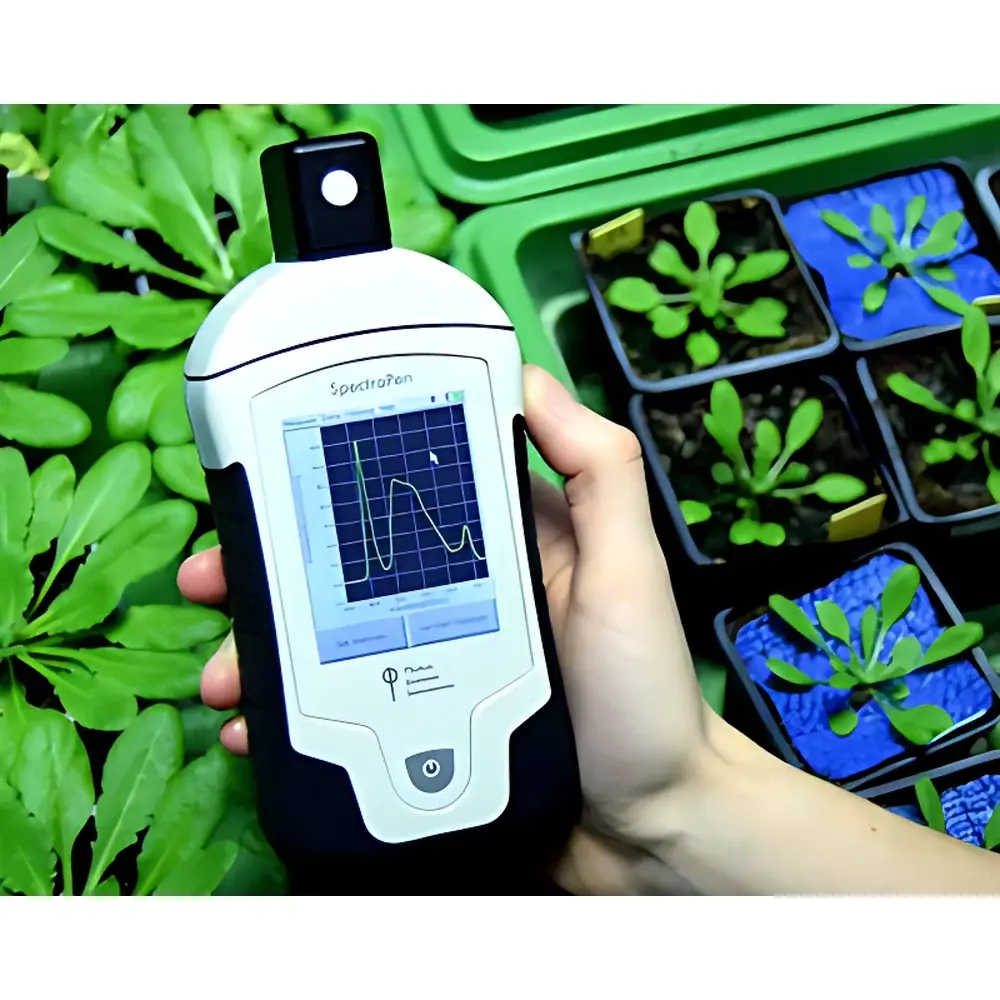
SpectraPen LM510 Handheld Spectroradiometer
| Brand | PSI / Photon Systems Instruments |
|---|---|
| Origin | Czech Republic |
| Model | SpectraPen LM510 |
| Spectral Range Options | UVIS (340–780 nm) or NIR (640–1050 nm) |
| Detector Orientation | Horizontal (H) or Vertical (V) |
| Cosine Corrector | Integrated |
| Power | Rechargeable Li-ion Battery |
| Connectivity | USB + Bluetooth |
| GPS | Built-in |
| Display | Touchscreen LCD |
| Data Storage | Internal Flash Memory |
| Compliance | CE, RoHS |
| Software | SpectraPen PC Suite (data export, spectral calibration, CIE color space calculation) |
Overview
The SpectraPen LM510 is a field-deployable, handheld spectroradiometer engineered for high-fidelity spectral irradiance measurement across biologically and photometrically relevant wavelength bands. Based on a miniature diffraction-grating optical engine coupled with a thermally stabilized back-thinned CCD detector, it delivers calibrated spectral data traceable to NIST-traceable standards. Unlike broadband photometers or simplified spectral sensors, the LM510 captures full spectral irradiance (µW/cm²/nm) at 1 nm nominal resolution—enabling quantitative analysis of spectral shape, peak position, bandwidth, and relative intensity distribution. Its core application domain spans plant photobiology, horticultural lighting validation, environmental light monitoring, and spectral quality assurance of artificial light sources—including LEDs, fluorescent lamps, and horticultural fixtures. The instrument operates autonomously without external computing, making it suitable for rapid in situ measurements under variable ambient conditions—from growth chambers and greenhouses to open-field ecosystems.
Key Features
- Real-time spectral acquisition with onboard computation of photometric (Lux, Lumen), radiometric (Watt/cm²), and photosynthetic metrics (PAR: 400–700 nm, YPF: 400–750 nm)
- Integrated CIE 1931 chromaticity coordinate calculation (x, y) and correlated color temperature (CCT) estimation
- Dual spectral configuration options: UVIS (340–780 nm) for visible/UV photobiological action spectra, or NIR (640–1050 nm) for far-red and NIR quantum yield assessment
- Two optical head orientations: Horizontal (H) for confined-space measurements (e.g., growth chambers, canopy interiors); Vertical (V) for tripod-mounted outdoor profiling and directional irradiance mapping
- Class A cosine angular response (±5° up to 80° incidence) certified per ISO/CIE 19476:2015 and DIN 5032-7
- Built-in high-sensitivity GPS module (±2.5 m CEP) for geotagged spectral logging in ecological transects or multi-site comparative studies
- USB 2.0 and Bluetooth 5.0 dual-mode interface supporting both real-time streaming and batch download; firmware-upgradable via PC Suite
Sample Compatibility & Compliance
The SpectraPen LM510 is designed for non-contact, non-destructive irradiance measurement of planar or diffuse light fields. It is compatible with steady-state and pulsed light sources (with minimum pulse width ≥10 ms), including narrowband LEDs, broad-spectrum HID lamps, and natural daylight under clear or overcast skies. All factory calibrations are performed against reference lamps traceable to PTB (Physikalisch-Technische Bundesanstalt) and include spectral responsivity, linearity, and temperature drift compensation (±0.02%/°C). The device complies with IEC 62471 (Photobiological Safety), ISO 11664-1 (Colorimetry), and EN 13032-1 (Lighting Measurement). Its firmware architecture supports audit-ready data logging with timestamp, GPS coordinates, instrument ID, and calibration validity status—meeting GLP-aligned documentation requirements for environmental and agricultural research protocols.
Software & Data Management
The SpectraPen PC Suite (Windows/macOS) provides comprehensive post-acquisition processing: spectral smoothing (Savitzky-Golay), baseline correction, integration band definition (user-definable from 200–1100 nm), PAR/YFP/PPFD summation, and CIE chromaticity plotting. Raw data exports as CSV and .SPX (binary spectral format) with embedded metadata (calibration date, serial number, GPS fix status). The software supports batch processing of field-collected datasets and generates compliance reports aligned with ASTM E308-22 (Standard Practice for Computing the Colors of Objects) and ISO 11988 (Plant Growth Lighting Characterization). Audit trails—including user login, parameter changes, and export events—are recorded in accordance with FDA 21 CFR Part 11 principles when configured with electronic signature modules.
Applications
- Horticultural lighting R&D: Quantification of photon flux density (PPFD), phytochrome photostationary state (PSS), and red:far-red (R:FR) ratios in LED grow lights
- Ecological field surveys: Diurnal and seasonal spectral irradiance mapping across forest understories, wetlands, and alpine zones
- Greenhouse climate control validation: Monitoring spectral shifts induced by glazing materials, shading nets, or supplemental lighting schedules
- LED manufacturing QA: Verification of binning consistency, spectral stability under thermal load, and compliance with ENERGY STAR® SSL criteria
- Environmental phototoxicity studies: UV-B (280–315 nm) and UV-A (315–400 nm) irradiance profiling near industrial sites or high-altitude locations
- Educational laboratories: Hands-on instruction in radiometry, photometry, and plant photomorphogenesis
FAQ
What spectral calibration standards are used for the LM510?
Each unit is calibrated against NIST-traceable tungsten halogen and deuterium reference lamps at PSI’s accredited calibration laboratory; calibration certificates include uncertainty budgets per ISO/IEC 17025.
Can the LM510 measure pulsed or modulated light sources?
Yes—provided pulse duration exceeds 10 ms and duty cycle remains above 10%; spectral averaging mode suppresses aliasing artifacts in PWM-driven LEDs.
Is the GPS module usable indoors or under dense canopy?
GPS signal acquisition requires open-sky visibility; indoor or heavily shaded deployments rely on manual georeferencing or external GNSS receivers via Bluetooth NMEA input.
How often does the instrument require recalibration?
PSI recommends annual recalibration for research-grade applications; field verification using a portable reference standard (e.g., LM-01 Calibration Lamp) is advised before critical measurement campaigns.
Does the LM510 support third-party software integration?
Yes—via ASCII-based serial protocol over USB/Bluetooth; MATLAB, Python (PySerial), and LabVIEW drivers are available through PSI’s Developer Portal.
Related Products





