
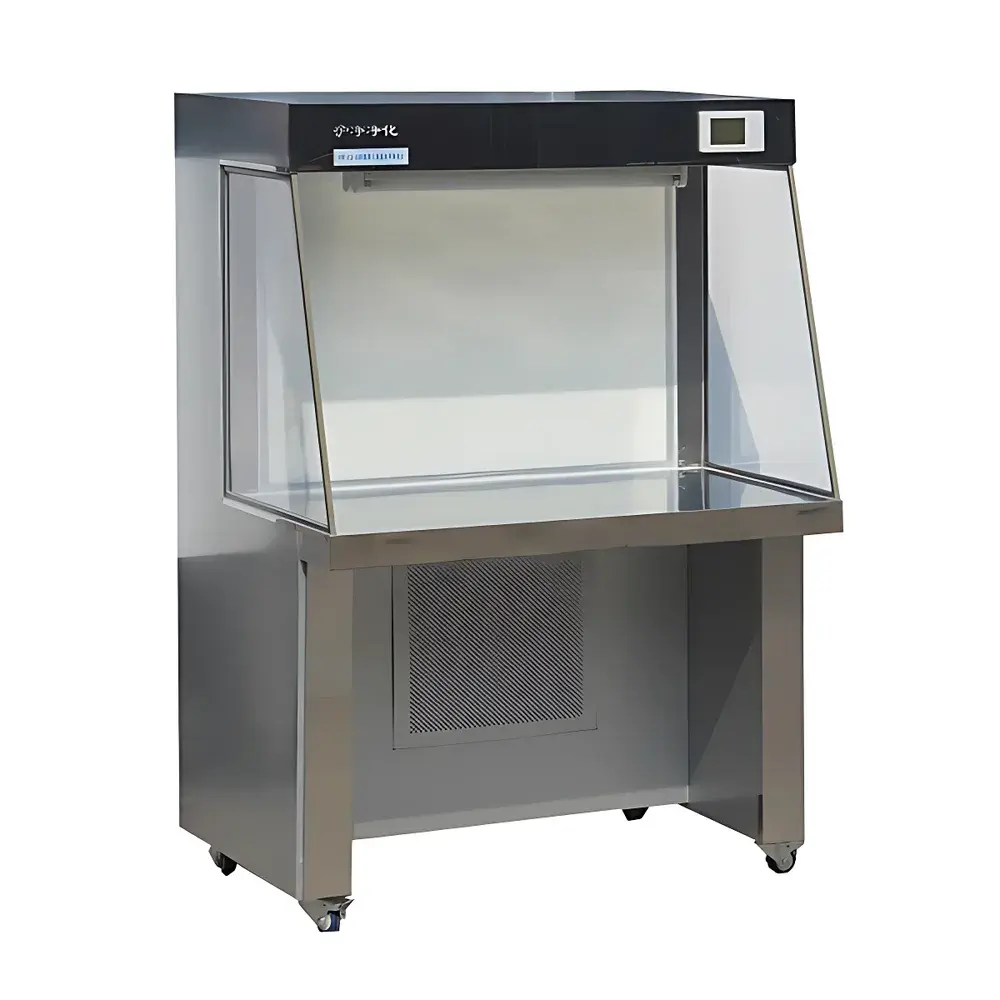
HJ SW-CJ-1Bu Vertical Flow Clean Bench
| Brand | HJ |
|---|---|
| Origin | Shanghai, China |
| Manufacturer Type | Direct Manufacturer |
| Instrument Category | Vertical Flow Clean Bench |
| Cleanliness Class | ISO Class 5 (100 @ ≥0.5 µm, Fed. Std. 209E) |
| Noise Level | ≤62 dB(A) |
| Occupancy | Single User |
| Airflow Pattern | Vertical Downflow |
| Average Air Velocity | 0.25–0.45 m/s (dual-speed control) |
| Microbial Count | ≤0.5 CFU/plate·hour (Φ90 mm settle plate) |
| Vibration Peak-to-Peak | ≤10 µm (X/Y/Z axes) |
| Illumination | ≥300 lx |
| Power Supply | AC 220 V, 50 Hz |
| Max. Power Consumption | 400 W |
| Net Weight | 100 kg |
| Working Area Dimensions (W×D×H) | 900 × 510 × 600 mm |
| Overall Dimensions (W×D×H) | 930 × 740 × 1440 mm |
| HEPA Filter Spec. | 795 × 600 × 38 mm (1 unit) |
| Fluorescent Lamp | 20 W × 1 |
| UV Lamp | 20 W × 1 |
Overview
The HJ SW-CJ-1Bu Vertical Flow Clean Bench is an ISO Class 5-certified laminar flow workstation engineered for personnel-protective, non-sterile applications requiring particulate-free ambient air in laboratory and light industrial settings. Unlike biological safety cabinets, this clean bench operates on a vertical downflow principle: air is drawn through a pre-filter, conditioned and pressurized, then passed through a certified HEPA filter (EN 1822 H14 or equivalent) before being delivered as unidirectional, low-turbulence laminar flow across the work surface at a controlled velocity of 0.25–0.45 m/s. This airflow profile minimizes cross-contamination between samples and ensures consistent particle removal—meeting the U.S. Federal Standard 209E criterion of ≤3,520 particles/m³ ≥0.5 µm (equivalent to ISO 14644-1 Class 5). Designed for routine aseptic tasks such as media preparation, sample weighing, electronics assembly, and pharmaceutical packaging line support, it provides operator exposure without containment of hazardous agents.
Key Features
- Vertical laminar airflow architecture with dual-speed electronic control (low/medium/high), enabling precise adaptation to workflow demands and energy optimization.
- Robust enclosure fabricated from pre-painted steel panels with seamless welded corners; work surface constructed from brushed 304 stainless steel—resistant to corrosion, non-porous, and compliant with ISO 14644-3 surface cleanliness validation protocols.
- Interlocked lighting and UV germicidal irradiation system: fluorescent lamp (20 W) and UV-C lamp (20 W, 254 nm) cannot operate simultaneously, preventing accidental UV exposure during active work.
- Digital LCD controller with real-time display of operational status, fan speed mode, and UV timer countdown—supporting intuitive, repeatable setup across shifts.
- Two-stage filtration: G4-rated pre-filter captures coarse particulates (>5 µm), significantly extending HEPA filter service life and reducing long-term maintenance frequency.
- Integrated vibration-damping base and rigid structural frame limit mechanical transmission to ≤10 µm peak-to-peak displacement across all three orthogonal axes—critical for micro-weighing and optical alignment tasks.
Sample Compatibility & Compliance
The SW-CJ-1Bu accommodates standard laboratory vessels—including Petri dishes, beakers, flasks, and vial racks—within its 900 × 510 × 600 mm working area. Its open-front, single-user configuration supports ergonomic access while maintaining laminar integrity under typical ambient lab conditions (temperature: 15–30°C; relative humidity: ≤70% RH). The unit complies with IEC 61000-6-3 (EMC emissions), IEC 61000-6-1 (immunity), and GB/T 25915.3–2010 (Chinese national standard for cleanroom equipment testing). While not certified for biosafety level (BSL) containment, it satisfies prerequisite environmental controls referenced in USP , ISO 13485 Annex A.3, and EU GMP Annex 1 (2022) for low-risk aseptic processing zones.
Software & Data Management
This clean bench operates as a standalone electromechanical system with no embedded firmware or network interface. All operational parameters—including fan speed selection, UV exposure duration (0–30 min adjustable), and runtime logging—are managed via the front-panel LCD interface. No software installation, cloud connectivity, or audit trail functionality is provided. For regulated environments requiring documentation, users may integrate external data loggers (e.g., calibrated thermo-hygrometers or particle counters) to record ambient temperature, humidity, and airborne particle counts per ISO 14644-2 surveillance requirements. The absence of digital control systems eliminates cybersecurity concerns and simplifies 21 CFR Part 11 compliance pathways where electronic records are not mandated.
Applications
- Preparation of microbiological growth media and sterile diluents in QC laboratories.
- Handling of non-pathogenic cell lines and plant tissue cultures in academic research facilities.
- Assembly and inspection of precision components in optics, semiconductor prototyping, and MEMS fabrication.
- Weighing of reference standards and high-purity reagents under low-particulate conditions.
- Pharmaceutical secondary packaging operations where product sterility is assured upstream (e.g., filling under isolator), but environmental particulate control remains critical.
- Electronics manufacturing tasks involving solder paste application, PCB inspection, and component placement.
FAQ
Does this unit provide protection against biohazards or toxic vapors?
No. The SW-CJ-1Bu is a clean bench—not a biological safety cabinet. It protects samples from environmental contamination but offers no personnel or environmental protection from hazardous agents.
What HEPA filter standard does the unit meet?
It employs a filter certified to EN 1822 H14 classification (≥99.995% efficiency at MPPS ~0.1–0.2 µm), validated per ISO 14644-3 Annex B. Filter replacement intervals depend on ambient air quality and usage frequency; typical service life ranges from 12–24 months.
Can the UV lamp be used while the fan is running?
No. The safety interlock prevents concurrent operation of UV and airflow systems. UV sterilization must be performed with the sash closed and fan off.
Is calibration or certification included with purchase?
Factory-installed HEPA filter integrity and airflow velocity are verified prior to shipment. On-site certification (e.g., ISO 14644-3 particle count, uniformity mapping) must be performed by an accredited third-party service provider per user facility requirements.
What maintenance is required beyond filter replacement?
Weekly wipe-down of stainless steel surfaces with 70% ethanol or isopropyl alcohol; monthly inspection of pre-filter loading; annual verification of UV lamp intensity using a calibrated radiometer (target: ≥40 µW/cm² at 1 m distance).



