
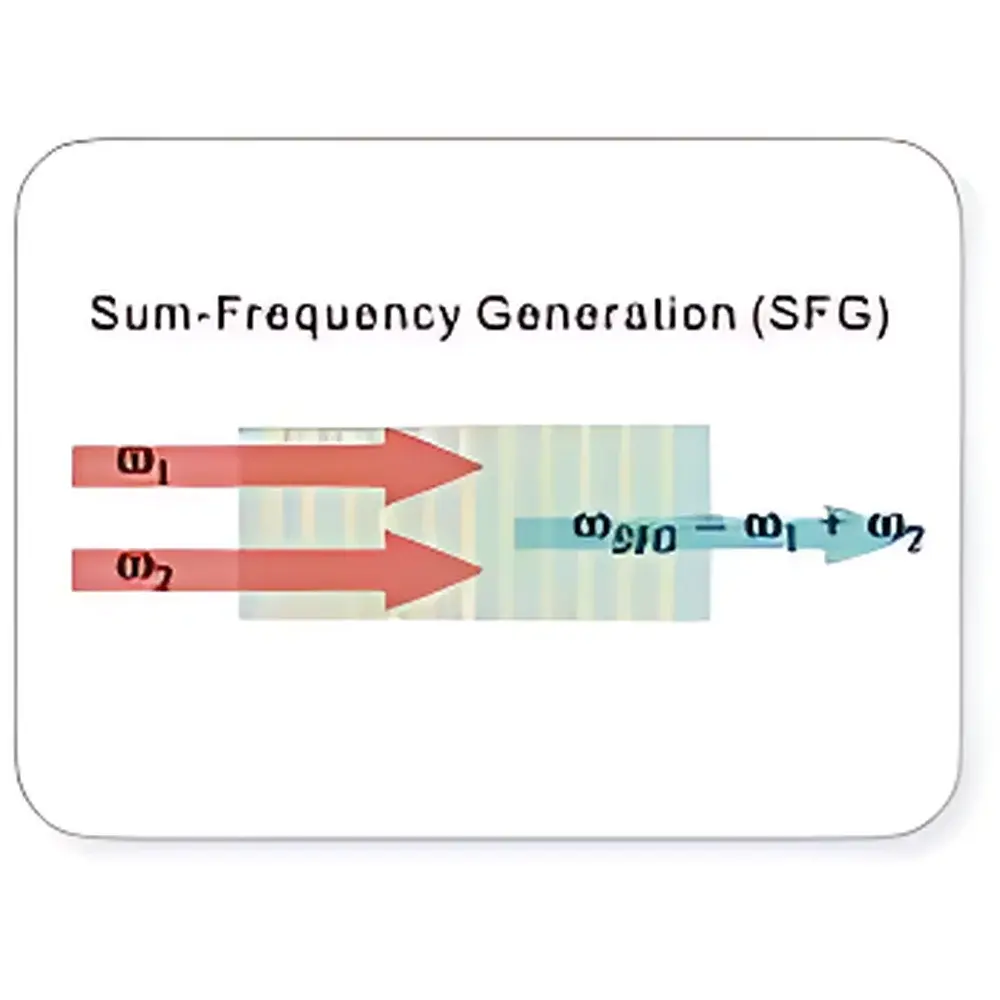
PPLN Crystal for Sum-Frequency Generation (SFG)
| Brand | HCP (Longcai Technology) |
|---|---|
| Origin | Taiwan |
| Type | Periodically Poled Lithium Niobate (PPLN) Crystal |
| Model | PPLN-SFG |
| Coating | Broadband AR-Coated on Both Faces |
| Poling Period Options | Multi-Period & Fan-Out Grating Design |
| Grating Length (X) | 0.3, 0.5, 1.0, 10, 25, 50 mm |
| Thickness (Z) | 0.5 mm or 1.0 mm |
| Output Wavelength Range | 516–737 nm |
Overview
The HCP PPLN Crystal for Sum-Frequency Generation (SFG) is a precision-engineered nonlinear optical crystal designed for efficient wavelength conversion in continuous-wave (CW) and pulsed laser systems. Based on periodically poled lithium niobate (LiNbO₃), this crystal leverages quasi-phase-matching (QPM) to enable high-conversion-efficiency SFG processes across the visible spectrum (516–737 nm). Unlike bulk birefringent phase-matching approaches, QPM via engineered domain inversion allows precise control over interaction bandwidth, spectral acceptance, and temperature tuning behavior—making it ideal for applications requiring narrow-linewidth visible output derived from near-infrared pump and signal sources (e.g., 1064 nm + 1550 nm → 630 nm).
Key Features
- Multi-period and fan-out grating architectures support broadband or tunable SFG operation without mechanical re-alignment.
- Broadband anti-reflection (AR) coatings applied to both input and output faces minimize Fresnel losses across the entire 516–737 nm output range and corresponding pump/signal bands (e.g., 780–1550 nm).
- Precision poling with sub-micron domain uniformity ensures high spatial coherence and reproducible conversion efficiency over extended operational lifetimes.
- Available in standardized grating lengths (0.3 mm to 50 mm) and thicknesses (0.5 mm and 1.0 mm), optimized for walk-off mitigation and effective interaction length scaling.
- Fully customizable specifications—including poling period distribution, clear aperture, coating spectral windows, and kinematic mounting integration—enable system-level optimization for OEM laser modules and laboratory-grade spectroscopic setups.
Sample Compatibility & Compliance
This PPLN crystal is compatible with standard optomechanical mounts (e.g., SM1-threaded lens tubes, kinematic crystal holders) and integrates seamlessly into free-space and fiber-coupled SFG configurations. It meets material purity and domain fidelity requirements specified in IEC 61290-2-1 for nonlinear optical components. While not an end-user instrument itself, the crystal supports compliance-driven photonic systems operating under ISO/IEC 17025-accredited calibration protocols when deployed in metrology-grade laser sources. Its fabrication adheres to RoHS-compliant processes, with traceability documentation available upon request for GMP-aligned photonics manufacturing environments.
Software & Data Management
As a passive nonlinear optical component, the PPLN-SFG crystal does not incorporate embedded firmware or digital interfaces. However, its performance parameters—including phase-matching temperature curves, spectral acceptance bandwidths, and damage threshold data—are fully supported by industry-standard modeling tools such as SNLO (ASD Inc.), MATLAB-based QPM simulators, and commercial nonlinear optics design suites (e.g., RP Photonics’ RP Coating, LASCAD). HCP provides downloadable technical datasheets, poling period lookup tables, and orientation diagrams compatible with common optical design workflows. All delivered units include serialized traceability records aligned with ISO 9001 quality management documentation practices.
Applications
- Visible-light generation for confocal microscopy and stimulated Raman scattering (SRS) imaging using dual-near-IR laser inputs.
- Frequency stabilization of diode lasers via saturated absorption spectroscopy in atomic vapor cells (e.g., rubidium D1/D2 lines at 795 nm / 780 nm).
- Compact CW-visible sources for flow cytometry, fluorescence lifetime imaging (FLIM), and photoacoustic excitation.
- Mid-IR difference-frequency generation (DFG) seed stages where SFG-derived visible beams pump optical parametric oscillators (OPOs).
- Quantum optics experiments requiring polarization-entangled photon-pair generation via cascaded nonlinear processes.
FAQ
What pump and signal wavelengths are typically used to achieve the specified 516–737 nm SFG output?
Common combinations include 1064 nm (Nd:YAG/YVO₄) + 1550 nm (DFB/DBR diode) for ~630 nm output; 980 nm + 1550 nm for ~600 nm; and 780 nm + 1064 nm for ~450 nm (outside stated range, but achievable with alternate poling periods). Exact output depends on QPM condition satisfying ksum = kpump + ksignal.
Is temperature tuning required for phase matching?
Yes—LiNbO₃ exhibits strong thermo-optic dispersion. Each poling period defines a primary temperature-tuning curve; typical tuning sensitivity is ~0.1 nm/°C near room temperature, enabling fine spectral adjustment within ±5 nm of the design wavelength.
What is the optical damage threshold for these crystals?
For CW operation, the damage threshold exceeds 1 MW/cm² at 1064 nm with proper beam conditioning. For nanosecond pulses (10 ns, 10 Hz), thresholds exceed 500 MW/cm². Values scale inversely with pulse duration and are highly dependent on surface quality and coating integrity.
Can this crystal be used for second-harmonic generation (SHG) or optical parametric oscillation (OPO)?
Yes—identical crystal architecture supports SHG (e.g., 1064 nm → 532 nm) and OPO pumping when configured with appropriate input wavelengths and cavity design. Poling period selection determines functional mode.




