KA-110 Karrie Density Meter for Crude Oil and Liquid Petroleum Products
| Brand | Karrie |
|---|---|
| Origin | Shenzhen, China |
| Model | KA-110 |
| Power Supply | AC 220 V ±10%, 50 Hz |
| Temperature Control Range | Ambient to 100 °C |
| Temperature Stability | ±0.5 °C |
| Bath Dimensions | Ø250 mm × 350 mm (H) |
| Heating Power | Auxiliary Heater 600 W |
| Bath Ports | 2 × Ø60 mm |
| Refrigeration Compatibility | Optional KA-901 Immersion Chiller for measurements down to –20 °C |
Overview
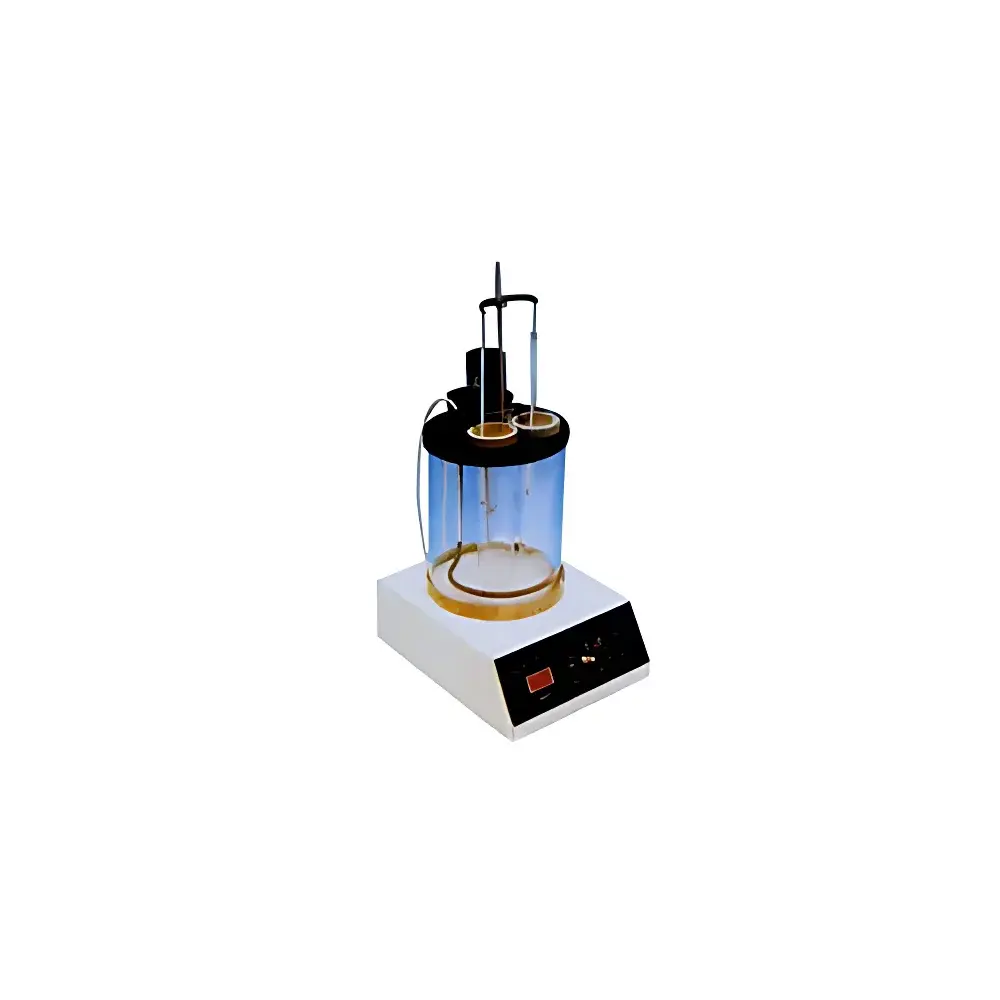
The KA-110 Karrie Density Meter is a precision thermostatically controlled bath system engineered for the laboratory determination of density in crude oil, liquid petroleum products, and miscible hydrocarbon–non-hydrocarbon mixtures. It operates in strict accordance with ASTM D1298 (Standard Test Method for Density, Relative Density, or API Gravity of Crude Petroleum and Liquid Petroleum Products by Hydrometer Method) and GB/T 1884–2000 (Laboratory Determination of Density of Crude Oil and Liquid Petroleum Products — Hydrometer Method). The instrument implements the classical hydrometer-based principle: sample temperature is stabilized within a calibrated glass bath, and a certified glass hydrometer is immersed to measure buoyancy-derived density at equilibrium temperature. This method remains the globally accepted reference technique for custody transfer, refinery blending, and quality control where traceability to national standards is required.
Key Features
- Optically transparent borosilicate glass bath (Ø250 mm × 350 mm H) enabling full visual monitoring of hydrometer immersion and meniscus alignment during measurement.
- Dual-zone heating architecture: a 600 W auxiliary heater enables rapid bath warm-up; a dedicated 400 W thermostatic heater maintains stable setpoint temperature with ±0.5 °C uniformity across the bath volume.
- Integrated motor-driven stirrer ensures laminar, non-turbulent circulation—critical for eliminating thermal stratification and achieving ISO 4287-compliant homogeneity prior to hydrometer insertion.
- Two independent Ø60 mm bath ports allow simultaneous stabilization of multiple hydrometers or parallel sample conditioning under identical thermal conditions.
- Modular refrigeration interface supports seamless integration with the optional KA-901 immersion chiller, extending operational range to –20 °C for low-temperature density assessment of waxy crudes, fuel oils, and cold-climate distillates.
- Front-panel digital controller with real-time temperature display, adjustable setpoint, and over-temperature cut-off protection compliant with IEC 61010-1 safety requirements.
Sample Compatibility & Compliance
The KA-110 accommodates standard ASTM D1298 hydrometers (e.g., ASTM IP 160, API MPMS Chapter 9.1), including heavy-, medium-, and light-range calibrated units. It supports samples with kinematic viscosity up to 200 mm²/s at measurement temperature and vapor pressure below 100 kPa (abs). The system meets functional requirements for GLP-compliant density testing laboratories and supports audit-ready documentation when used with validated SOPs. While the instrument itself does not embed electronic data logging, its thermal performance aligns with calibration intervals defined in ISO/IEC 17025:2017 Clause 6.4.10 for temperature-controlled test equipment.
Software & Data Management
The KA-110 is a hardware-only thermostatic platform with no embedded firmware or proprietary software. All measurement data—including bath temperature, equilibration time, hydrometer calibration certificate number, observed hydrometer reading, and correction factors—are recorded manually or via external LIMS-compatible templates. Laboratories may integrate the unit into 21 CFR Part 11–compliant workflows by pairing it with validated electronic lab notebooks (ELNs) that enforce user authentication, audit trails, and electronic signatures during result transcription. Calibration certificates for associated hydrometers must be maintained per ISO 17025 Section 6.6 and re-verified at least annually or after mechanical impact.
Applications
- Custody transfer verification of crude oil density prior to pipeline injection or marine loading (per API RP 2552 and ISO 91–1).
- Refinery process control for naphtha, kerosene, diesel, and fuel oil blending batches.
- Quality assurance of lubricating base oils and specialty solvents where density correlates with aromatic content and volatility.
- Research-grade density profiling of biofuel blends (e.g., FAME–diesel mixtures) across temperature gradients from 15 °C to 100 °C.
- Regulatory compliance testing for EN 590, ASTM D975, and GB 17411 diesel specifications requiring density at 15 °C.
FAQ
Does the KA-110 include a hydrometer or calibration certificate?
No. The instrument is supplied as a thermostatic bath only. Users must provide ASTM- or ISO-certified hydrometers with valid calibration certificates traceable to NIST or CNAS.
Can the KA-110 be used for API gravity calculation?
Yes. When operated at standardized temperatures (e.g., 15.6 °C or 60 °F) and paired with an API-specific hydrometer, the measured density is directly convertible to API gravity using ASTM D1250 or ISO 91–1 petroleum measurement tables.
Is the bath compatible with digital density meters (e.g., oscillating U-tube instruments)?
No. The KA-110 is purpose-built for glass hydrometer immersion. It lacks mounting fixtures, vibration isolation, or fluid handling interfaces required for digital densimeters.
What maintenance is required for long-term thermal stability?
Annual verification of temperature sensor accuracy against a NIST-traceable RTD probe and periodic cleaning of the glass bath with non-abrasive detergent are recommended. Heater element resistance should be checked every 24 months.
How is traceability ensured for regulatory submissions?
Traceability is established through documented calibration of the bath’s temperature sensor, user-provided hydrometer certificates, and adherence to measurement procedures outlined in GB/T 1884–2000 or ASTM D1298—including meniscus correction, thermometer calibration, and air buoyancy compensation.