
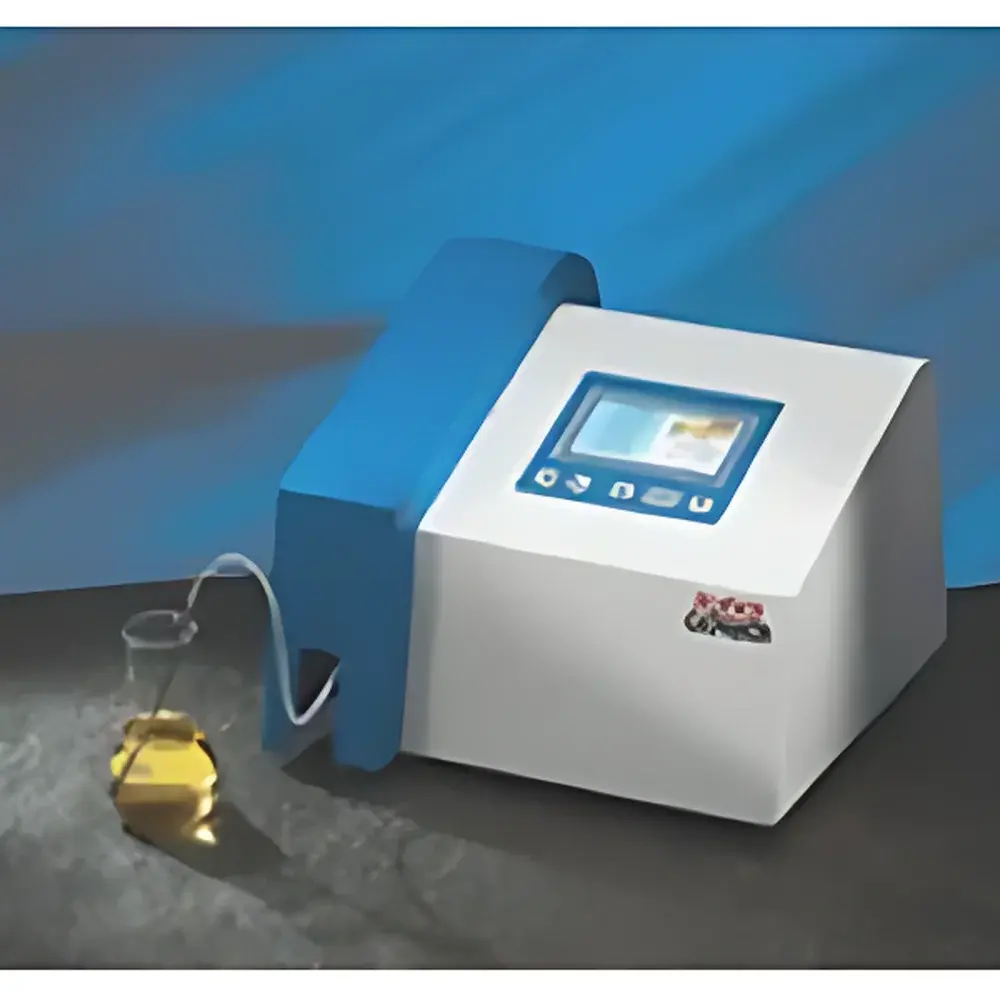
FUNKE GERBER FermentoFlash II Automated Beer Analyzer
| Brand | Funke Gerber |
|---|---|
| Origin | Germany |
| Model | FermentoFlash II |
| Instrument Type | Dedicated Beer Analyzer |
| Alcohol Range | 0–15 % v/v |
| Original Wort Extract (OE) | 0–20 % w/w |
| Real Extract (RE) | 0–10 % w/w |
| Apparent Extract (AE) | 0–10 % w/w |
| Density | 0.95–1.05 g/cm³ |
| Measurement Time | ~120 s (including sample introduction) |
| Sample Volume | 12–20 mL (degassed beer) |
| Calibration Reference Storage | Up to 20 reference beer profiles |
| Interface | RS232 serial output |
| Display | Integrated high-contrast LCD touchscreen |
Overview
The FUNKE GERBER FermentoFlash II is a fully automated, benchtop beer analyzer engineered for rapid, standardized determination of key physicochemical parameters in finished beer and fermentation samples. It operates on the principle of integrated density and refractive index measurement—combined with temperature-controlled sample handling and algorithmic correction—to simultaneously calculate alcohol by volume (ABV), original wort extract (OE), real extract (RE), apparent extract (AE), and specific gravity (density) in under two minutes. Designed in accordance with internationally recognized brewing metrology practices—including DIN ISO 15284, EBC Analytica Chapter 9, and ASBC Methods of Analysis—this instrument supports routine quality control in breweries, contract labs, and R&D facilities where traceability, repeatability, and regulatory alignment are essential.
Key Features
- Single-step analysis: Delivers five core beer parameters—alcohol content, OE, RE, AE, and density—in ≤120 seconds per sample, minimizing operator intervention and throughput bottlenecks.
- Integrated degassing-compatible workflow: Accepts pre-degassed beer samples (12–20 mL) without requiring inline vacuum or CO₂ stripping modules, reducing ancillary equipment dependency.
- Reference-based calibration architecture: Stores up to 20 user-defined reference beer profiles (e.g., Pilsner, Weizen, Stout), enabling matrix-matched calibration for improved accuracy across diverse beer styles.
- Temperature-stabilized measurement cell: Maintains precise thermal equilibrium during density and refractometric acquisition, mitigating drift associated with ambient fluctuations.
- RS232 serial interface: Enables direct data export to LIMS, Excel, or brewery MES platforms; supports ASCII-formatted output with configurable delimiter and timestamping.
- Intuitive touchscreen interface: High-contrast LCD display with multilingual menu navigation (English, German, French, Spanish) and context-sensitive prompts for method selection, calibration, and error diagnostics.
Sample Compatibility & Compliance
The FermentoFlash II is validated for use with filtered, clarified, and degassed beer samples across the full spectrum of modern brewing—lagers, ales, sour beers, non-alcoholic variants, and craft formulations. It complies with EBC Method 9.12 (Alcohol Determination), ASBC Beer-1B (Alcohol by Distillation and Hydrometry), and ISO 15284 (Determination of Alcohol Content in Beer). All measurement algorithms are traceable to NIST-certified density standards and certified reference materials (CRMs) for wort extract. The system meets GLP requirements for audit-ready operation, including user-access logging, calibration history retention, and electronic signature support when paired with compliant laboratory software.
Software & Data Management
No proprietary PC software is required for basic operation—the instrument functions autonomously via its embedded firmware. However, optional Gerber DataLink software (Windows-compatible) provides extended functionality: batch report generation (PDF/CSV), trend analysis over time, statistical process control (SPC) charting, and integration with 21 CFR Part 11-compliant environments through role-based access control and electronic audit trails. Raw measurement logs include timestamps, operator ID, sample ID, calibration status, and environmental sensor readings (ambient temperature, internal cell temperature), ensuring full data integrity per ISO/IEC 17025 clause 7.7.
Applications
- Final product release testing in commercial breweries and contract manufacturing facilities.
- Fermentation monitoring: Rapid assessment of attenuation, alcohol yield, and residual extract at multiple stages (e.g., post-fermentation, before filtration, pre-packaging).
- Recipe development and consistency validation across pilot and production batches.
- Raw material verification: Screening of adjunct sugars, malt extracts, and wort concentrates prior to mashing.
- Regulatory submission support: Generation of auditable analytical records for EU Food Information Regulation (EU No. 1169/2011), FDA labeling compliance, and BRCGS Brewery Standard audits.
FAQ
What sample preparation is required prior to analysis?
Beer samples must be degassed (via gentle vacuum or agitation followed by settling) and brought to room temperature (20 ± 2 °C). Filtration is recommended for hazy or unfiltered products to prevent optical interference.
Can the FermentoFlash II analyze non-alcoholic or low-alcohol beer?
Yes—the instrument maintains linearity and precision down to 0.05 % ABV and is routinely used for verifying <0.5 % ABV claims in compliance with EU and US labeling regulations.
Is external calibration verification necessary?
While factory calibration is stable, periodic verification using certified reference beer (e.g., EBC Reference Beer CRM) is recommended every 30 days or after 200 measurements, per internal QA protocols.
Does the system support networked data transfer (e.g., Ethernet or USB)?
The FermentoFlash II features RS232 as standard; optional RS232-to-Ethernet converters or USB-serial adapters may be deployed for integration into existing lab networks, subject to IT security review.
How is method validation documented for regulatory submissions?
Gerber provides a comprehensive Instrument Qualification Package (IQ/OQ/PQ templates), along with validation protocols aligned with ASTM E2500 and ICH Q2(R2), supporting GMP-aligned implementation in regulated environments.




