
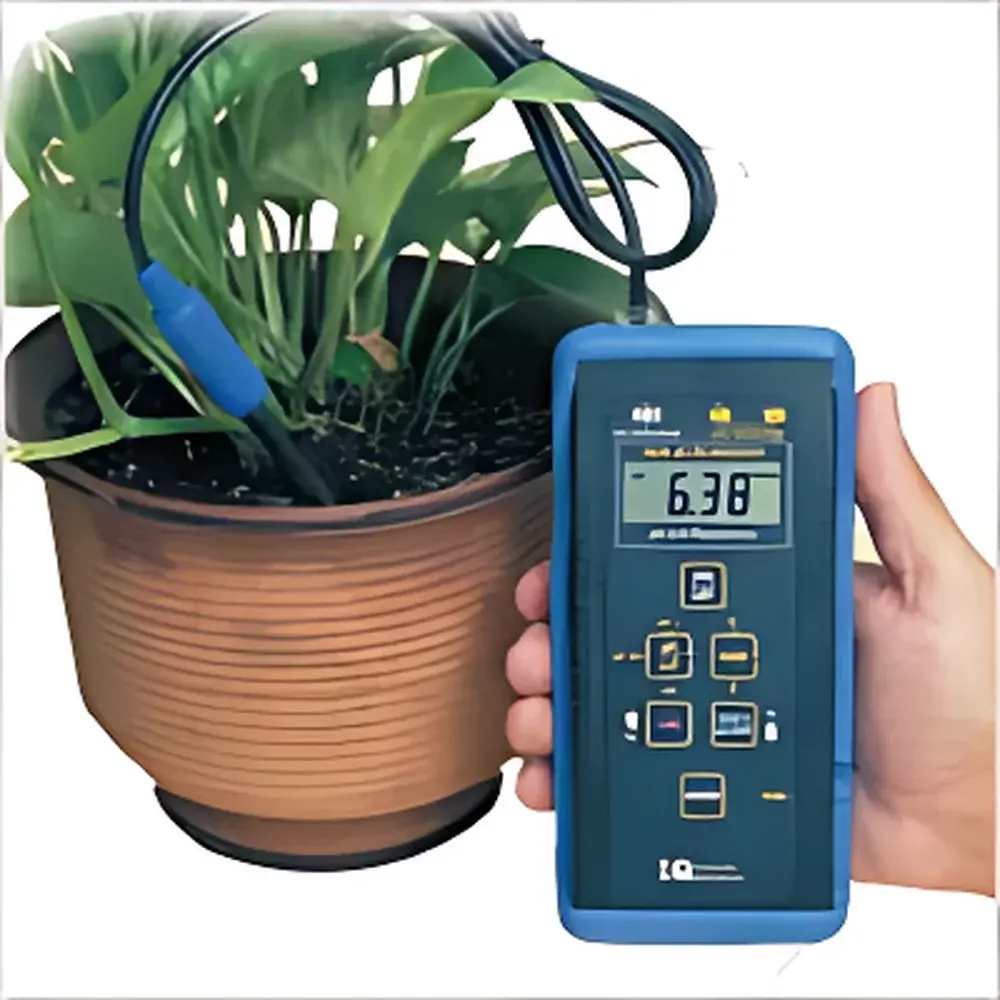
Horiba 150 In-Situ Soil pH Meter
| Origin | USA |
|---|---|
| Manufacturer Type | Authorized Distributor |
| Origin Category | Imported |
| Model | 150 |
| Measurement Range | pH 0.00–14.00, Temp 0–100 °C, Output Voltage ±1999 mV |
| Resolution | pH 0.01/0.1, Temp 0.1 °C, Voltage 0.1/1.0 mV |
| Accuracy | pH ±0.01, Temp ±0.5 °C, Voltage ±0.1 mV |
| Calibration | Single- or Two-Point |
| Buffer Recognition | pH 1.68, 4.00, 6.86, 7.00, 7.14, 9.18, 10.01, 11.88, 12.45 |
| Temperature Compensation | Manual or Automatic (0–100 °C) |
| Power Supply | 9 V DC battery or 12 V AC adapter |
| Dimensions | 90 mm × 180 mm × 40 mm |
| Weight | 1300 g |
Overview
The Horiba 150 In-Situ Soil pH Meter is a field-deployable electrochemical instrument engineered for direct, real-time measurement of soil pH and temperature under native moisture conditions—without requirement for slurry preparation or extraction. It operates on the potentiometric principle using a solid-state silicon-based pH sensing chip integrated into a rugged stainless-steel probe (Model 2163S), enabling stable, drift-resistant potential readings in heterogeneous, high-ionic-strength, and low-moisture soils. Unlike traditional glass electrode systems, this sensor eliminates fragile bulb breakage, liquid junction clogging, and KCl leakage—critical advantages for long-term in-situ monitoring, agricultural field surveys, and ecological restoration site assessments. The device conforms to ASTM D4972–22 (Standard Test Method for pH of Soils) for field pH determination and supports traceable calibration against NIST-traceable buffer standards.
Key Features
- Integrated dual-parameter measurement: simultaneous pH and temperature acquisition with automatic temperature compensation (ATC) across 0–100 °C
- Silicon chip pH sensor (Model 2163S) with replaceable design (compatible with Model 2164S spare electrodes), ensuring operational continuity and cost-effective maintenance
- High-resolution analog output (±1999 mV) compliant with industrial 0–5 V or 4–20 mA signal conditioning systems for integration into SCADA or environmental data loggers
- Two-point calibration capability with auto-buffer recognition for nine certified pH standards (1.68–12.45), reducing operator error and improving inter-laboratory comparability
- Robust housing (90 × 180 × 40 mm; 1300 g) rated IP67 for dust/water resistance during extended outdoor deployment
- Flexible power architecture: operates on standard 9 V alkaline battery (field mode) or optional 12 V AC adapter (Model 2110) for stationary base stations
Sample Compatibility & Compliance
The Horiba 150 is validated for use in mineral soils, organic-rich peat, volcanic ash substrates, and amended agricultural soils with moisture content ≥15 wt%. It is not intended for dry, sandy, or highly calcareous soils (<5% moisture) without pre-wetting per ASTM D2487 guidance. Electrode insertion depth is optimized for 5–15 cm profiles, aligning with USDA NRCS soil sampling protocols. Device firmware and calibration documentation support GLP-compliant data integrity requirements, including audit-trail-capable calibration logs when paired with Horiba’s optional PC interface software. All components comply with RoHS 2011/65/EU and CE electromagnetic compatibility directives.
Software & Data Management
While the Horiba 150 operates as a standalone field meter, it supports analog voltage output interfacing with third-party data acquisition platforms (e.g., Campbell Scientific CR1000X, HOBO UX120). Optional Horiba DataLink v3.2 software (Windows-based) enables time-stamped calibration history export (CSV), batch calibration certificate generation, and deviation trend analysis per ISO/IEC 17025 Clause 7.7. Raw mV outputs are linearly convertible to pH using the Nernst equation (−59.16 mV/pH at 25 °C), facilitating custom algorithm integration in Python or MATLAB environments for research-grade soil biogeochemical modeling.
Applications
- Agricultural precision management: spatial pH mapping for lime prescription and nutrient availability modeling (e.g., P fixation thresholds)
- Environmental remediation: real-time pH tracking in phytoremediation plots and acid sulfate soil (ASS) monitoring programs
- Wetland and riparian zone assessment: redox-sensitive pH profiling in anaerobic horizons
- Landfill cover system performance evaluation: leachate-induced acidification detection beneath final caps
- Educational field labs: hands-on pedology instruction aligned with AP Environmental Science and university soil science curricula
FAQ
Can the Horiba 150 measure pH in dry or compacted soils?
No. Accurate measurement requires sufficient soil moisture (≥15%) to establish electrochemical contact between the silicon chip and soil solution. Pre-wetting to field capacity is required per ASTM D4972–22.
Is the 2163S electrode compatible with other Horiba meters?
Yes—the 2163S probe uses a standardized BNC + thermistor interface and is cross-compatible with Horiba LAQUA twin series benchtop pH/Temp instruments for lab verification.
Does the device meet FDA or EPA regulatory requirements for compliance reporting?
The Horiba 150 itself is not an EPA-certified method, but its measurements are admissible in RCRA Subtitle C site assessments when used per approved QA/QC protocols (e.g., SW-846 Method 9045D adaptation) and supported by documented calibration traceability.
How often should calibration be performed in continuous field deployment?
Daily two-point calibration is recommended for high-accuracy campaigns; weekly verification suffices for trend-monitoring applications where absolute accuracy tolerance is ±0.1 pH.
What is the expected service life of the silicon chip sensor under routine field use?
Typical operational lifespan exceeds 24 months with proper cleaning (deionized water rinse after each use) and storage in Horiba-recommended moist storage solution (Model 2169).
Related Products







