
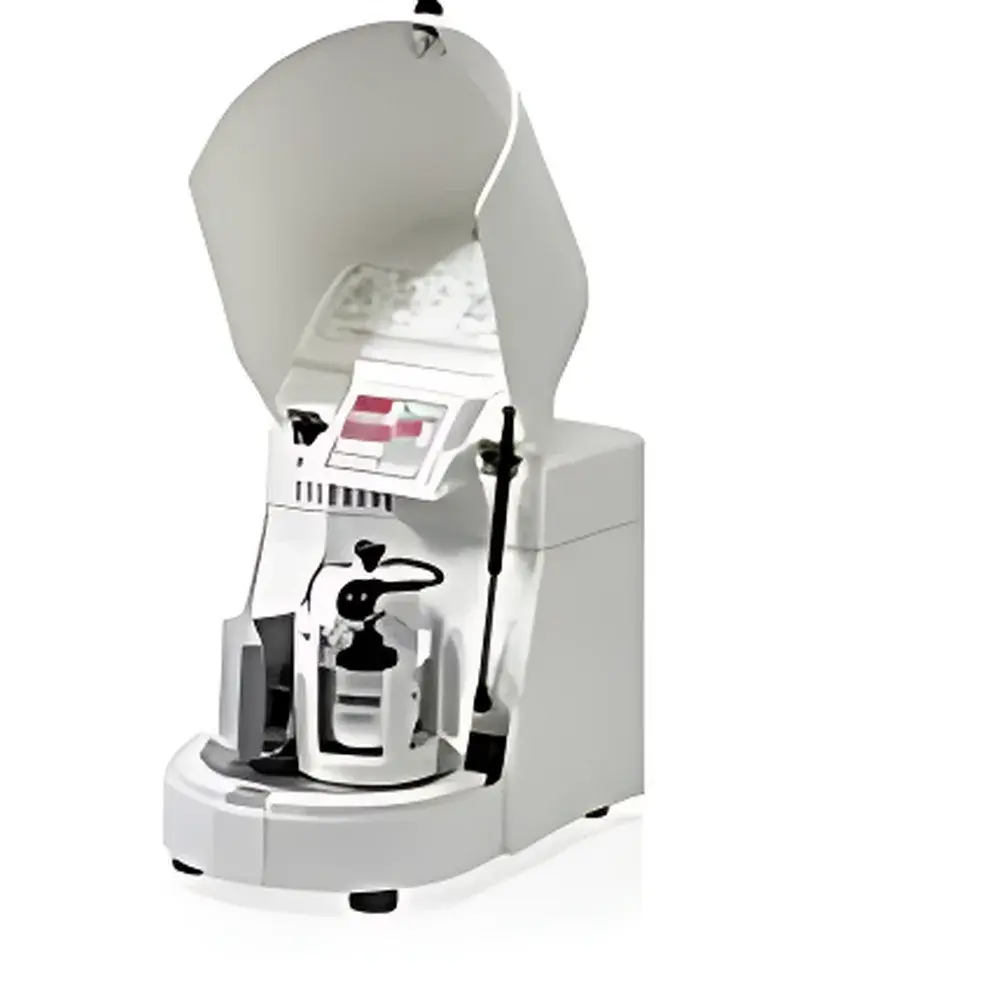
Fritsch PULVERISETTE 6 Premium Line Planetary Micro Mill
| Brand | Fritsch |
|---|---|
| Origin | Germany |
| Model | PULVERISETTE 6 Premium Line |
| Grinding Principle | Planetary Ball Milling (Centrifugal + Rotational Motion) |
| Maximum Bowl Volume | 500 mL |
| Final Particle Size | < 1 µm |
| Grinding Modes | Dry & Wet |
| Inert Atmosphere Capability | Yes |
| Power Supply | 100–240 V, 50–60 Hz, 1100 W |
| Net Weight | 63 kg |
| Dimensions (W×H×D) | 37 × 53 × 50 cm |
| Bowl Options | 80 / 250 / 500 mL |
| Grinding Media Diameters | 3, 5, 10, 15, 20, 30, 40 mm |
| Material Options | Agate, Silicon Nitride, Alumina, Zirconia, Stainless Steel, Hardened Steel, Tungsten Carbide |
| Max Feed Size | < 10 mm |
| Max Batch Volume | 225 mL |
| Simultaneous Sample Processing | Up to 2 independent bowls |
| Temperature/Pressure Monitoring | Compatible with FRITSCH GTM System |
Overview
The Fritsch PULVERISETTE 6 Premium Line Planetary Micro Mill is a high-energy laboratory ball mill engineered for precision comminution of solid, brittle, and semi-ductile materials. Operating on the principle of planetary motion—where grinding bowls rotate in reverse direction to the sun wheel while simultaneously revolving around it—the instrument generates intense centrifugal and Coriolis forces. These forces accelerate grinding balls to velocities exceeding 20 m/s, enabling efficient size reduction via combined impact, shear, and friction mechanisms. First patented by FRITSCH in 1962, this design remains the benchmark for reproducible ultrafine grinding in research and quality control laboratories. The PULVERISETTE 6 delivers consistent sub-micron particle size distributions (< 1 µm), making it suitable for applications demanding strict particle morphology control, such as X-ray diffraction sample preparation, laser-induced breakdown spectroscopy (LIBS), pharmaceutical active ingredient micronization, and mechanochemical synthesis.
Key Features
- High-precision digital timer with programmable grinding duration (1 s resolution), pause intervals, and rotational speed (100–650 rpm), ensuring full process repeatability across batches.
- Modular bowl system supporting three standardized volumes: 80 mL, 250 mL, and 500 mL—each compatible with seven discrete grinding ball diameters (3–40 mm) to optimize energy transfer for diverse material hardnesses.
- Seven certified grinding media materials—including agate (for trace-metal-free analysis), zirconia (high wear resistance), tungsten carbide (for extreme hardness), and stainless steel (for general-purpose use)—allow method-specific contamination control per ISO 17025 and ASTM E2904 guidelines.
- Integrated safety interlock system prevents operation unless bowl lid is fully locked and clamped; automatic motor cutoff engages if temperature exceeds preset thresholds during extended runs.
- Optional inert gas purging port enables operation under argon or nitrogen atmospheres—critical for air-sensitive compounds, pyrophoric metals, or redox-active battery cathode precursors.
- Designed for GLP/GMP-compliant environments: all operational parameters (speed, time, direction, cooling cycles) are digitally logged and exportable in CSV format for audit trails per FDA 21 CFR Part 11 requirements when paired with FRITSCH’s optional software suite.
Sample Compatibility & Compliance
The PULVERISETTE 6 accommodates a broad spectrum of sample types—from hard ceramics (e.g., alumina, silicon carbide) and geological minerals (quartz, feldspar) to soft pharmaceutical excipients, polymers, and biological tissues. Its dual-bowl configuration permits parallel processing of two dissimilar samples without cross-contamination, provided bowls are independently sealed and loaded. Wet grinding is supported using solvents including ethanol, isopropanol, or aqueous surfactant solutions—ideal for nanoparticle dispersion stabilization. All wet-capable components meet USP Class VI biocompatibility standards. Instrument compliance includes CE marking (2014/30/EU EMC Directive, 2014/35/EU LVD), RoHS 2011/65/EU, and adherence to DIN EN 61000-6-2/6-4 for electromagnetic compatibility in shared laboratory infrastructure.
Software & Data Management
When operated with FRITSCH’s optional “FRITSCH Software Suite” (v4.2+), the PULVERISETTE 6 supports secure user authentication, method library management, real-time parameter monitoring, and automated report generation. All grinding protocols—including speed profiles, cooling intervals, and GTM-integrated temperature/pressure logs—are timestamped and stored with SHA-256 hash verification. Export formats include PDF (for QC documentation), XML (for LIMS integration), and ASCII (for statistical process control analysis). Audit trail functionality meets ALCOA+ principles (Attributable, Legible, Contemporaneous, Original, Accurate, Complete, Consistent, Enduring, Available), satisfying regulatory expectations for pharmaceutical development (ICH Q5C) and materials certification (ISO/IEC 17025:2017 Clause 7.7).
Applications
- Preparation of homogeneous powders for XRD, SEM-EDS, and BET surface area analysis in materials science labs.
- Mechanochemical synthesis of MOFs, solid electrolytes, and metastable alloy phases without solvents.
- Particle size reduction of APIs and excipients to enhance dissolution kinetics in preformulation studies (USP & Ph. Eur. compliant).
- Routine homogenization of heterogeneous geological core samples prior to ICP-MS quantification.
- Production of nanostructured catalysts via high-energy milling followed by controlled thermal annealing.
- Homogenization of food matrices (spices, grains, dairy powders) for nutritional profiling and contaminant screening.
FAQ
What is the maximum recommended continuous grinding time per cycle?
Continuous operation is limited to 90 minutes per cycle to prevent thermal overload; built-in thermal sensors trigger automatic shutdown above 65 °C bowl surface temperature.
Can the PULVERISETTE 6 be integrated into an automated lab workflow?
Yes—via RS-232 or optional Ethernet interface, it supports remote start/stop, status polling, and parameter synchronization with third-party LIMS or robotic sample handling platforms.
Is GTM system calibration traceable to national standards?
GTM pressure transducers are factory-calibrated against NIST-traceable deadweight testers; temperature probes conform to IEC 60751 Class A tolerances.
How often should the planetary gear train be serviced?
Under standard usage (≤ 4 hrs/day), lubrication and torque verification are recommended every 12 months or after 1,000 operating hours—documented in the included maintenance logbook.
Does Fritsch provide validation documentation for GMP environments?
Yes—IQ/OQ protocols, calibration certificates for speed/torque sensors, and material-of-construction declarations (EN 10204 3.1) are available upon request for regulated users.
Related Products



