
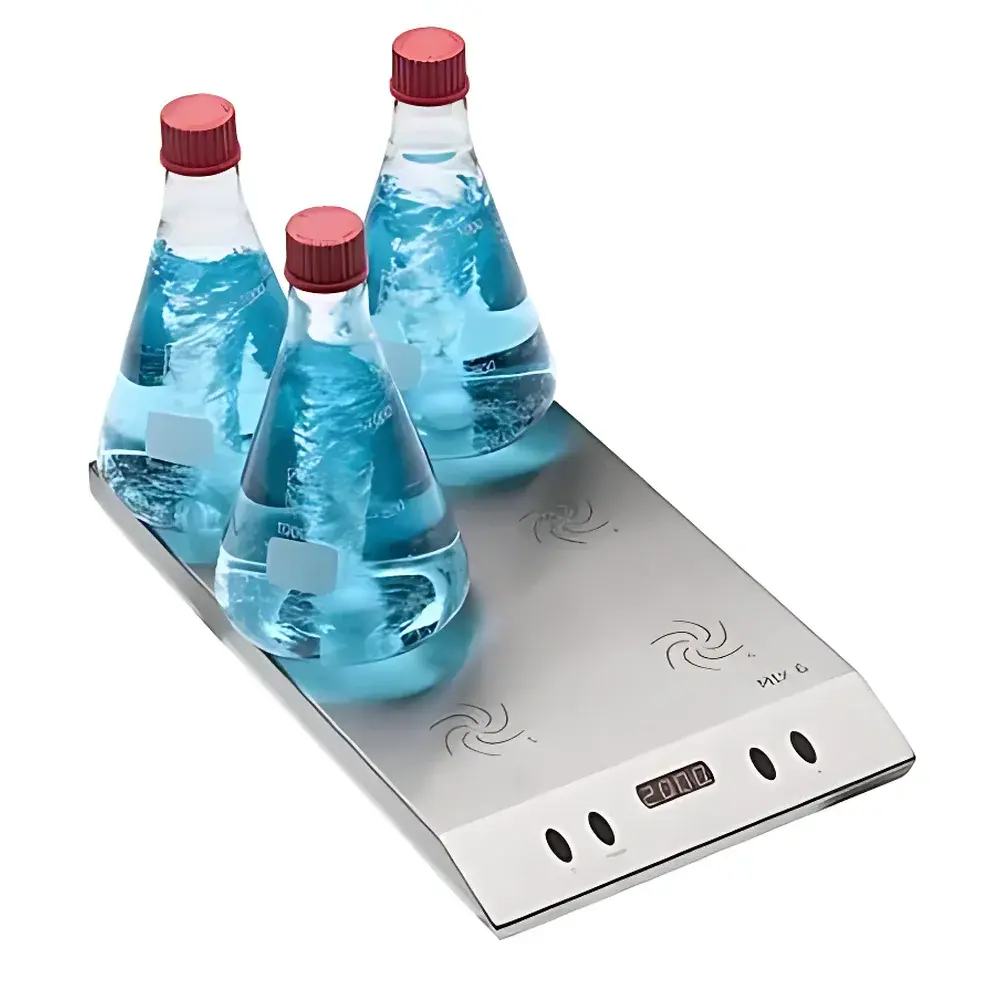
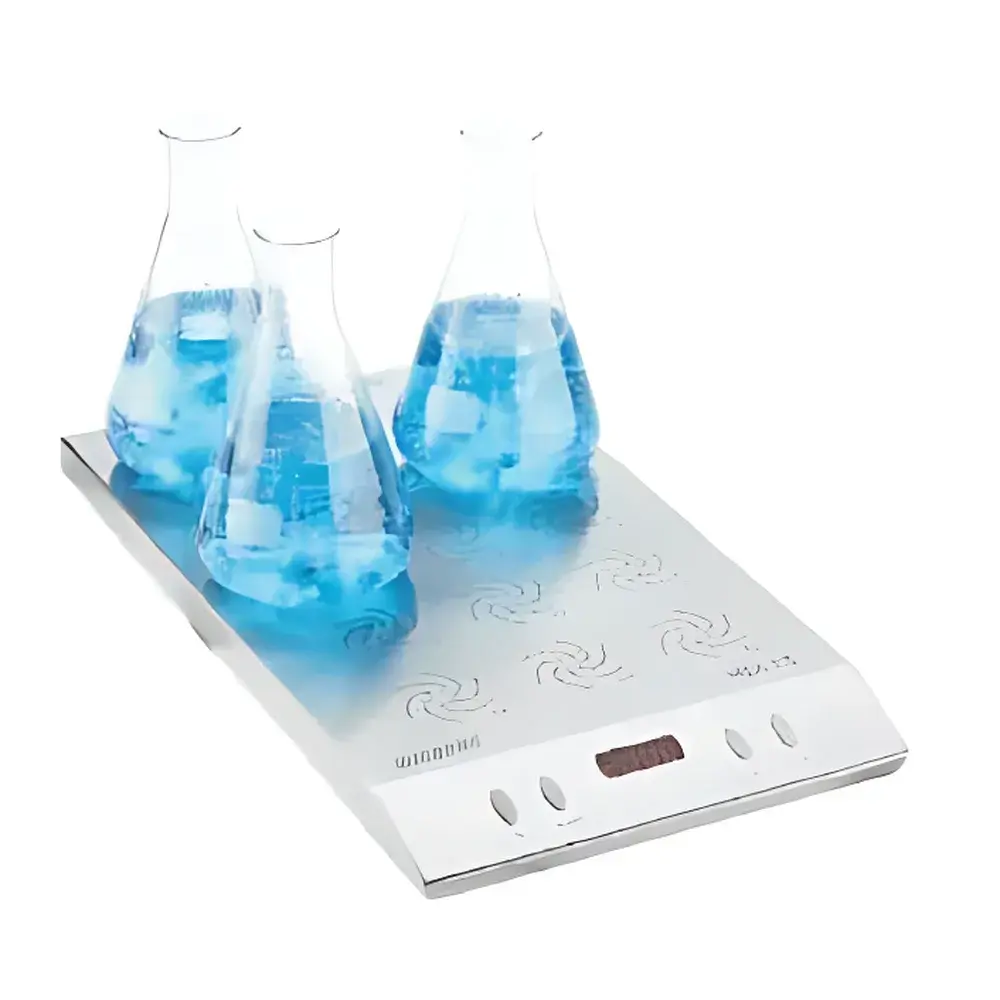
WIGGENS MAG Series Induction Magnetic Drive Multi-Position Stirrer WHMIX 4 MS
| Brand | WIGGENS |
|---|---|
| Origin | Germany |
| Model | WHMIX 4 MS |
| Stirring Positions | 4 (independently controllable) |
| Speed Range | 100–2000 rpm |
| Power per Position | 7 W (total 28 W) |
| Operating Temperature | −10 to +50 °C at ≤80% RH |
| Enclosure Material | Stainless Steel |
| IP Rating | IP64 |
| Dimensions (W×D×H) | 245 × 425 × 38 mm |
| Weight | ~8.9 kg |
| Voltage | 100–240 V, 50–60 Hz, 1.5 A |
Overview
The WIGGENS MAG Series Induction Magnetic Drive Multi-Position Stirrer WHMIX 4 MS is an engineered solution for precision-controlled, long-duration mixing in regulated laboratory environments. Unlike conventional stirrers relying on mechanical gearboxes or brushed DC motors, this system employs contactless electromagnetic induction drive technology—eliminating physical coupling between the motor and stirring plate. This architecture ensures zero wear, no lubrication requirements, and intrinsic resistance to chemical corrosion and thermal drift. Designed for continuous operation under demanding conditions—including ISO 17025-accredited QC labs, GMP-compliant pharmaceutical development suites, and bioprocess R&D workflows—the WHMIX 4 MS delivers stable rotational torque across its full speed range (100–2000 rpm), even at low speeds where viscous drag or inertial lag commonly compromise reproducibility. Its sealed, fanless drive unit operates silently and without self-heating, preventing unintended thermal input into sensitive samples such as enzyme assays, cell cultures, or temperature-sensitive polymer solutions.
Key Features
- Contactless electromagnetic induction drive: No brushes, gears, or moving parts in the drive path—ensuring 100% maintenance-free operation over extended service life.
- Four independently programmable stirring positions: Each channel supports discrete speed and power settings, enabling parallel experiments with heterogeneous viscosity, volume, or thermal profiles.
- Precise digital control interface: Bright LED display shows real-time rpm and selected power level; soft-start function ensures reliable magnet stir bar capture and controlled acceleration without splashing or vortex instability.
- Four-tier power adjustment (Level 1–4): Optimized torque delivery for applications ranging from gentle suspension of fragile particles (e.g., antibody-coated beads) to high-viscosity media (e.g., agarose gels or silicone emulsions).
- IP64-rated stainless steel housing: Fully sealed against dust ingress and water splashes; non-porous surface resists chemical etching and facilitates decontamination per CDC/NIH biosafety protocols.
- Auto-memory function: Stores last-used parameters (speed, power, ramp profile) for rapid reactivation—critical for routine SOP-driven workflows requiring traceable parameter recall.
- Thermally neutral operation: Low-power electronics and passive heat dissipation prevent measurable sample temperature rise during multi-hour runs—validated per ASTM E2912 guidelines for thermal stability assessment.
Sample Compatibility & Compliance
The WHMIX 4 MS accommodates standard PTFE- or glass-coated magnetic stir bars across volumes from 1 mL to 3 L per position. Its uniform magnetic field geometry ensures consistent coupling efficiency regardless of vessel shape (round-bottom flasks, square media bottles, or multi-well plates with compatible inserts). All models comply with IEC 61010-1:2010 for electrical safety in laboratory equipment and meet EN 61326-1:2013 for electromagnetic compatibility (EMC). The stainless steel construction satisfies USP material classification for Class VI plastics-equivalent inertness, and the absence of organic seals or gaskets eliminates extractables risk—making it suitable for USP analytical instrument qualification (AIQ) and FDA 21 CFR Part 11–aligned environments when integrated with validated LIMS or ELN systems.
Software & Data Management
While the WHMIX 4 MS operates as a standalone benchtop instrument, its parameter retention logic supports audit-ready documentation: all user-modified settings (start speed, max speed, power level, ramp time) are retained through power cycles without battery backup. For laboratories requiring electronic records, optional RS-232 or USB-to-serial adapters enable integration with custom Python- or LabVIEW-based acquisition scripts. Timestamped parameter logs can be exported for inclusion in GLP/GMP batch records, satisfying ALCOA+ principles (Attributable, Legible, Contemporaneous, Original, Accurate) when paired with secure network storage and role-based access controls.
Applications
- Parallel dissolution testing of solid dosage forms under USP Apparatus II conditions.
- Long-term stability studies of biologics formulations requiring constant agitation at 2–8 °C (when used inside refrigerated chambers).
- Cell culture media preparation with oxygen-sensitive components (e.g., heme-containing proteins), where mechanical shear and localized heating must be minimized.
- Synthesis of metal–organic frameworks (MOFs) requiring precise stoichiometric homogenization over 48–72 h without catalyst degradation.
- QC release testing of suspensions and emulsions per Ph. Eur. 2.9.20, where inter-batch reproducibility of dispersion energy input is critical.
FAQ
Is the WHMIX 4 MS compatible with all standard magnetic stir bars?
Yes—it generates a uniform rotating magnetic field optimized for 10–40 mm PTFE- or ceramic-coated stir bars. Performance is verified with bars meeting DIN ISO 17025 traceable calibration standards.
Can the four positions run at different speeds simultaneously?
Yes—each position has independent speed and power control via dedicated encoder dials and LED indicators, supporting heterogeneous experimental designs.
Does the device support external triggering or automation interfaces?
It does not feature native Ethernet or Modbus, but analog/digital I/O expansion is possible via third-party serial gateways compliant with RS-232/USB CDC class drivers.
What is the expected service lifetime under continuous operation?
Based on accelerated life testing per IEC 60068-2-64, the induction drive module maintains specification compliance beyond 20,000 hours of cumulative runtime at rated load.
How is thermal stability validated for low-speed, high-duration protocols?
Independent verification per ASTM E2912 confirms ≤0.15 °C sample temperature deviation after 12 h at 150 rpm in 500 mL aqueous buffer (25 °C ambient, still air).



