
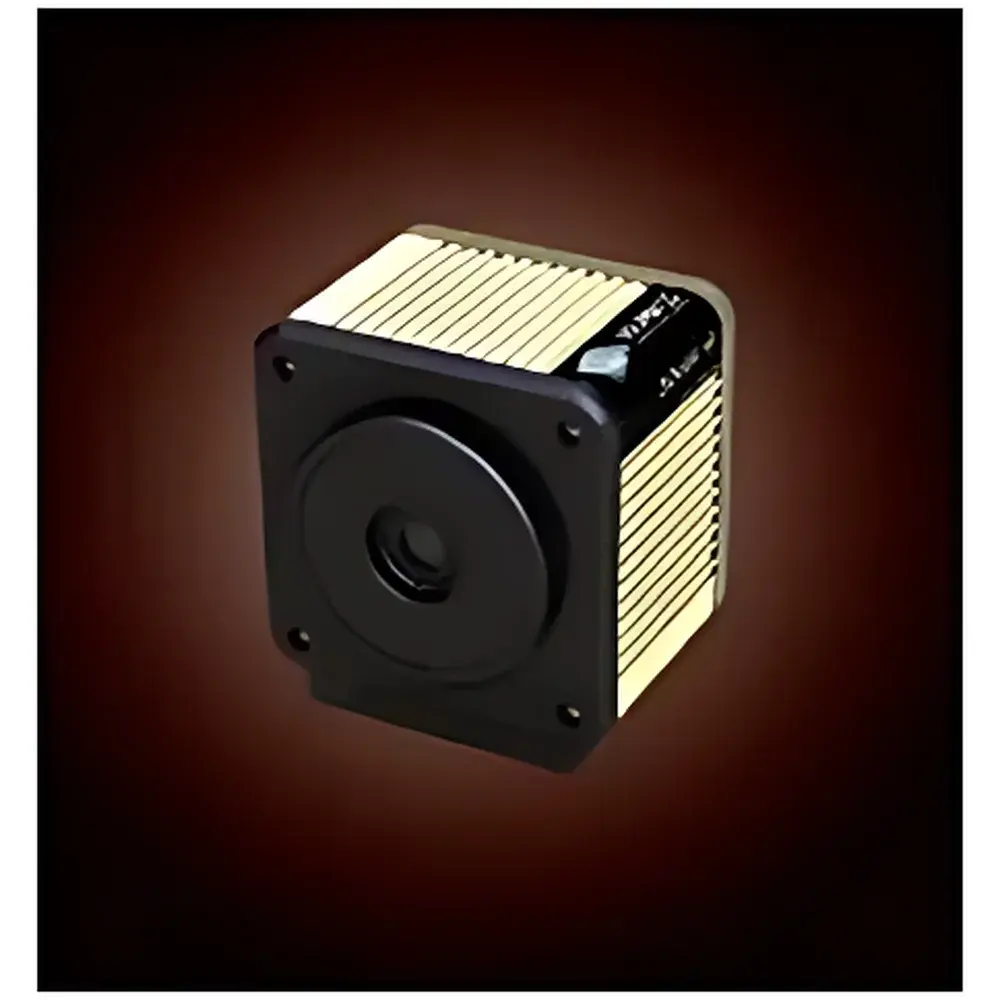
Phasics SID4 DWIR / SID4 LWIR-640 / SID4 IR-MCT Wavefront Sensor
| Brand | Phasics |
|---|---|
| Origin | France |
| Model | SID4 DWIR, SID4 LWIR-640, SID4 IR-MCT |
| Wavelength Range | 3–5 & 8–14 µm (DWIR), 8–14 µm (LWIR-640), 1.2–5.5 µm (IR-MCT) |
| Aperture Size | 10.88 × 8.16 mm² (DWIR), 16 × 12 mm² (LWIR-640), 9.60 × 7.68 mm² (IR-MCT) |
| Spatial Resolution | 68 µm (DWIR), 100 µm (LWIR-640), 60 µm (IR-MCT) |
| Phase Accuracy | 75 nm RMS (DWIR & LWIR-640), 3 nm RMS @ 3 µW/cm² (IR-MCT) |
| Sensitivity | 25 nm RMS (DWIR & LWIR-640), 3 nm RMS @ 3 µW/cm² (IR-MCT) |
| Dynamic Range | 300 µm |
| Frame Rate | 50 fps (DWIR), 24 fps (LWIR-640), 140 fps (IR-MCT) |
| Real-time Processing | 10 fps (DWIR & LWIR-640), 20 fps (IR-MCT) |
| Detector Technology | Cooled MCT (DWIR & IR-MCT), Uncooled Microbolometer (LWIR-640) |
| Dimensions (W×H×L) | 85 × 115 × 193 mm (DWIR), 96 × 110 × 90 mm (LWIR-640), 135 × 140 × 240 mm (IR-MCT) |
| Weight | ~1.6 kg (DWIR), ~0.85 kg (LWIR-640), ~3.5 kg (IR-MCT) |
Overview
The Phasics SID4 DWIR, SID4 LWIR-640, and SID4 IR-MCT are high-precision, quantitative wavefront sensors engineered for rigorous metrology in the infrared spectrum. Each model leverages Phasics’ patented quadriwave lateral shearing interferometry (QWLSI) — a common-path, non-scanning, single-shot phase retrieval technique — to deliver absolute wavefront measurements without moving parts or calibration drift. Unlike conventional Shack-Hartmann sensors, QWLSI enables simultaneous acquisition of both phase and intensity with sub-wavelength accuracy, full-field resolution, and immunity to vibration and thermal instability. The SID4 platform is purpose-built for demanding applications across MWIR (3–5 µm), LWIR (8–14 µm), and SWIR-to-MWIR (1.2–5.5 µm) bands — supporting characterization of thermal emitters, cooled and uncooled optics, CO₂ lasers, quantum cascade lasers (QCLs), optical parametric oscillators (OPOs), and infrared imaging systems under real-world illumination conditions.
Key Features
- Single-shot, full-field wavefront measurement via quadriwave lateral shearing interferometry (QWLSI), eliminating reliance on iterative algorithms or reference beams.
- Native high numerical aperture (NA) compatibility: all models operate at F/1 without relay optics, preserving throughput and minimizing aberration introduction.
- True achromatic design across designated spectral bands — enabling multi-wavelength analysis and chromatic aberration quantification in IR lens testing.
- High spatial sampling: 160 × 120 (DWIR & LWIR-640) and 160 × 128 (IR-MCT) pixels with physical resolutions of 68 µm, 100 µm, and 60 µm respectively.
- Dual-mode operation: simultaneous extraction of wavefront error (WFE), point spread function (PSF), modulation transfer function (MTF), Strehl ratio, beam propagation parameters (M²), and Zernike decomposition up to 36 terms.
- Real-time processing engine embedded onboard: supports full-resolution frame rates of 10–20 fps with on-device Zernike fitting, centroid tracking, and ISO 10110-compliant surface error reporting.
Sample Compatibility & Compliance
The SID4 series is validated for use with blackbody sources, collimated and divergent IR beams, uncooled microbolometer arrays, and cryogenically cooled MCT detectors. All models meet ISO 10110-5 (surface irregularity), ISO 14999-2 (interferometric testing of optical components), and ASTM E2844 (infrared imaging system performance evaluation) requirements. The SID4 IR-MCT variant complies with MIL-STD-810G for shock/vibration tolerance and operates within Class 1 laser safety limits per IEC 60825-1 when integrated into OEM laser diagnostic stations. Data provenance is ensured through timestamped metadata embedding and optional 21 CFR Part 11–compliant audit trails when used with Phasics’ certified software suite.
Software & Data Management
Phasics’ WFSuite v5.x provides a modular, API-accessible environment supporting Windows and Linux platforms. It includes native drivers for LabVIEW, MATLAB, Python (via PyPhasics), and C/C++. Raw interferograms and reconstructed wavefronts are stored in HDF5 format with embedded calibration metadata (wavelength, pupil geometry, detector gain). Batch processing workflows support automated MTF sweep, focal plane scanning, and thermal drift compensation using internal temperature sensors. Export options include CSV, TIFF, and FITS formats compatible with Zemax OpticStudio, CODE V, and FRED for downstream optical design validation. Software licensing supports concurrent node-locked and floating license models for integration into GLP/GMP-compliant QA laboratories.
Applications
- Infrared lens metrology: Quantitative assessment of MTF, PSF, field curvature, distortion, and Zernike coefficients across temperature-stabilized test benches — particularly for cooled MWIR/LWIR objectives used in defense and aerospace surveillance systems.
- Laser beam diagnostics: Full characterization of CO₂, QCL, and OPO sources including beam quality (M²), Strehl ratio, wavefront error budgeting, and thermal lensing dynamics during pulsed operation.
- Thermal imaging system validation: Objective assessment of NETD-limited performance, vignetting, and stray light-induced wavefront degradation in uncooled bolometric cameras.
- Adaptive optics alignment: Closed-loop feedback for deformable mirror control in mid-IR astronomical instrumentation and free-space optical communication terminals.
- Hyperspectral source calibration: High-sensitivity SID4 IR-MCT enables wavefront mapping of low-flux blackbody spectra down to 3 µW/cm² — critical for radiometric traceability in NIST-traceable calibration facilities.
FAQ
What distinguishes QWLSI from Shack-Hartmann wavefront sensing in the IR domain?
QWLSI eliminates spot centroid uncertainty inherent in Shack-Hartmann systems by measuring local phase gradients directly via interference fringes — resulting in higher sensitivity (<3 nm RMS), immunity to low-SNR conditions, and no requirement for spot-finding algorithms that fail under defocused or structured illumination.
Can the SID4 sensors be used without external cooling?
SID4 LWIR-640 employs an uncooled microbolometer array and requires no active cooling; SID4 DWIR and SID4 IR-MCT integrate thermoelectrically stabilized MCT detectors with integrated cold finger interfaces — compatible with standard LN₂ dewars or closed-cycle coolers.
Is real-time Zernike decomposition supported at full frame rate?
Yes — onboard FPGA-based processing delivers Zernike coefficients up to mode 36 at 10–20 fps depending on model, with latency <12 ms from photon detection to coefficient output.
How is calibration traceability maintained across operating temperatures?
Each sensor ships with NIST-traceable calibration certificates covering wavelength-dependent pixel response, phase-to-height conversion factors, and thermal drift coefficients measured over −10 °C to +50 °C ambient range.
Are OEM integration kits available for custom optical train mounting?
Yes — Phasics provides mechanical interface drawings (ANSI B47.1-compliant flanges), electrical pinouts, and SDK documentation under NDA for turnkey integration into vacuum chambers, cryostats, and industrial laser processing heads.




