
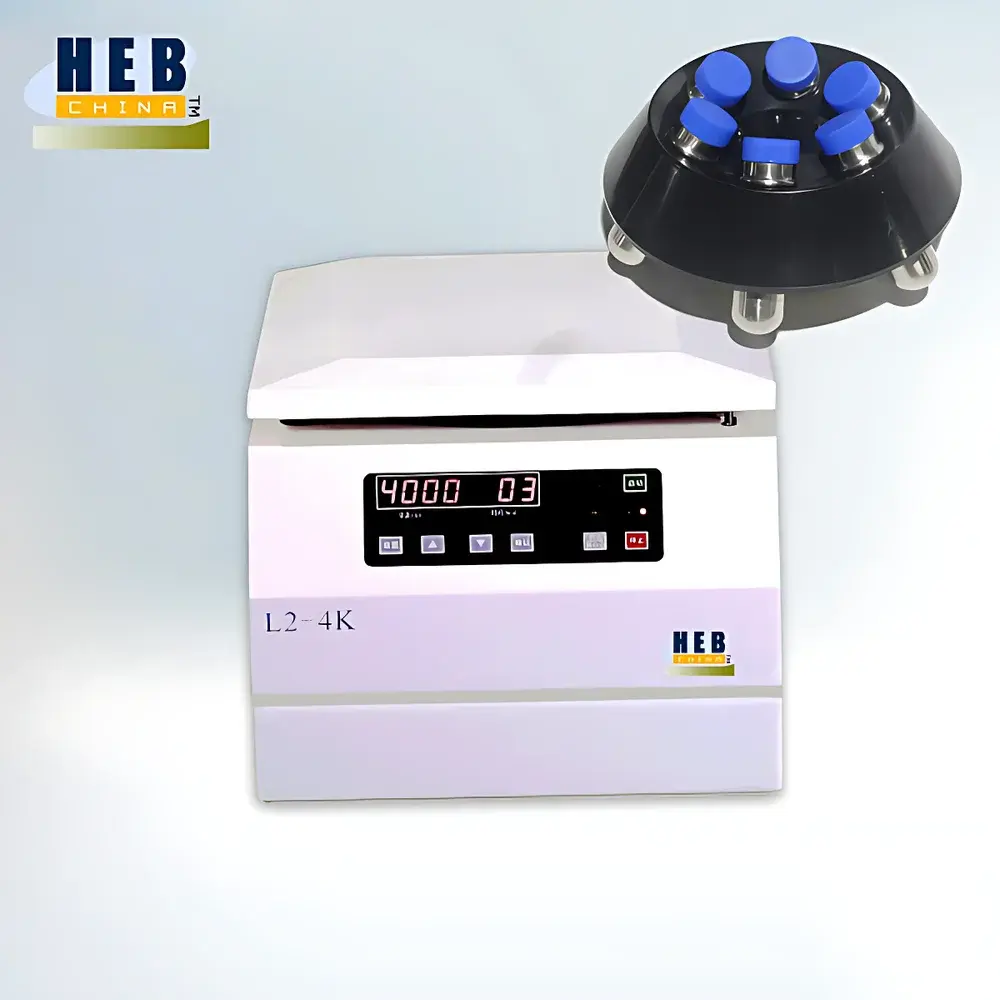
Jihepu L2-4K Benchtop Low-Speed Centrifuge
| Brand | Jihepu |
|---|---|
| Origin | Shandong, China |
| Model | L2-4K |
| Type | Benchtop Centrifuge |
| Maximum Speed | 4000 rpm |
| Maximum RCF | 2250 × g |
| Maximum Capacity | 6 × 50 mL |
| Dimensions (W×D×H) | 385 × 320 × 270 mm |
| Noise Level | ≤58 dB(A) |
| Power Supply | AC 220 V ±10%, 50/60 Hz, 10 A |
| Rated Power | 100 W |
| Net Weight | 15 kg |
| Timer Range | 1–99 min |
| Speed Accuracy | ±20 rpm |
| Acceleration/Deceleration Steps | 10-step programmable |
| Rotor Compatibility | Fixed-angle rotors only (e.g., 6×50 mL, 12×15 mL, 24×10 mL) |
Overview
The Jihepu L2-4K Benchtop Low-Speed Centrifuge is engineered for routine separation tasks in clinical, academic, and quality control laboratories where reliability, operational safety, and space efficiency are critical. Designed around a robust direct-drive brushless DC motor architecture, the L2-4K operates on the principle of sedimentation under controlled centrifugal force—enabling effective pelleting of cells, precipitates, and particulates from suspensions without compromising sample integrity. With a maximum rotational speed of 4000 rpm and an achievable relative centrifugal force (RCF) of 2250 × g, it meets the performance requirements for low-speed applications such as blood fractionation, cell harvesting, and polymer precipitation. Its compact footprint (385 × 320 × 270 mm) allows seamless integration into crowded benchtop environments, while its all-steel construction and stainless-steel rotor chamber ensure long-term corrosion resistance and compliance with basic laboratory hygiene standards.
Key Features
- Brushless DC motor drive system—eliminates carbon brush wear, reduces maintenance needs, and ensures consistent torque delivery across the full speed range.
- Digitally controlled microprocessor interface with high-contrast LED display—provides real-time monitoring of speed (rpm), RCF, time remaining, and acceleration/deceleration status.
- Live parameter adjustment—users may modify speed, time, or acceleration profile during active runs without interrupting operation or requiring rotor deceleration to standstill.
- Automated RCF calculation—eliminates manual conversion errors by dynamically computing and displaying g-force based on current rotor radius and set speed.
- 10-step programmable acceleration and deceleration profiles—supports gentle pelleting of fragile biological samples and minimizes resuspension during braking.
- Electromagnetic door interlock system—prevents lid opening during rotation and enforces mandatory rotor stop before access, meeting IEC 61010-2-020 safety requirements for centrifuges.
- Acoustically optimized enclosure—noise emission limited to ≤58 dB(A) at 1 m distance, suitable for shared laboratory spaces without dedicated acoustic isolation.
Sample Compatibility & Compliance
The L2-4K accommodates standard fixed-angle rotors compatible with common laboratory tube formats—including 10 mL, 15 mL, 20 mL, and 50 mL conical centrifuge tubes—supporting protocols aligned with ISO 15189, CLSI GP40-A4, and general Good Laboratory Practice (GLP) frameworks. While not certified for biosafety level 3 (BSL-3) containment or aerosol-tight operation, its sealed stainless-steel chamber facilitates easy decontamination using 70% ethanol or approved disinfectants. The unit complies with electromagnetic compatibility (EMC) directives per EN 61326-1 and electrical safety standards per EN 61010-1. It is intended for use with non-hazardous, non-explosive, and non-radioactive samples; users must validate rotor-tube compatibility and balance tolerances prior to operation per manufacturer-recommended loading guidelines.
Software & Data Management
The L2-4K operates as a standalone instrument without proprietary software dependency. All operational parameters—including run history, speed settings, timer values, and error logs—are retained in non-volatile memory and accessible via front-panel navigation. Though it does not support USB data export, RS-232, or network connectivity, its digital interface supports audit-ready documentation: each run displays timestamped start/stop conditions and final RCF value, enabling manual logbook entry traceable to GLP/GMP record-keeping practices. For regulated environments requiring electronic records, integration with third-party laboratory information management systems (LIMS) can be achieved through external camera-based logging or serial output adapters (optional accessories, not included).
Applications
This centrifuge serves core workflows across diverse laboratory domains: blood banking (serum/plasma separation from whole blood), microbiology (pelleting bacterial cultures prior to DNA extraction), environmental testing (sedimentation of suspended solids in water samples), and pharmaceutical QC (clarification of formulation batches). Its 6 × 50 mL capacity and uniform 2250 × g field make it especially suited for batch processing of clinical specimens, teaching labs performing hematology experiments, and research groups conducting preliminary protein or nucleic acid isolation steps prior to high-speed ultracentrifugation. The device is routinely deployed in hospital core labs, university teaching facilities, and contract testing organizations operating under ISO/IEC 17025-accredited scopes.
FAQ
What rotor types are supported by the L2-4K?
The L2-4K accepts only fixed-angle rotors, including configurations for 6 × 50 mL, 12 × 15 mL, 24 × 10 mL, and other variants—all rated for 4000 rpm and 2250 × g.
Is the L2-4K compliant with FDA 21 CFR Part 11?
No—the instrument lacks electronic signature capability, audit trail generation, or user-access controls required for Part 11 compliance; it is intended for non-GxP environments or as a secondary unit within validated workflows.
Can I use this centrifuge for centrifuging hazardous materials?
It is not designed for biohazardous, volatile, or radioactive samples; users must implement additional containment measures (e.g., sealed buckets, secondary containment trays) and adhere to institutional biosafety protocols.
Does the L2-4K include automatic imbalance detection?
Yes—it features mechanical imbalance sensing that halts operation and triggers audible/visual alerts if load asymmetry exceeds safe thresholds during acceleration.
What is the recommended maintenance schedule?
Routine cleaning of the rotor chamber and inspection of rotor threads every 3 months; annual verification of speed accuracy and brake response by qualified service personnel is advised.



