
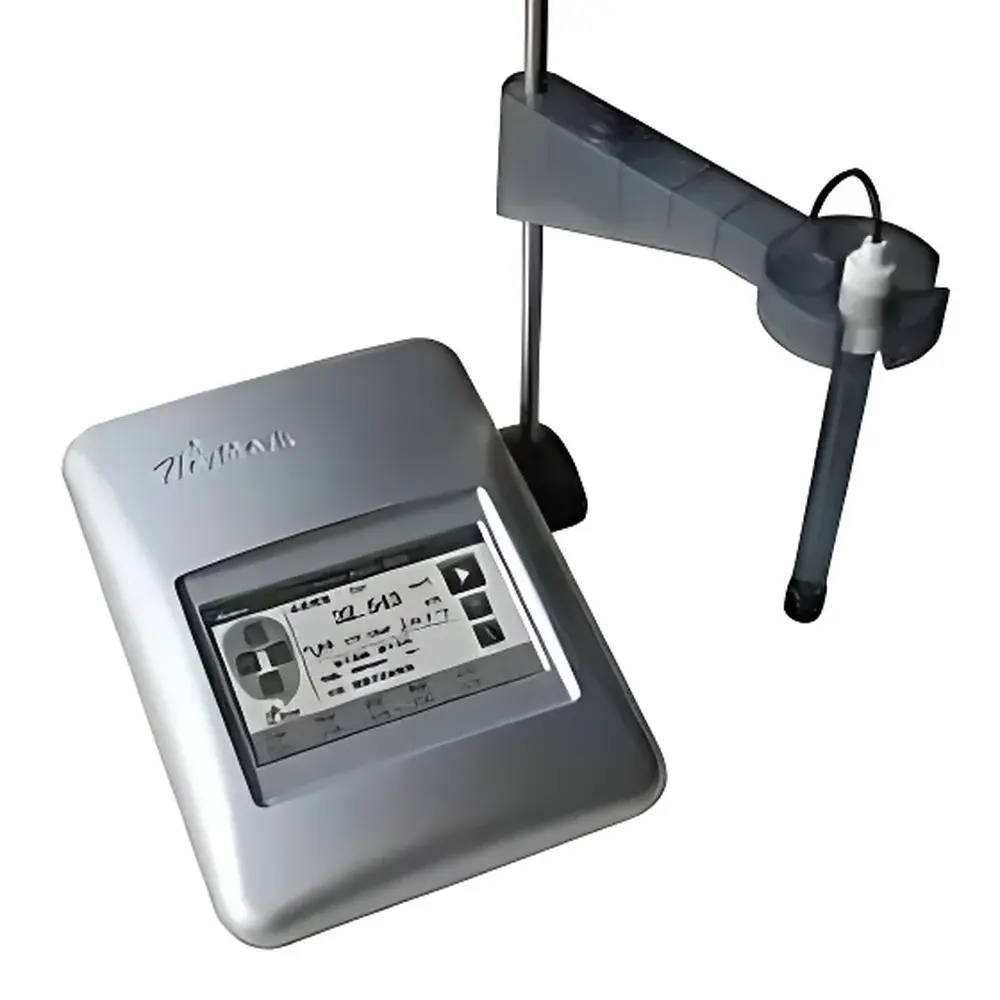
HePu IS339 Benchtop Multi-Ion Analyzer
| Brand | HePu (Jihepu) |
|---|---|
| Origin | Shandong, China |
| Manufacturer Type | Authorized Distributor |
| Country of Origin | China |
| Model | IS339 |
| Price Range | USD 700–1,400 (FOB) |
| Instrument Type | Benchtop |
| Ion Measurement Modes | pX, ion concentration (mg/L, g/L, mol/L, mmol/L), mV, temperature |
| Temperature Range | -30.0 to 130.0 °C (MTC) |
| Temperature Accuracy | ±0.1 °C |
| pX Accuracy | ±0.002 pX (pXI mode), ±0.005 pX (pXII mode) |
| mV Accuracy | ±0.1 mV |
| Concentration Accuracy | ±0.3% (CI mode), ±0.5% (CII mode) |
| pX Resolution | 0.1 / 0.01 / 0.001 selectable |
| mV Resolution | 0.01 / 0.1 / 1 selectable |
| Concentration Resolution | 0.1 / 0.01 / 0.001 selectable |
| Temperature Resolution | 0.1 °C |
| Calibration Points | Up to 5-point |
| Measurement Methods | Direct measurement, sample addition, standard addition, Gran plot |
| Data Storage Capacity | 2000 datasets |
| Interface | BNC electrode input, NTC 30 kΩ temperature probe input, RS232, USB |
| Display | 5.0-inch color TFT touchscreen (800 × 480) |
| Power Supply | External 9 V / 1 A adapter |
| Compliance | GLP-compliant data logging with audit trail metadata |
Overview
The HePu IS339 Benchtop Multi-Ion Analyzer is a high-precision potentiometric instrument engineered for quantitative determination of specific ionic species in aqueous environmental, industrial, and laboratory samples. Based on the Nernst equation and selective ion electrode (ISE) detection principles, the IS339 measures activity-based pX values (where X = F⁻, Cl⁻, Na⁺, K⁺, Ca²⁺, NH₄⁺, NO₃⁻, S²⁻, etc.) and converts them into concentration units—mol/L, mmol/L, mg/L, or g/L—with configurable calibration protocols. Its dual-mode pX accuracy (±0.002 pX in high-precision mode) and integrated temperature compensation (MTC/ATC) ensure trace-level reproducibility across diverse matrices—from potable water and wastewater effluents to soil leachates and electroplating baths. Designed for routine compliance testing, the analyzer meets core functional requirements for ISO 10523 (water pH and ion activity), ASTM D1293 (electrical conductivity and ion-related parameters), and EPA Method 300.0 (anion analysis by ISE), serving as a validated alternative to chromatographic methods where speed, cost, and field-deployable simplicity are prioritized.
Key Features
- “Ion App” architecture: Users define, save, and recall custom measurement workflows—including electrode selection, calibration sequence, unit conversion, and report formatting—enabling method portability and instrument multiplexing without firmware updates.
- GLP-compliant data management: Each stored dataset includes timestamp, operator ID (user-defined), electrode serial number, calibration history, temperature reading, and environmental conditions—supporting traceability per ISO/IEC 17025 and FDA 21 CFR Part 11 when paired with IS-LINK software.
- Adaptive resolution control: Independent resolution settings for pX (0.001), mV (0.01), concentration (0.001), and temperature (0.1 °C) allow optimization for regulatory reporting (e.g., USP for dissolution ion monitoring) or exploratory research.
- Benchtop ergonomics: Integrated electrode stand with vertical adjustment arm, protective dust cover, and vibration-dampened base minimize mechanical drift during extended measurements.
- Multi-method support: Direct reading, sample addition, standard addition, and Gran plot analysis accommodate complex matrices with interfering ions or low-concentration targets—critical for fluoride in groundwater or ammonium in activated sludge.
Sample Compatibility & Compliance
The IS339 accepts standard BNC-compatible ISEs and NTC 30 kΩ temperature probes, supporting certified electrodes for F⁻ (LaF₃ crystal), Cl⁻ (AgCl/Ag₂S), Na⁺ (glass membrane), K⁺ (valinomycin), Ca²⁺ (PVC membrane), NH₄⁺ (nonactin), NO₃⁻ (polymeric membrane), and S²⁻ (Ag₂S). It operates within pH 2–12 for most ISEs and tolerates turbidity ≤500 NTU and suspended solids ≤100 mg/L when filtered per APHA Standard Methods 2540D. All measurement data adhere to GLP documentation standards, including automatic calibration verification logs, outlier flagging, and forced re-calibration prompts after 24 h of continuous operation. The device is CE-marked for EMC Directive 2014/30/EU and RoHS 2011/65/EU compliance.
Software & Data Management
IS-LINK PC software enables real-time bidirectional communication via RS232 or USB, supporting live graphing of pX vs. time, automated calibration curve generation, and export of CSV/Excel-compatible reports with embedded metadata (operator, location, instrument ID, electrode lot). Audit trails record all user actions—including parameter edits, calibration overrides, and data deletions—with SHA-256 hashing for integrity verification. Raw datasets include full sensor response curves, enabling post-acquisition Gran plot reconstruction or interference coefficient validation per IUPAC Technical Report on ISE performance evaluation.
Applications
- Environmental labs: Monitoring fluoride in drinking water (WHO guideline: 1.5 mg/L), nitrate in agricultural runoff (EPA MCL: 10 mg/L as N), and ammonium in wastewater influent.
- Pharmaceutical QC: Quantifying chloride impurities in APIs per ICH Q2(R2), sodium in lyophilized formulations, and potassium in electrolyte solutions.
- Food & beverage: Measuring sodium in processed foods (FDA nutrition labeling), nitrate in cured meats, and calcium in fortified dairy products.
- Academic research: Teaching potentiometric principles, validating ISE selectivity coefficients, and conducting kinetic studies of ion exchange resins.
FAQ
Does the IS339 support automatic temperature compensation (ATC) for all ion measurements?
Yes—ATC uses an integrated NTC 30 kΩ thermistor probe (included) to adjust pX and concentration calculations in real time across -5.0 to 130.0 °C; manual temperature entry (MTC) is also available.
Can calibration data be exported and validated independently of the instrument?
Yes—IS-LINK exports full calibration reports with slope, offset, R², and electrode response time, compatible with LIMS integration and third-party statistical process control (SPC) tools.
Is the “Ion App” functionality programmable via external scripts or APIs?
No—the Ion App editor is GUI-based and runs natively on the device’s embedded Linux OS; however, method files (.iap) are human-readable JSON and can be version-controlled externally.
What maintenance is required for long-term accuracy?
Annual verification against NIST-traceable ISE standards (e.g., NIST SRM 3129a for fluoride) and quarterly electrode membrane cleaning per manufacturer guidelines are recommended for GLP audits.
Does the IS339 meet FDA 21 CFR Part 11 requirements for electronic records?
When used with IS-LINK v3.2+ and configured with user authentication, digital signatures, and audit-trail archiving, it satisfies predicate rule requirements for closed-system validation—though site-specific risk assessment remains the user’s responsibility.
Related Products







