
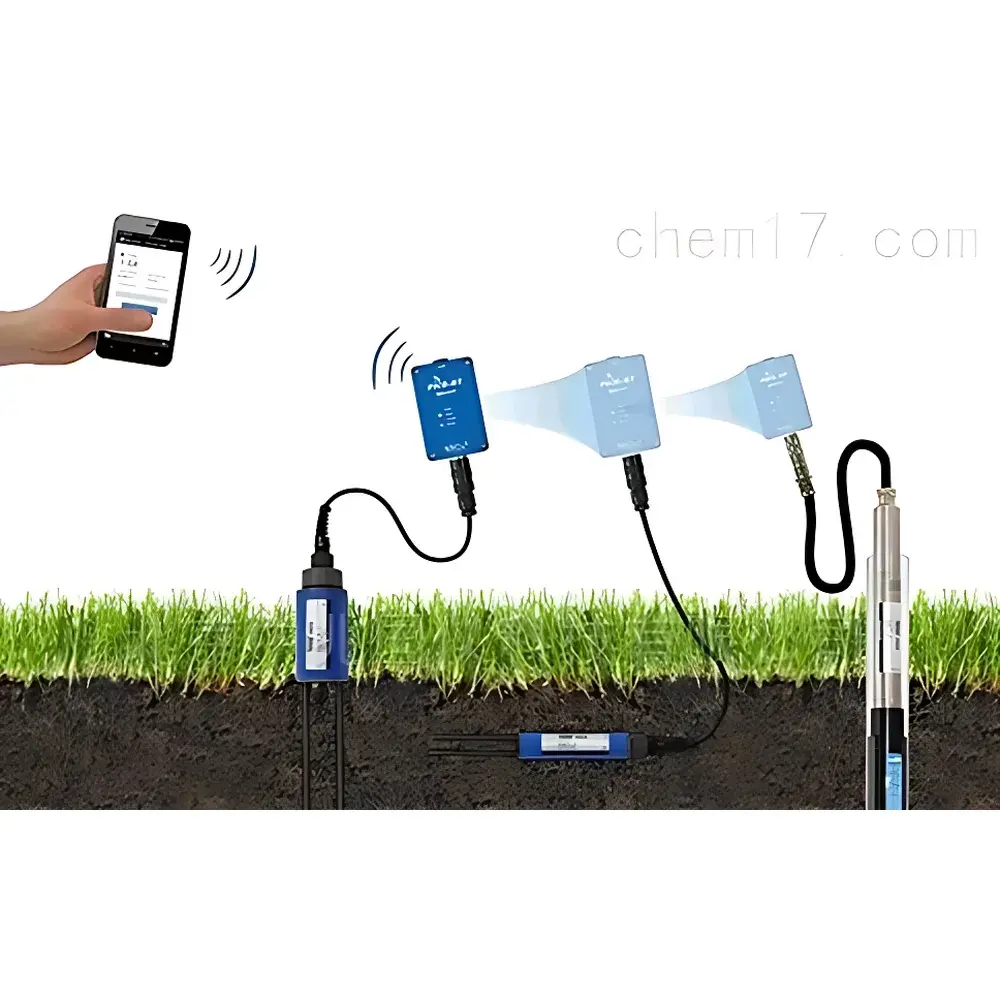
IMKO TRIME-PICO 64/32 TDR Portable Soil Moisture and Electrical Conductivity Analyzer
| Origin | Germany |
|---|---|
| Manufacturer Type | Authorized Distributor |
| Import Status | Imported |
| Model | TRIME-PICO 64/32 |
| Instrument Category | Soil Moisture and Water Potential Analyzer |
| Measurement Principle | Time-Domain Reflectometry (TDR) at 1 GHz |
| Output | Analog Voltage (0–2.5 V or 0–5 V), RS-232, Bluetooth v4.0 (PICO-BT variant) |
| Probe Configuration | 64 mm / 32 mm dual-length waveguide rods |
| ECtrime Resolution | 0.01 dS/m (typical, dependent on calibration) |
| Moisture Range | 0–50 vol% (calibration-dependent) |
| Operating Temperature | –10 °C to +50 °C |
| IP Rating | IP67 (probe), IP54 (handheld unit) |
Overview
The IMKO TRIME-PICO 64/32 is a field-deployable, high-fidelity Time-Domain Reflectometry (TDR) instrument engineered for in situ quantification of volumetric soil water content (θv) and apparent electrical conductivity (ECtrime). Unlike capacitance-based sensors, the TRIME-PICO 64/32 employs a 1 GHz electromagnetic pulse transmitted along precision-machined stainless-steel waveguides (64 mm and 32 mm configurations), enabling direct measurement of dielectric permittivity (εr) with sub-nanosecond time-of-flight resolution (10 ps–2 ns). Since εr exhibits a strong, empirically validated correlation with θv across diverse soil textures—particularly in low-moisture regimes (<15 vol%) common in semi-arid and rainfed agricultural zones—the system delivers robust reproducibility where conventional sensors suffer from hysteresis and salinity-induced drift. Its dual-length probe design allows flexible deployment: surface measurements using the 32 mm rod, and profiled sampling down to 60 cm depth via extension rods compatible with standard auger holes.
Key Features
- True TDR architecture with 1 GHz pulse generation and high-speed time-of-flight detection—no curve-fitting approximations or factory-fixed calibrations.
- Dual-probe geometry (64 mm / 32 mm) optimized for both shallow-root-zone monitoring and deep-profile interrogation using standardized extension rods.
- Simultaneous acquisition of dielectric permittivity and ECtrime from the same waveform analysis—enabling concurrent moisture and salinity assessment without sensor switching.
- Onboard analog voltage output (0–2.5 V or 0–5 V selectable) plus digital interfaces: RS-232 for legacy dataloggers and Bluetooth 4.0 (PICO-BT variant) for real-time transmission to Android/iOS field tablets.
- Ruggedized probe housing rated IP67; handheld unit rated IP54—designed for long-term operation in dust, rain, and temperature extremes (–10 °C to +50 °C).
- Calibration-flexible architecture: supports user-defined θv–εr and ECtrime–salinity (g/L) relationships per FAO 2006 guidelines, accommodating local soil texture and mineralogy.
Sample Compatibility & Compliance
The TRIME-PICO 64/32 is validated for use in mineral soils ranging from coarse sand to heavy clay, including saline-alkali profiles up to 15 dS/m (ECe). It complies with ISO 11272:2020 (soil physical properties — determination of water content), ASTM D5778-21 (standard test method for electronic friction cone and piezocone penetration testing), and supports GLP-aligned data integrity through timestamped, non-volatile internal storage. While not FDA 21 CFR Part 11-certified as a standalone device, its raw waveform export (CSV/TXT) enables traceable post-processing in validated laboratory environments. All calibration curves—including Moisture–ECtrime conversion tables for sandy vs. loamy substrates—are documented in accordance with FAO Irrigation and Drainage Paper No. 56 and ICID Salinity Assessment Protocols.
Software & Data Management
Data acquisition and visualization are supported via IMKO’s proprietary TRIME-View software (Windows), which provides waveform diagnostics, automatic travel-time extraction, and multi-point profile stitching. Raw TDR traces can be exported for third-party analysis in MATLAB, Python (SciPy), or R. The system logs metadata (GPS coordinates, operator ID, probe insertion depth, ambient temperature) alongside each reading, ensuring auditability. For networked deployments, optional integration with LoRaWAN gateways enables automated upload to cloud platforms (e.g., ThingSpeak, AWS IoT Core) with configurable alert thresholds on moisture depletion or salinity spikes—facilitating irrigation scheduling and drainage management in precision agriculture workflows.
Applications
- Long-term monitoring of soil moisture dynamics in semi-arid agroecosystems (e.g., North China Plain, Central Asia steppe belts).
- Salinity mapping and leaching requirement estimation in irrigated croplands affected by secondary salinization.
- Calibration reference for satellite-based soil moisture products (e.g., SMAP, Sentinel-1 SAR backscatter).
- Root-zone water balance studies in controlled-environment lysimeters and rhizotron facilities.
- Validation of hydrological models (e.g., HYDRUS-1D, SWAP) requiring high-temporal-resolution boundary condition data.
- Regulatory compliance sampling under national soil health monitoring programs aligned with EU Soil Thematic Strategy indicators.
FAQ
Does the TRIME-PICO 64/32 require soil-specific calibration for moisture measurement?
Yes. While factory-default Topp equation parameters are provided, optimal accuracy demands site-specific calibration using gravimetric samples from representative horizons—especially in organic-rich or high-clay soils.
Can ECtrime be directly converted to soil solution electrical conductivity (ECe)?
ECtrime correlates strongly with ECe, but conversion requires empirical adjustment based on soil texture, bulk density, and pore-water geometry. IMKO provides guidance per FAO 2006 Annex 2 for deriving transfer functions.
Is the probe compatible with automated weather station loggers?
Yes—via RS-232 serial interface with Modbus RTU protocol support, enabling seamless integration into Campbell Scientific CR1000X, Delta-T GP2, or Decagon EM50G networks.
What is the minimum detectable moisture change in dry soils (<5 vol%)?
Under controlled conditions, resolution is ±0.3 vol% for θv and ±0.02 dS/m for ECtrime, verified against oven-dry standards per ISO 11272.
How often should the probe rods be cleaned or recalibrated?
Mechanical cleaning with soft brush and deionized water is recommended after each field day in high-salt environments; full recalibration is advised annually or after 500 insertions, per IMKO Service Bulletin TRIME-SV-2023-04.







