
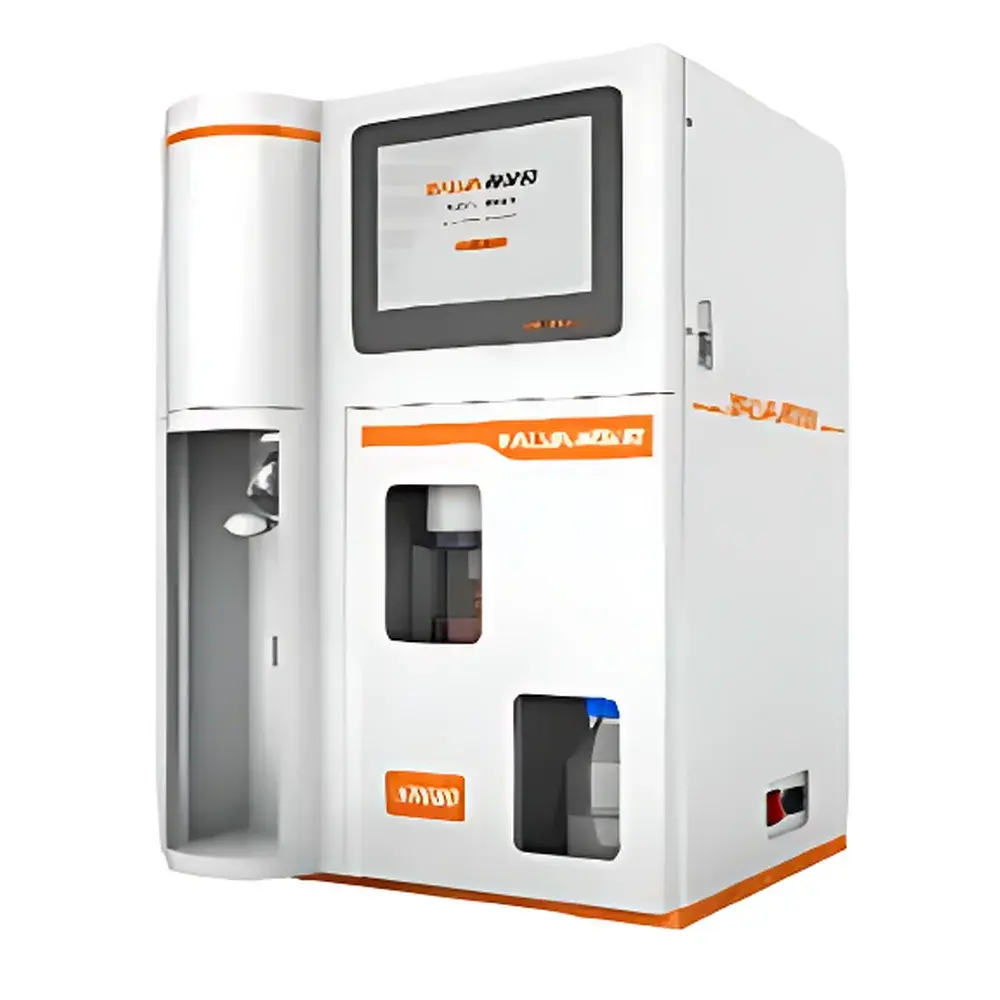
HePu KN680 Fully Automated Kjeldahl Nitrogen Determinator
| Brand | HePu (Jihepu) |
|---|---|
| Origin | Shandong, China |
| Model | KN680 |
| Nitrogen Range | 0.1–220 mg N |
| Digestion-to-Distillation Cycle Time | 3–8 min/sample |
| Repeatability (RSD) | ≤0.5% |
| Sample Mass Capacity | ≤5 g (solid) or ≤20 mL (liquid) |
| Nitrogen Recovery Rate | ≥99.5% |
| Power Consumption | 1800 W |
| Dimensions (L×W×H) | 500 × 450 × 750 mm |
| Weight | 35 kg |
Overview
The HePu KN680 Fully Automated Kjeldahl Nitrogen Determinator is an engineered solution for precise, traceable, and high-throughput nitrogen quantification in accordance with internationally recognized wet-chemistry protocols—specifically ISO 8968-1, AOAC 981.10, 984.27, and USP <467>. It implements the classical Kjeldahl method in its complete sequence: acid digestion (using concentrated H₂SO₄), alkaline steam distillation, boric acid trapping, and potentiometric or colorimetric endpoint detection via titration. Unlike semi-automated systems, the KN680 executes all critical steps—including acid addition, alkali dosing, dilution, steam generation, condensate collection, titrant delivery, endpoint recognition, waste evacuation, and data calculation—without manual intervention. Its architecture integrates thermal, fluidic, and optical subsystems within a single robust chassis designed for GLP/GMP-compliant laboratories requiring audit-ready traceability and operational reproducibility.
Key Features
- Steam pre-addition technology: Introduces low-pressure steam immediately after water dilution to homogenize highly viscous or crystallized digests, reducing localized exothermic reactions during subsequent NaOH addition and minimizing nitrogen loss.
- Programmable multi-stage alkali dosing: Enables batched, timed, and volume-controlled alkali injection to prevent violent boiling—critical for heterogeneous or high-fat samples (e.g., dairy powders, animal feed).
- Alkali pump anti-crystallization system: Patented solvent-flush mechanism prevents NaOH residue buildup, ensuring long-term valve and pump reliability without routine disassembly.
- Dual distillation modes: Selectable “steam-preaddition mode” (optimized for volatile or thermally labile matrices) and “delayed distillation mode” (for high-salt or high-protein digests requiring extended equilibration).
- Adaptive titration with SuperFast™ algorithm: Combines variable-speed, variable-volume titration—coordinating distillate flow rate with real-time titrant delivery—to achieve synchronous completion of distillation and titration for samples up to 70 mg N; extends dynamic range to 220 mg N via auto-calibration.
- Endpoint color learning & micro-adjustment: Captures user-defined endpoint hues from actual borate-indicator complexes (e.g., methyl red–bromocresol green), compensating for batch-to-batch indicator variation and ambient lighting conditions.
- Integrated safety architecture: Includes steam generator pressure monitoring, dry-run protection, liquid-level sensing, temperature-triggered power throttling, safety door interlock, Kjeldahl tube presence verification, and overflow detection in the receiving cup.
- 10-inch 16-bit true-color touchscreen with SmartOneKey™ interface: Supports role-based login (administrator/operator/auditor), configurable access permissions, and full electronic audit trail per FDA 21 CFR Part 11 requirements.
Sample Compatibility & Compliance
The KN680 accommodates diverse sample types across regulated and research environments: cereal grains, legumes, meat and dairy products, fertilizers, wastewater sludge, soil extracts, pharmaceutical excipients, and botanical matrices. It supports direct analysis of ammonium salts, volatile fatty acids (VFA), and total alkalinity—enabling extended elemental speciation beyond total nitrogen. All operational parameters—including digestion time, alkali concentration, steam intensity (1–100% adjustable), and distillation duration (0–9999 min)—are programmable per method. The system complies with ISO/IEC 17025 documentation standards, maintains full calibration traceability to NIST-traceable nitrogen standards, and generates timestamped, digitally signed reports compliant with GLP audit protocols.
Software & Data Management
Embedded firmware enables local storage of >100,000 test records and >10,000 customizable method templates. Data export supports CSV, PDF, and XML formats via USB, RS232, LAN, or Wi-Fi. Cloud synchronization is supported through secure HTTPS-based API endpoints, allowing remote method deployment, real-time instrument status monitoring, and centralized data aggregation across multi-site laboratories. Mobile access is enabled via dedicated iOS/Android applications and WeChat Mini Programs—providing push notifications for cycle completion, error alerts, and maintenance reminders. All user actions—including login/logout, parameter changes, and report generation—are logged with immutable timestamps and operator IDs.
Applications
The KN680 serves as a primary nitrogen analyzer in food safety labs (protein content per FAO/WHO conversion factors), agricultural extension services (soil fertility assessment), environmental testing facilities (wastewater TN compliance per EPA Method 351.2), pharmaceutical QC units (nitrogen impurity profiling in APIs), and academic research groups studying nitrogen cycling in ecological systems. Its ability to quantify ammoniacal-N, nitrate-N, and organic-N—following appropriate pre-reduction or digestion adaptations—makes it suitable for method development under ASTM D5179 and ISO 14253-1.
FAQ
Does the KN680 comply with AOAC Official Methods of Analysis?
Yes—the instrument implements AOAC 981.10 (crude protein in foods), 984.27 (dairy products), and 992.15 (feedstuffs) with validated recovery and precision performance.
Can the system be integrated into a LIMS environment?
Yes—via standardized HL7 or ASTM E1384-compliant data output over TCP/IP or serial protocols, supporting bidirectional communication for sample ID ingestion and result upload.
What maintenance intervals are recommended for long-term accuracy?
Quarterly verification of steam pressure calibration, monthly inspection of alkali tubing integrity, and annual photometric validation of color sensor linearity using certified dye standards.
Is external cooling water required for condensation?
No—the KN680 employs an integrated Peltier-cooled condenser with automatic dew-point control, eliminating dependency on municipal water supply or chiller units.
How does the system handle high-salt or high-viscosity digestates?
Through programmable steam pre-addition, staged alkali dosing, and adaptive distillation timing—validated for seawater-impacted soils and molasses-based fermentation broths per ISO 11261.




