
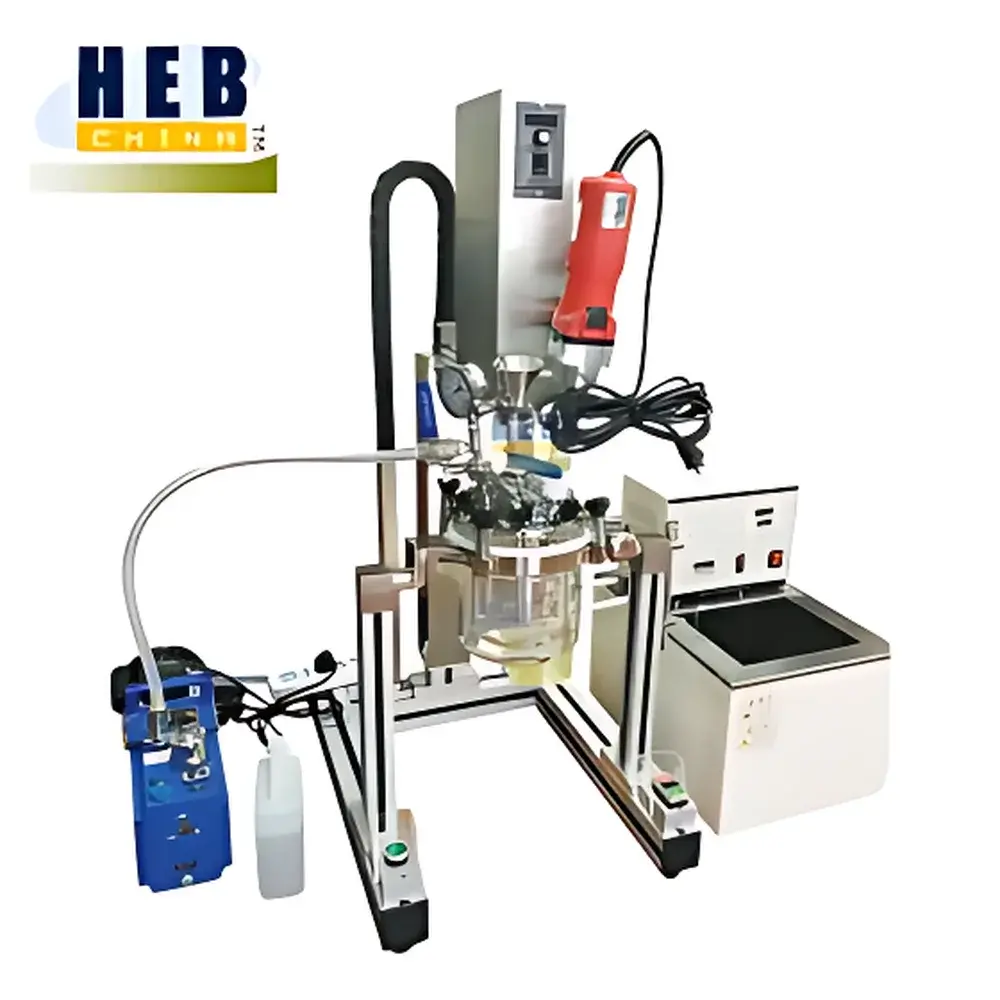
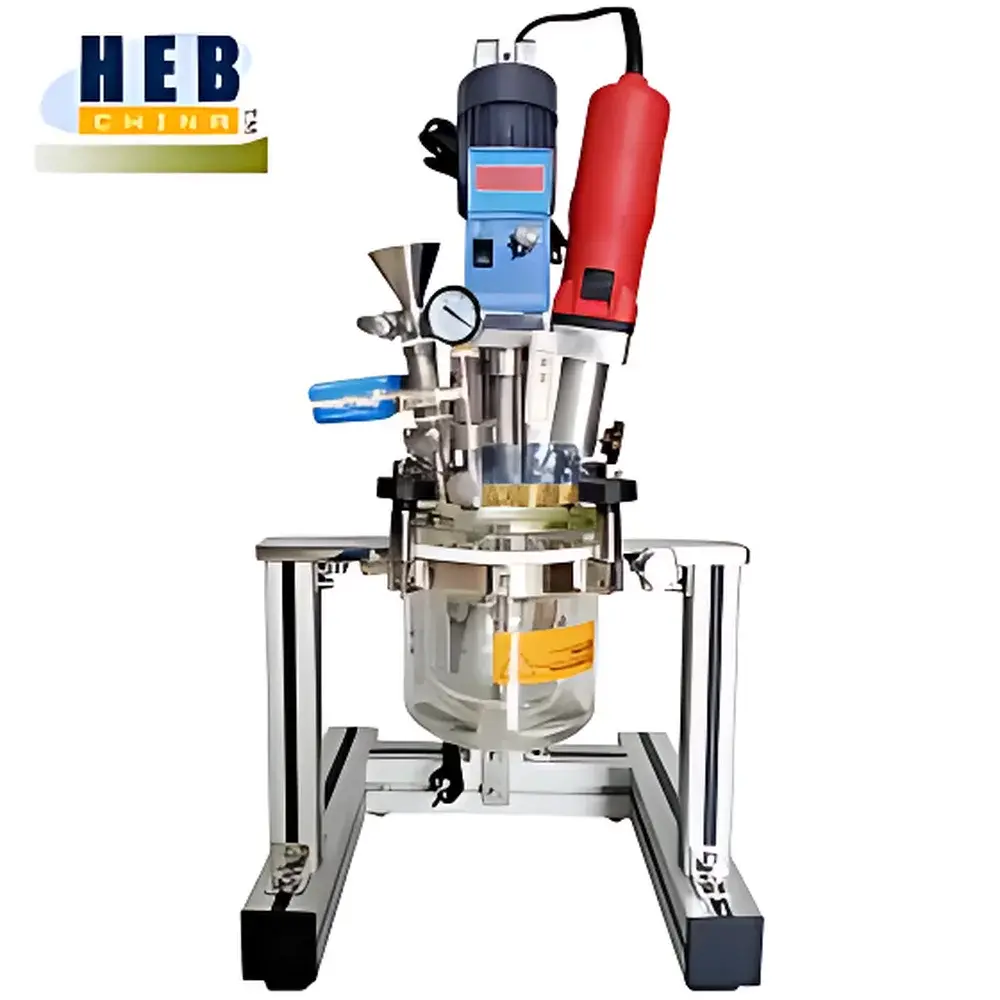
English Product Name
| Brand | Jihepu |
|---|---|
| Model | AIR-5L |
| Capacity | 5000 mL |
| Working Pressure | -0.096 MPa (vacuum) |
| Vessel Material | Borosilicate glass (Duran®/Pyrex®-grade) jacketed vessel with SUS316L stainless steel lid and PTFE/silicone seals |
| Stirring Speed | 0–200 rpm (adjustable, stepper motor-driven) |
| Homogenizer Power | 1050 W |
| Homogenizer Speed | 10,000–28,000 rpm |
| Maximum Shear Tip Speed | 27 m/s |
| Temperature Range | Ambient to 120 °C (optional 250 °C configuration with oil bath circulation) |
| Max. Viscosity Handling | 70,000 cP (130,000 cP with high-torque option) |
| Electrical Supply | 220 V, 50/60 Hz |
| Compliance | Designed for GLP-compliant lab-scale process development |
Overview
The Jihepu AIR-5L is a fully integrated benchtop vacuum reaction vessel engineered for controlled synthesis, dispersion, emulsification, and homogenization under variable pressure and temperature conditions. Built upon a modular platform architecture, it combines a double-walled borosilicate glass reactor body (5 L nominal volume) with a precision-engineered SUS316L stainless steel sealing head, vacuum-rated PTFE-silicone gasketing, and dual-drive capability—simultaneous low-speed torque-controlled agitation and high-speed rotor-stator homogenization. Its core operating principle relies on Couette flow dynamics for macro-mixing and turbulent shear generation at the homogenizer tip for submicron particle size reduction or phase stabilization. Designed explicitly for laboratory-scale process simulation, the AIR-5L replicates key unit operations found in pilot- and production-scale reactors—including vacuum degassing, inert gas blanketing, temperature-programmed reaction kinetics, and real-time rheological response monitoring—making it suitable for R&D validation prior to tech transfer per ICH Q5C and FDA Process Validation Guidance (Stage 1).
Key Features
- Modular multi-port reactor head with standardized 10 mm vacuum port, dual thermocouple ports (RTD and Pt100), feed inlet, vent valve, and three configurable auxiliary ports for pH probes, conductivity sensors, or reflux condensers
- Electromechanical lift system (280 mm travel) enabling precise vertical alignment of homogenizer shaft and anchor-type刮壁 stirrer—critical for uniform wall scraping and heat transfer efficiency in viscous media
- Dual independent drive systems: brushless DC stirrer motor (0–200 rpm, 180 W) with torque feedback control; and high-efficiency induction homogenizer motor (10,000–28,000 rpm, 1050 W) with digital speed regulation and thermal overload protection
- Borosilicate glass vessel (ISO 3585 compliant) with 12 mm jacket inlet/outlet for external temperature control via circulating baths (water or silicone oil); optional electric heating mantle integration
- GMP-aligned wetted parts: SUS316L contact surfaces, FDA-listed PTFE seals, and autoclavable silicon rubber scraper blades (PTFE-coated scraper option available for abrasive slurries)
- Integrated safety architecture: dual insulation monitoring, electronic current-limiting circuitry, emergency stop with mechanical cut-off, and vacuum interlock preventing homogenizer activation below preset pressure threshold
Sample Compatibility & Compliance
The AIR-5L accommodates a broad range of chemically aggressive, thermally sensitive, and shear-thinning or shear-thickening formulations—including organometallic catalysts, polymer dispersions, nanoemulsions, pharmaceutical suspensions, and battery electrolyte precursors. Its borosilicate glass body resists corrosion from halogenated solvents, strong acids (e.g., HNO₃, H₂SO₄ ≤ 60%), and alkalis up to 20% NaOH at ≤80 °C. All fluid-contact materials comply with USP Class VI biological reactivity standards and EU Regulation (EC) No 1935/2004 for food-contact suitability. The system supports audit-ready documentation: electronic log files include timestamped operator ID, setpoints, actual values, alarm events, and parameter change history—structured to satisfy 21 CFR Part 11 requirements when paired with validated third-party LIMS or ELN software. It is routinely deployed in laboratories adhering to ISO/IEC 17025, ASTM D445 (viscosity), and USP (emulsion stability) test protocols.
Software & Data Management
While the base AIR-5L operates via front-panel digital controls with LED display, optional RS485/Modbus RTU interface enables seamless integration into centralized lab automation networks. Compatible with SCADA platforms (e.g., Ignition, Siemens Desigo CC), it transmits real-time data streams including vacuum level (mbar), jacket temperature (°C), homogenizer RPM, stirrer torque (%), and elapsed run time. Optional data acquisition modules record at 1 Hz resolution with CSV export and configurable alarm thresholds. All firmware updates are delivered via secure USB key with SHA-256 signature verification. Audit trails meet ALCOA+ principles: attributable, legible, contemporaneous, original, accurate, complete, consistent, enduring, and available—supporting GxP environments during regulatory inspections.
Applications
- Pharmaceutical formulation development: nanostructured lipid carriers (NLCs), microemulsion preconcentrates, and amorphous solid dispersion screening under inert atmosphere
- Advanced materials synthesis: sol-gel processing of silica aerogels, graphene oxide dispersion stabilization, and metal-organic framework (MOF) crystallization under reduced pressure
- Agrochemical R&D: suspension concentrates (SC), water-dispersible granules (WDG), and encapsulated active ingredient release profiling
- Electrolyte engineering for Li-ion batteries: lithium salt dissolution kinetics, additive compatibility testing, and gas evolution monitoring during SEI formation
- Food-grade emulsion optimization: plant-based dairy alternatives, flavor oil encapsulation, and cold-process mayonnaise analogues requiring strict thermal control
FAQ
Can the AIR-5L operate under positive pressure, and what is the maximum rated pressure?
Yes—standard configuration supports vacuum down to –0.096 MPa; optional reinforced sealing kits and pressure-rated glass vessels enable operation up to +0.3 MPa gauge pressure (certified per PED 2014/68/EU Annex I, Category I).
Is the glass reactor body replaceable, and are spare vessels traceably calibrated?
All borosilicate vessels are supplied with individual calibration certificates (volume tolerance ±0.5% per ISO 4787), and replacement vessels are serialized and matched to original batch QC records.
Does the system support automated temperature ramping and hold profiles?
When connected to an external programmable circulator (e.g., Huber Chiller), the AIR-5L accepts analog 0–10 V setpoint signals; full PID-controlled ramp-and-hold functionality requires optional PLC add-on module.
What homogenizer work heads are included, and are they interchangeable with other Jihepu platforms?
Standard delivery includes 25BCS rotor-stator head (25 mm diameter, 0.2 mm clearance); all BCS-series heads (20–30 mm) are mechanically and electrically compatible across AIR-1L through AIR-10L models.
How is vacuum integrity verified during qualification?
Factory acceptance testing includes 30-minute hold test at –0.096 MPa with decay rate ≤0.5 mbar/min; users receive IQ/OQ documentation templates aligned with ASTM E2500 Annex A for installation and operational qualification.



