
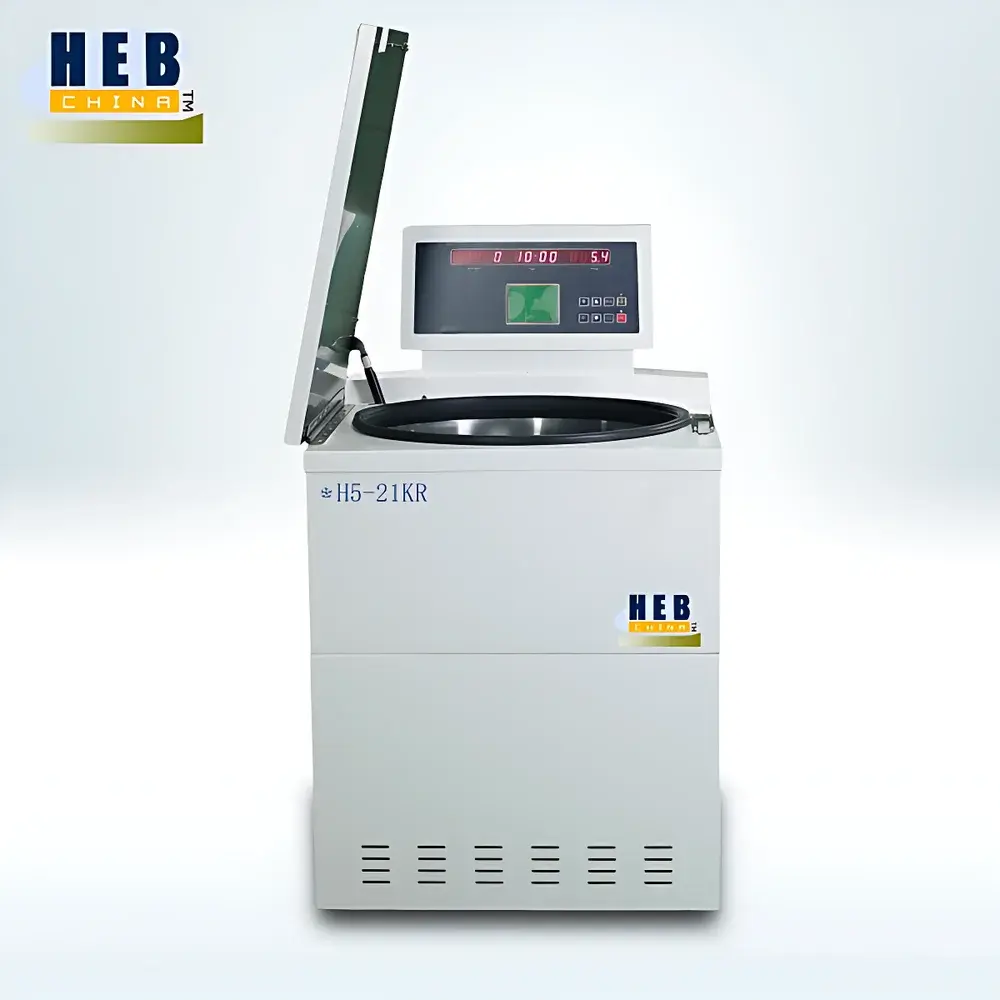
HePu H5-21KR High-Speed Refrigerated Centrifuge
| Brand | HePu (Jihepu) |
|---|---|
| Origin | Shandong, China |
| Model | H5-21KR |
| Type | Floor-standing high-speed refrigerated centrifuge |
| Max Speed | 21,000 rpm |
| Max RCF | 47,580 × g |
| Max Capacity | 4 × 750 mL |
| Temperature Range | −20 °C to +40 °C |
| Temp. Accuracy | ±2.0 °C |
| Timer Range | 1 min – 23 h 59 min |
| Speed Accuracy | ±20 rpm |
| Noise Level | ≤65 dB(A) |
| Power Supply | AC 220 V ±10%, 50 Hz, 35 A |
| Total Power | 3.5 kW |
| Dimensions (W×D×H) | 825 × 625 × 910 mm |
| Net Weight | 310 kg |
| Rotor Compatibility | Fixed-angle rotors (6–16 positions, up to 500 mL), swing-out rotor (4 × 750 mL) |
| Safety Features | Automatic rotor recognition, lid interlock, overspeed/overtemperature/unbalance detection, auto-locking rotor mechanism |
Overview
The HePu H5-21KR High-Speed Refrigerated Centrifuge is an engineered floor-standing solution designed for demanding separation tasks in life science and industrial laboratories. It operates on the principle of sedimentation under controlled gravitational force (RCF), enabling efficient isolation of subcellular components—including organelles, nucleic acids, proteins, and viral particles—based on density, size, and shape. Its refrigerated architecture maintains sample integrity during prolonged high-speed runs, making it suitable for temperature-sensitive applications such as plasmid purification, exosome isolation, and monoclonal antibody processing. The unit integrates a high-torque AC frequency-controlled motor, eliminating carbon brush wear and ensuring long-term operational stability with minimal maintenance. With a maximum RCF of 47,580 × g and a top speed of 21,000 rpm, the H5-21KR meets the performance requirements of ISO 15189-accredited clinical labs and GLP-compliant bioprocessing workflows.
Key Features
- Microprocessor-based control system with intuitive LCD interface supporting dual parameter input (rpm or ×g), with real-time conversion and one-touch switching.
- Automatic rotor identification via embedded RFID or mechanical coding—ensures firmware-enforced speed limits per rotor type to prevent mechanical over-stress.
- Dual-path thermal management: Imported hermetic compressor combined with independent heating circuitry enables precise chamber temperature control from −20 °C to +40 °C, even at full speed.
- Advanced vibration-damping chassis and balanced drive assembly reduce operational noise to ≤65 dB(A) and suppress harmonic resonance across all speed ranges.
- Comprehensive safety suite includes lid interlock with force-sensing engagement, real-time imbalance detection, overspeed cutoff, and automatic deceleration upon fault detection.
- Self-locking rotor mechanism eliminates manual tightening—rotors engage fully and reproducibly with rotational torque, reducing operator variability and cross-contamination risk.
Sample Compatibility & Compliance
The H5-21KR accommodates a broad spectrum of biological and biochemical samples—from whole blood and cell lysates to viscous fermentation broths and nanoparticle suspensions. Its certified rotor library includes eight fixed-angle rotors (capacity range: 10 mL to 500 mL) and one swing-bucket rotor (4 × 750 mL), each validated per ISO 21501-4 for dimensional tolerance and fatigue resistance. All rotors are constructed from high-strength aluminum alloy (6061-T6) or titanium (where specified), compliant with ASTM F899 for medical device material biocompatibility. The centrifuge’s temperature control system adheres to IEC 61010-2-020 (safety requirements for laboratory equipment), and its data logging functionality supports audit-ready traceability under FDA 21 CFR Part 11 when paired with optional PC interface software.
Software & Data Management
While the H5-21KR operates as a standalone instrument, its RS-232/USB interface allows integration with LIMS or ELN platforms for protocol synchronization and raw run-data export (CSV format). The onboard memory stores up to 100 user-defined protocols, each retaining setpoints for speed, temperature, time, acceleration/deceleration profiles, and rotor ID. All critical events—including door cycles, temperature deviations >±3 °C, and safety interventions—are timestamped and logged internally for GLP/GMP documentation. Optional software modules provide remote monitoring, electronic signature support, and automated report generation aligned with ISO/IEC 17025 clause 7.7 (result reporting).
Applications
- Clinical diagnostics: Separation of serum/plasma from whole blood; isolation of PBMCs and platelet-rich plasma (PRP).
- Biopharmaceutical development: Clarification of mammalian cell culture harvests; concentration and buffer exchange of therapeutic proteins.
- Genomics & molecular biology: Pellet recovery of genomic DNA, RNA, and CRISPR ribonucleoprotein complexes.
- Virology & vaccine research: Purification of lentiviral vectors and enveloped virus particles via sucrose or iodixanol gradient ultracentrifugation (when used with compatible swing-bucket rotor).
- Quality control in API manufacturing: Particle size distribution analysis of nanosuspensions and liposomal formulations.
FAQ
Does the H5-21KR support validation documentation (IQ/OQ/PQ)?
Yes—HePu provides factory-issued calibration certificates for speed, temperature, and timer accuracy, along with a configurable OQ protocol template compliant with ISO/IEC 17025 Annex A.2.
Can the centrifuge maintain −20 °C at 21,000 rpm?
No—maximum refrigeration capacity is load- and ambient-dependent; at full speed and maximum load, stable operation is guaranteed down to −10 °C (per IEC 61010 test conditions). For sustained sub-zero runs, reduced speed or partial loading is recommended.
Is rotor 9 (4 × 750 mL swing-bucket) compatible with all standard 750 mL conical tubes?
Rotor 9 accepts only certified tubes meeting ISO 13485 tube geometry tolerances; HePu recommends using its proprietary polypropylene tubes (Cat. No. HT-750C) to ensure balance and seal integrity.
What maintenance intervals are required for the compressor and drive system?
Compressor oil inspection every 24 months; drive belt tension check every 12 months; full rotor calibration verification annually or after 500 runs—per HePu Service Bulletin H5-SV-2023.
Is the H5-21KR suitable for radioactive sample processing?
The centrifuge chamber is not lead-lined; however, optional stainless-steel shielding kits and decontamination-compatible rotor coatings (e.g., electropolished Ti-6Al-4V) are available upon request for low-activity isotopes (≤10 µCi of 32P or 125I).



