
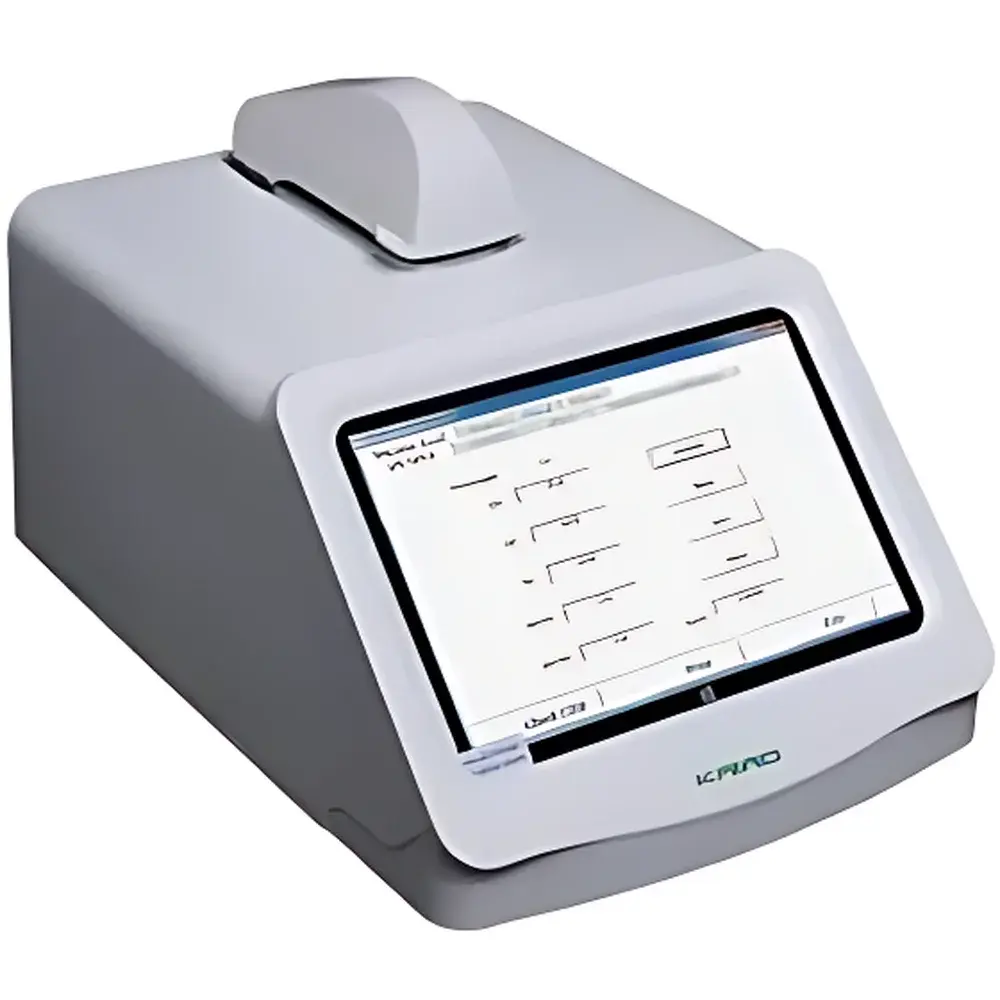
K2800 Microvolume UV-Vis Spectrophotometer by Jihepu
| Brand | Jihepu |
|---|---|
| Origin | Shandong, China |
| Model | K2800 |
| Detector Type | CCD-based photodiode array |
| Wavelength Selection | Fixed at 230 nm, 260 nm, and 280 nm |
| Wavelength Accuracy | ±1 nm |
| Spectral Bandwidth | <5 nm |
| Pathlength | 1.0 mm / 0.2 mm (switchable via integrated sample stage) |
| Sample Volume | 1–2 µL |
| Absorbance Range | 0.02–80 Abs |
| Absorbance Accuracy | ±0.002 Abs or ±2% (whichever is greater) |
| Measurement Time | <5 s per sample |
| Light Source | Pulsed Xenon Lamp |
| Data Output Format | CSV-compatible spreadsheet |
| Dimensions | 260 × 190 × 150 mm |
| Weight | 2.0 kg |
| Display | Integrated high-resolution capacitive touchscreen with embedded system monitoring |
Overview
The K2800 Microvolume UV-Vis Spectrophotometer is an engineered solution for rapid, accurate nucleic acid and protein quantification in resource-constrained or high-throughput laboratory environments. Unlike conventional cuvette-based spectrophotometers, the K2800 employs fixed-wavelength microvolume measurement based on surface tension-mediated sample retention—eliminating the need for disposable cuvettes, dilution steps, or thermal equilibration. Its optical architecture leverages a pulsed xenon lamp coupled with a high-stability CCD-based photodiode detection system to deliver reproducible absorbance readings at three biologically critical wavelengths: 230 nm (contaminant indicator), 260 nm (nucleic acid peak), and 280 nm (protein aromatic residue peak). The instrument operates on the principle of direct transmission absorbance across two precisely calibrated pathlengths (1.0 mm and 0.2 mm), enabling dynamic range extension without manual dilution—effectively covering nucleic acid concentrations from 10 ng/µL to 4000 ng/µL for double-stranded DNA, equivalent to a 50-fold expansion over standard 10-mm-pathlength instruments.
Key Features
- Microvolume capability: Requires only 1–2 µL of undiluted sample, minimizing precious sample consumption and eliminating pipetting errors associated with serial dilution.
- Dual-pathlength design: Automatic mechanical switching between 1.0 mm and 0.2 mm pathlengths ensures optimal signal-to-noise ratio across broad concentration ranges.
- Fixed-wavelength precision optics: Optimized for biomolecular quantification—no wavelength scanning or monochromator drift; all measurements occur at rigorously stabilized 230 nm, 260 nm, and 280 nm emission bands.
- Integrated touchscreen interface: Embedded Linux-based OS with capacitive 7-inch display supports real-time data visualization, on-device calculation of A260/A280, A260/A230, and concentration (ng/µL) using user-defined extinction coefficients.
- Rugged optical alignment: Fiber-optic light delivery is fully internalized and mechanically decoupled from external handling—preventing misalignment due to vibration or accidental impact.
- Regulatory-ready data handling: All measurements are timestamped and stored in editable CSV format with full audit trail metadata (operator ID, date/time, pathlength, wavelength, raw absorbance values).
Sample Compatibility & Compliance
The K2800 accommodates a wide range of biological samples including purified dsDNA, ssDNA, RNA, oligonucleotides, proteins (BSA, lysozyme), and crude lysates—provided surface tension permits stable droplet formation on the quartz measurement stage. It meets core performance criteria referenced in ISO 8655-7 (volumetric accuracy of micropipettes used for loading) and aligns with general laboratory practices outlined in CLSI EP10-A3 for method comparison and verification. While not certified to FDA 21 CFR Part 11 out-of-the-box, its deterministic measurement workflow, immutable CSV export, and absence of cloud connectivity make it suitable for GLP-compliant environments where electronic records are maintained under local IT governance policies.
Software & Data Management
The onboard software provides standalone operation with no PC dependency. Each measurement generates a structured CSV file containing raw absorbance values at all three wavelengths, calculated ratios, inferred concentrations, pathlength setting, and environmental timestamps. Files are saved directly to internal flash memory and exportable via USB-A port. No proprietary drivers or vendor-specific analysis suites are required—data integrates natively with Excel, GraphPad Prism, R, or LIMS platforms supporting tabular import. Firmware updates are performed via signed USB firmware packages to maintain traceability and integrity.
Applications
- High-efficiency nucleic acid QC in NGS library preparation workflows.
- Routine quantification of CRISPR gRNA, siRNA, and mRNA before transfection or encapsulation.
- Protein purity assessment in affinity-purified eluates (A260/A280 and A260/A230 ratios).
- Concentration verification of synthetic peptides and small-molecule conjugates in formulation development.
- Educational laboratories requiring robust, low-maintenance instrumentation for undergraduate biochemistry labs.
FAQ
Does the K2800 support wavelength scanning or spectral acquisition?
No. It is a fixed-wavelength microvolume instrument optimized exclusively for 230 nm, 260 nm, and 280 nm absorbance quantification.
Can the K2800 measure samples with low surface tension, such as detergents or organic solvents?
Not reliably. Sample retention depends on aqueous-phase surface tension; non-aqueous or high-detergent buffers may fail to form stable measurement droplets.
Is calibration traceable to NIST standards?
Factory calibration uses traceable neutral density filters and reference standards compliant with ISO/IEC 17025-accredited procedures; end-user recalibration is not supported.
What maintenance is required?
Routine cleaning of the quartz measurement stage with >99.9% isopropanol and lint-free wipes every 20–30 measurements; no optical alignment or lamp replacement is needed within the specified 10,000-hour xenon lamp lifetime.
How is data security managed for regulated environments?
All data reside locally on device storage; no network interfaces, remote access, or cloud synchronization are implemented—ensuring full control over data sovereignty and audit readiness.
Related Products




