
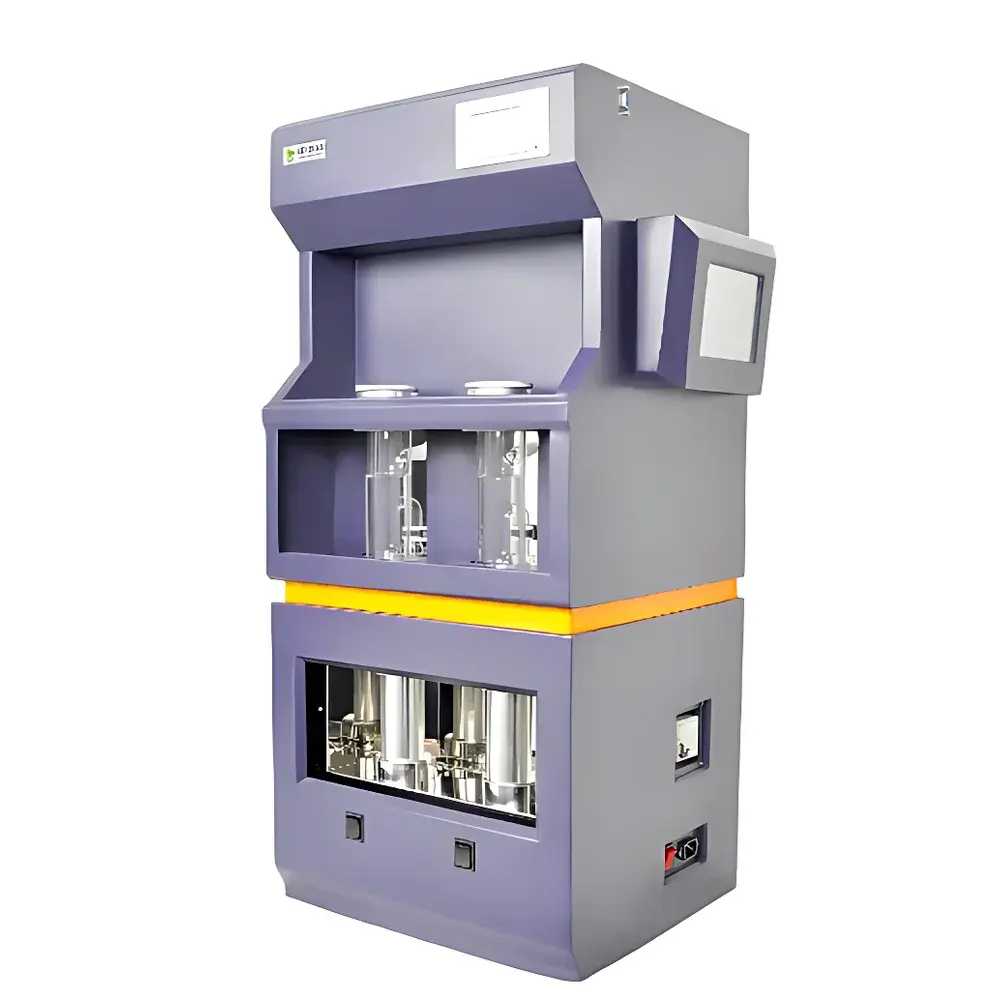
HePu SE-A2 Automated Soxhlet Fat Analyzer
| Brand | HePu (Jinan Hepu Instrument Co., Ltd.) |
|---|---|
| Origin | Shandong, China |
| Manufacturer Type | Authorized Distributor |
| Country of Origin | China |
| Model | SE-A2 |
| Extraction Chamber Volume | 120 mL |
| Receiving Flask Volume | 120 mL |
| Temperature Range | 0–300 °C |
| Temperature Control Accuracy | ±0.8% |
| Number of Channels | 2 or 6 (configurable) |
Overview
The HePu SE-A2 Automated Soxhlet Fat Analyzer is a fully integrated laboratory instrument engineered for precise, reproducible, and compliant quantification of total fat and extractable lipids in solid and semi-solid matrices. It operates on the classical Soxhlet extraction principle—where solvent reflux cycles continuously percolate through a porous sample matrix to isolate soluble lipids—but enhances it with automation, thermal precision, inert atmosphere control, and multi-method flexibility. Designed in strict accordance with ISO 1444–1:2022 (Animal feeding stuffs — Determination of crude fat), AOAC Official Method 920.39, and Chinese national standards GB 5009.6–2016 and GB/T 6433–2006, the SE-A2 delivers traceable, auditable results suitable for regulatory submissions, quality control laboratories, and research environments requiring GLP- or GMP-aligned workflows.
Key Features
- Full automation of extraction, solvent reflux, rinse, evaporation, pre-drying, and gravimetric calculation—including optional integrated weighing module support for real-time mass tracking.
- Dual independent electric lift mechanisms per channel, enabling asynchronous operation of up to six parallel units (SE-A2 base configuration supports 2 channels; expandable to 6 via modular upgrade).
- PTFE-coated, reusable sample thimbles—eliminating disposable filter paper cartridges and reducing annual consumables cost by USD 450–1,500 (based on typical lab throughput).
- Programmable pre-drying stage with independent temperature setpoint (0–150 °C), minimizing thermal degradation of heat-labile lipids and improving recovery accuracy for unsaturated fatty acids.
- Four extraction modes: Classical Soxhlet, Hot Extraction, Soxhlet-Hot Hybrid, and Continuous Flow—enabling method optimization across diverse matrices (e.g., dairy powders, oily seeds, activated sludge, polymer composites).
- Integrated inert gas purging system (N₂ or Ar) with programmable flow rate and duration to prevent oxidation of polyunsaturated fatty acids (PUFAs) during extraction and drying.
- Real-time solvent leak detection (ether-specific sensor, LOD: 90 ppm), cooling water flow monitoring with auto-shutdown, and forced solvent reflux loop achieving ≥95% recovery within 90 min (petroleum ether or diethyl ether).
Sample Compatibility & Compliance
The SE-A2 accommodates samples ranging from 0.5 g to 15 g—including foodstuffs (meat, cereals, baked goods), feedstuffs (soybean meal, fishmeal), environmental solids (soil, sediment, biosolids), and industrial materials (plastics, leather, paperboard). Its 0–300 °C metal bath heating system supports solvents with boiling points from 35 °C (diethyl ether) to 150 °C (chlorobenzene), ensuring compatibility with ASTM D297–19 (rubber hydrocarbons), EPA Method 3541 (solid-phase extraction), and ISO 10520:2017 (determination of fat in animal tissues). All firmware and software comply with FDA 21 CFR Part 11 requirements for electronic records and signatures, including audit trail logging, user role-based access control, and data integrity validation. CE marking and ISO 9001:2015 certification confirm conformity to EU safety directives and quality management standards.
Software & Data Management
The SE-A2 runs on an embedded Linux-based OS with a 7-inch capacitive touchscreen interface emulating Windows-style navigation—minimizing training time while supporting multilingual UI (English, Spanish, French, Chinese). The HePu LabSuite™ software enables storage of up to 1,000 customizable extraction protocols and 1,000 result datasets, each tagged with operator ID, timestamp, method version, and instrument calibration status. Protocols support conditional logic (e.g., “if moisture content >12%, activate extended pre-dry step”), and raw data export is available in CSV, PDF, and XML formats compatible with LIMS integration. All changes to parameters or results are logged in a tamper-evident audit trail meeting GLP Annex 11 and ISO/IEC 17025:2017 documentation requirements.
Applications
- Quantitative fat analysis in nutritional labeling (compliant with EU Regulation (EU) No 1169/2011 and FDA 21 CFR §101.9).
- Crude fat determination in animal feed per AOAC 920.39 and EN ISO 6496:2017.
- Extraction of semi-volatile organic compounds (SVOCs) from soil and wastewater sludge per EPA SW-846 Method 3541.
- Isolation of plasticizers (e.g., phthalates) from PVC polymers prior to GC-MS analysis.
- Preparative lipid fractionation for subsequent fatty acid methyl ester (FAME) profiling using GC-FID or GC-MS.
- Supporting total fat analysis when coupled with the optional AutoHydrolysis H6 module for acid/alkaline hydrolysis (Roese-Gottlieb, Babcock, Gerber methods).
FAQ
What extraction solvents are compatible with the SE-A2?
Petroleum ether (bp 40–60 °C), diethyl ether, chloroform, and hexane are validated; higher-boiling solvents (e.g., toluene, chlorobenzene) may be used with appropriate safety interlocks and venting configurations.
Does the SE-A2 meet FDA 21 CFR Part 11 requirements?
Yes—electronic records include full audit trails, digital signatures, and role-based access controls. Validation documentation (IQ/OQ/PQ templates) is provided upon request.
Can the instrument operate unattended overnight?
Yes—integrated safety systems (solvent leak detection, dry-run protection, cooling water monitoring, and automatic shutdown) enable secure unattended operation for up to 24 h.
Is method validation support available?
HePu provides application notes, SOP templates, and third-party validation services aligned with ISO/IEC 17025 and AOAC guidelines.
What maintenance is required?
Annual calibration of temperature sensors and pressure transducers; quarterly inspection of PTFE seals and condenser tubing; no routine replacement of heating elements or lift motors due to industrial-grade component selection.



