
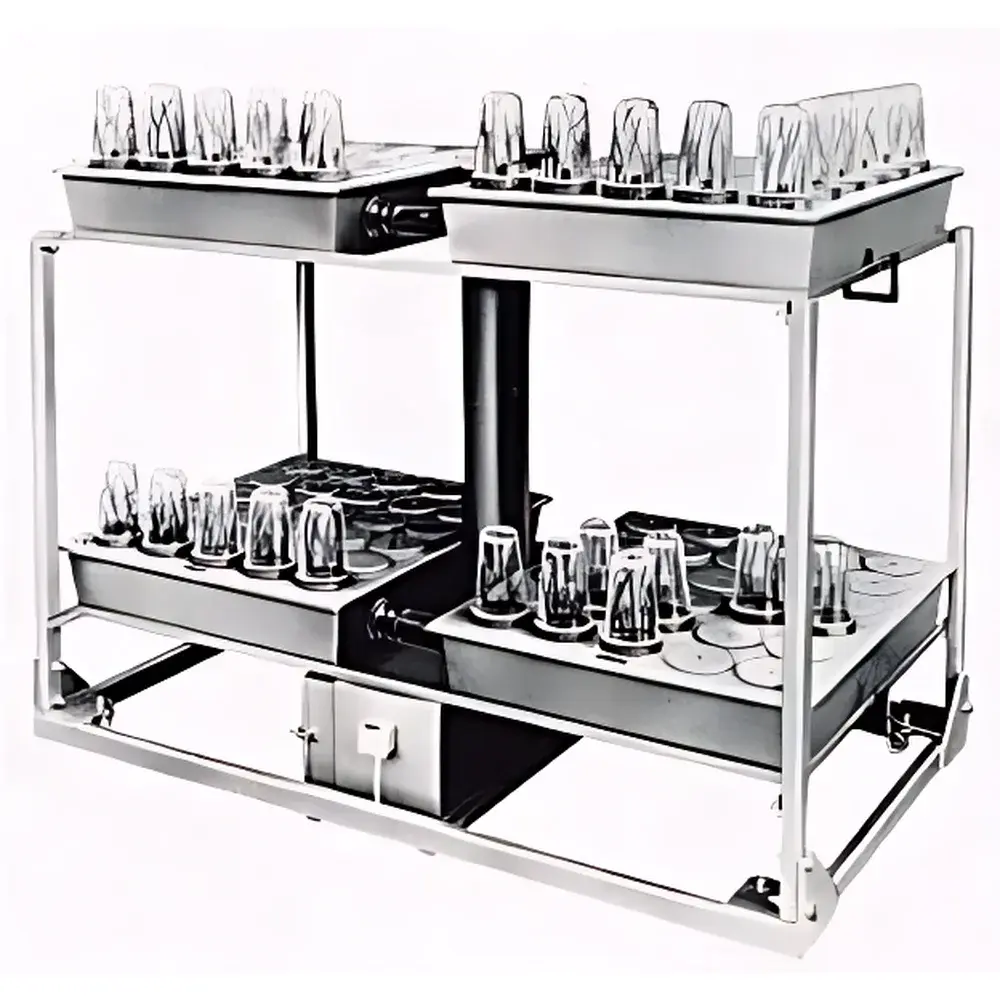
Burkard MEI0001 Plant Isolation and Propagation Unit
| Origin | UK |
|---|---|
| Manufacturer Type | Authorized Distributor |
| Origin Category | Imported |
| Model | MEI0001 |
| Pricing | Upon Request |
Overview
The Burkard MEI0001 Plant Isolation and Propagation Unit is a precision-engineered environmental containment system designed for controlled plant propagation, micropropagation, and pathogen-free seedling development in research laboratories, quarantine facilities, and commercial tissue culture operations. Built to stringent UK engineering standards, the unit operates on a positive-pressure, filtered-air circulation principle—ensuring sterility through continuous delivery of HEPA-filtered, humidified air to 120 independently accessible propagation modules. Its core architecture integrates passive humidity maintenance (via constant 25 mm water sump depth per trough), automated inlet valve control to prevent overflow, and dual-stage particulate filtration (pre-filter + HEPA H14) to meet ISO Class 5 (Class 100) cleanroom-equivalent air quality requirements within the working chamber. The unit is not a growth chamber in the photobiological sense—it provides sterile, stable hygrometric conditions without integrated lighting or temperature regulation; users typically integrate it with external climate-controlled rooms or walk-in growth chambers.
Key Features
- Modular design supporting up to 120 individual plant units with independent access via removable trays
- Constant-depth water reservoir system maintaining precise 25 mm water level in each propagation trough—ensuring consistent evaporative humidity without manual intervention
- Automated inlet water valve with float-controlled shut-off mechanism to prevent overfilling and maintain operational safety
- Dual-stage air filtration: coarse pre-filter (G4 class) followed by certified HEPA H14 filter (≥99.995% efficiency at 0.3 µm), validated per EN 1822-1
- Hinged, fully opening transparent polycarbonate lid enabling unobstructed handling, pruning, and transitional transfer of plant material to more advanced growth stages
- Robust welded stainless steel frame and corrosion-resistant aluminum enclosure, engineered for long-term laboratory use and routine decontamination with ethanol or hydrogen peroxide vapor
- Low-power operation (30 W nominal) with dedicated fan motor and sealed electronics compartment meeting IP54 ingress protection rating
Sample Compatibility & Compliance
The MEI0001 accommodates standard plant tissue culture vessels—including Magenta boxes, glass jars, and disposable culture tubes—as well as custom trays up to 120 mm × 80 mm footprint per slot. It is routinely deployed in facilities adhering to OECD Biocontainment Guidelines, EPPO PM 7/88 recommendations for pest-free production, and national phytosanitary protocols requiring physical isolation of high-risk germplasm. While the unit itself does not carry CE marking for medical devices, its construction complies with EN 61000-6-3 (EMC emission limits) and EN 61000-6-2 (immunity). For GLP-compliant studies, optional audit-trail-capable data loggers (temperature/humidity/pressure differential) may be integrated via RS-485 interface—supporting 21 CFR Part 11–aligned electronic records when paired with validated software platforms.
Software & Data Management
The MEI0001 is a standalone hardware platform with no embedded microprocessor or proprietary firmware. All environmental monitoring and logging must be performed externally using third-party calibrated sensors and compliant data acquisition systems (e.g., DeltaTrak, Testo, or Vaisala viewLinc). This architecture ensures full traceability, avoids vendor lock-in, and simplifies IQ/OQ validation in regulated environments. Users commonly configure continuous differential pressure monitoring (chamber vs. ambient) and relative humidity logging at 15-minute intervals, with raw CSV exports suitable for statistical process control (SPC) analysis and annual equipment performance reviews per ISO/IEC 17025 clause 6.4.2.
Applications
- Pathogen elimination protocols during meristem culture of virus-infected cultivars (e.g., potato, strawberry, banana)
- Quarantine propagation of imported germplasm under national phytosanitary import permits
- Production of foundation stock for certified seed programs requiring documented isolation history
- Pre-acclimatization staging of in vitro-derived plantlets prior to greenhouse transfer
- Controlled environment trials evaluating rooting efficiency across auxin/cytokinin gradients
- Supporting CRISPR-edited line stabilization where genetic segregation must occur under strict biological containment
FAQ
Does the MEI0001 include integrated temperature or lighting controls?
No. The unit maintains only humidity and sterility. Temperature and photoperiod must be managed by the host facility’s environmental control system.
Can the HEPA filter be replaced by the end user?
Yes—filter replacement is tool-free and requires only removal of the front access panel. Filter service life is typically 12–18 months under continuous operation in low-dust laboratory environments.
Is the unit compatible with autoclavable components?
All internal trays and water troughs are constructed from autoclavable polypropylene (121°C, 20 min); the main enclosure is not autoclavable but withstands repeated surface decontamination with 70% ethanol or 5% hydrogen peroxide solution.
What electrical supply is required?
Standard 100–240 V AC, 50/60 Hz, with IEC C13 inlet. No grounding adapter is needed—the chassis is double-insulated per EN 61010-1.
How is calibration verified during qualification?
Calibration is performed externally using NIST-traceable hygrometers and particle counters. A full PQ protocol includes airflow velocity mapping (ISO 14644-3), leak testing (smoke test per ISO 14644-3 Annex B), and humidity uniformity assessment across all 120 positions.



