
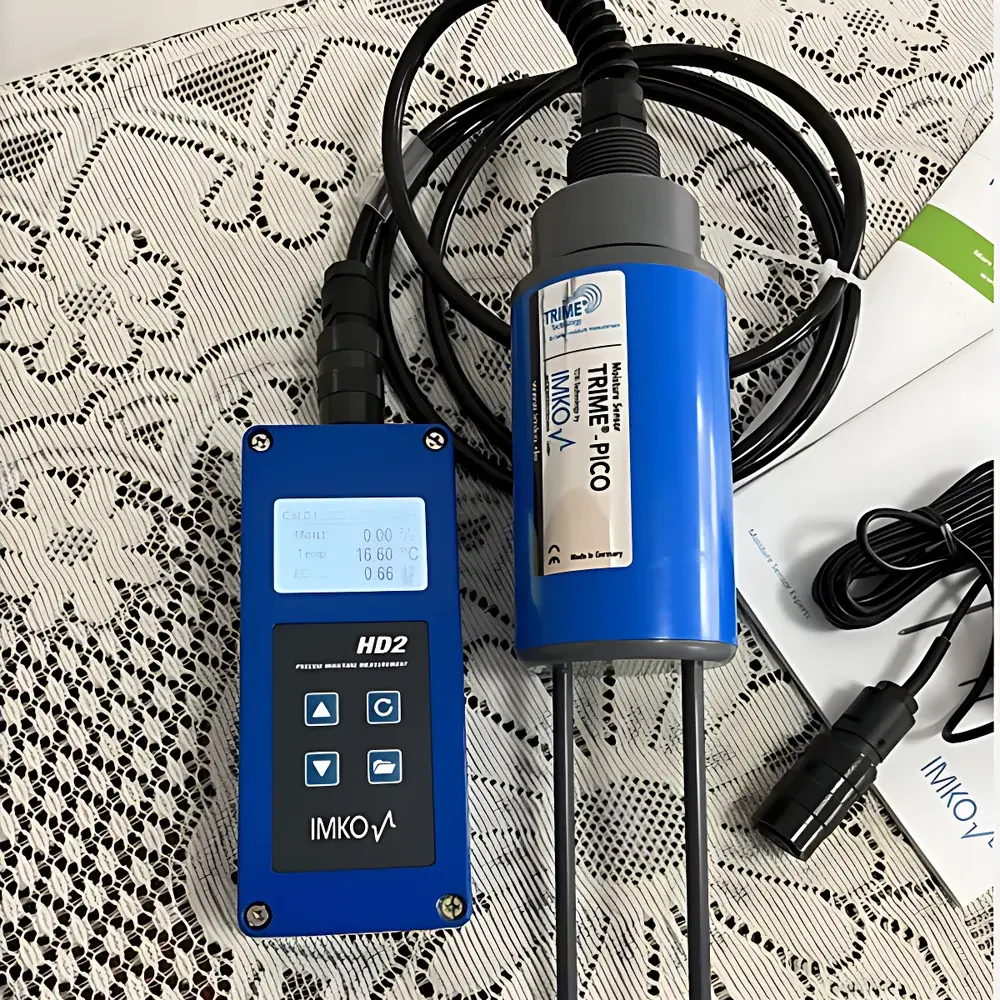
TRIME-PICO Portable Soil Moisture Profiler
| Origin | Germany |
|---|---|
| Manufacturer Type | Authorized Distributor |
| Origin Category | Imported |
| Model | TRIME-PICO |
| Price Range | USD 6,800–13,600 |
| Instrument Type | Soil Moisture and Temperature Profiler |
| Measurement Depth Options | 11 cm and 16 cm |
| Power Supply | 7–24 V DC |
| Current Consumption | 100 mA @ 12 V DC (during 2–3 s measurement pulse) |
| Volumetric Water Content Range | 0–100% |
| Accuracy (EC ≤ 6 dS/m) | ±1% (0–40%), ±2% (40–70%) |
| Accuracy (6–12 dS/m) | ±2% (0–40%), ±3% (40–70%) |
| Repeatability (EC ≤ 6 dS/m) | ±0.2% |
| Repeatability (6–12 dS/m) | ±0.3% |
| Temperature Range | −15 °C to +50 °C |
| Temperature Accuracy | ±0.2 °C |
| Measurement Volume (11 cm probe) | 0.25 L (110 mm × Ø50 mm) |
| Measurement Volume (16 cm probe) | 1.25 L (160 mm × Ø100 mm) |
| Probe Housing Material | IP68-rated sealed PVC |
| Probe Dimensions (11 cm) | 155 mm × Ø32 mm |
| (16 cm) | 155 mm × Ø63 mm |
| Electrode Length | 110 mm / 160 mm |
| Electrode Diameter | 3.5 mm / 6 mm |
| Output Interfaces | IMP-BUS, RS485, Analog (0–1 V or 4–20 mA) |
| Calibration | Factory-standard calibration for common mineral soils |
Overview
The TRIME-PICO Portable Soil Moisture Profiler is a field-deployable, time-domain transmission (TDT)-based instrument engineered for rapid, non-destructive quantification of volumetric water content (θv) and soil temperature in the topsoil layer. Unlike capacitance-based sensors susceptible to salinity-induced drift, the TRIME-PICO employs high-frequency TDT technology—measuring the propagation velocity of an electromagnetic pulse along parallel stainless-steel electrodes—to derive dielectric permittivity with minimal sensitivity to bulk electrical conductivity (EC) variations. This principle enables robust performance across diverse soil textures (sand to clay loam) and salinity ranges (up to 50 dS/m), supporting reliable data acquisition under variable field conditions. The dual-depth configuration (11 cm and 16 cm) allows users to select optimal profiling resolution for shallow-rooted crops, seedbed monitoring, or infiltration studies without requiring probe reinstallation.
Key Features
- Two interchangeable probe configurations: 11 cm depth (32 mm electrode spacing) optimized for precision surface-layer analysis (e.g., germination zones); 16 cm depth (64 mm spacing) for deeper root-zone characterization with larger representative sampling volume (1.25 L).
- Integrated dual-sensor architecture: Simultaneous acquisition of volumetric water content and temperature within a single measurement cycle (2–3 seconds), eliminating temporal misalignment between parameters.
- IP68-rated sealed PVC probe housing ensures long-term reliability in saturated, frozen, or abrasive soils—validated for continuous burial under field conditions.
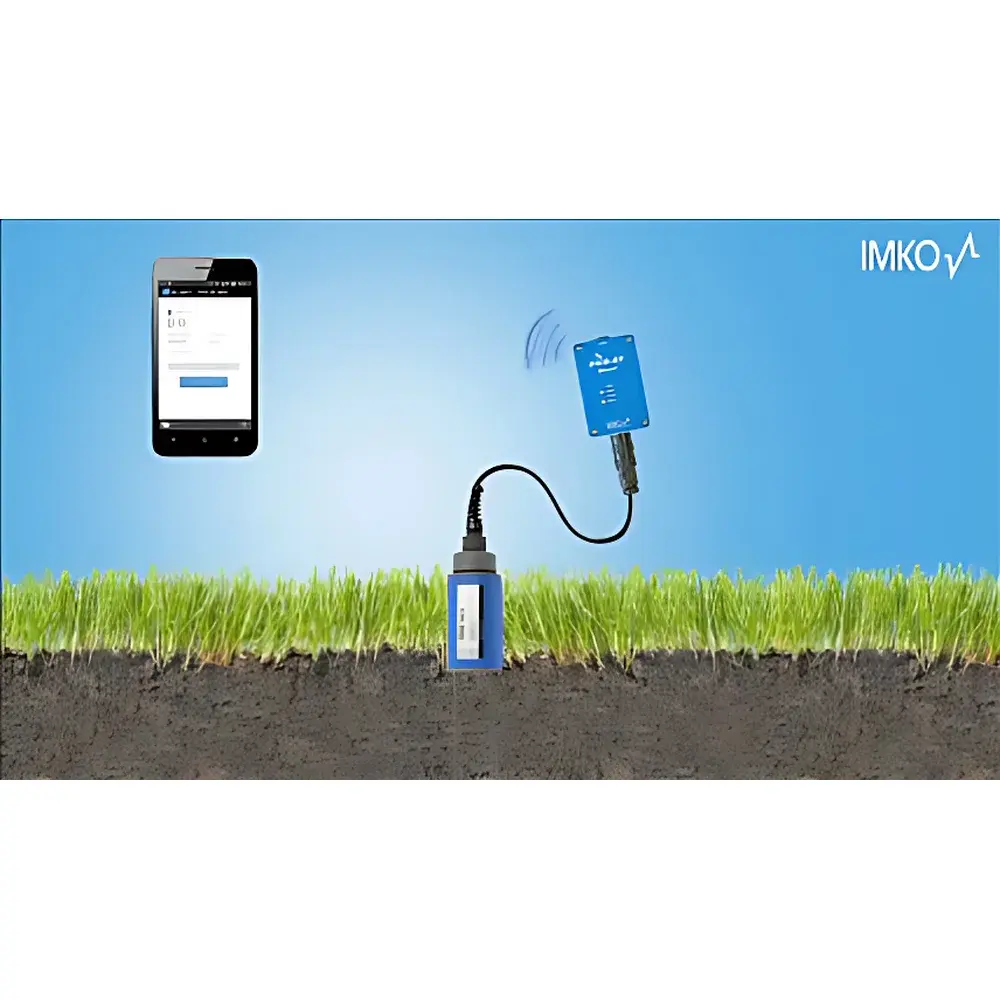
- Multi-interface output support: IMP-BUS (for direct integration with IMKO’s TRIME-eco or TRIME-T3 telemetry systems), RS485 (Modbus RTU protocol), and analog outputs (0–1 V or 4–20 mA) compatible with industrial SCADA, dataloggers (e.g., Campbell Scientific CR1000X), and PLCs.
- On-device calibration flexibility: Pre-loaded standard calibration for common mineral soils (e.g., ISO 11277-compliant textural classes); capacity to store up to 15 user-defined calibration curves—essential for organic-rich, volcanic, or saline-affected soils where factory calibrations diverge from site-specific behavior.
Sample Compatibility & Compliance
The TRIME-PICO is validated for use in mineral soils ranging from coarse sand (≥ 80% sand) to heavy clay (≤ 20% sand), including structured agricultural loams and compacted subsoils. Its TDT methodology inherently mitigates errors associated with high EC (up to 12 dS/m at full accuracy, extended range to 50 dS/m with defined uncertainty bands), making it suitable for irrigated fields, greenhouse substrates, and reclaimed mine soils. While not certified to ISO/IEC 17025 as a standalone metrological standard, the instrument adheres to principles outlined in ISO 14034 (environmental technology verification) and supports GLP-aligned data collection workflows when paired with audit-trail-capable software (e.g., TRIME-View). Probe materials comply with RoHS Directive 2011/65/EU and REACH Regulation (EC) No. 1907/2006.
Software & Data Management
Data acquisition and post-processing are supported via IMKO’s TRIME-View desktop application (Windows), which provides real-time visualization, batch calibration curve management, and export to CSV, Excel, or NetCDF formats. All measurements include embedded metadata: timestamp (RTC-synced), probe ID, EC band classification, and temperature-compensated θv. For networked deployments, the IMP-BUS interface enables seamless integration with IMKO’s cloud-ready TRIME-eco gateway, supporting automated upload to secure HTTPS endpoints with TLS 1.2 encryption. When configured with RS485 Modbus, the device satisfies FDA 21 CFR Part 11 requirements for electronic records when used with compliant datalogger firmware (e.g., Campbell Scientific LoggerNet v5.0+ with digital signature and audit trail modules).
Applications
- Irrigation scheduling for precision agriculture—enabling dynamic threshold-based triggering using spatially resolved θv profiles.
- Soil hydrological modeling input: high-temporal-resolution θv time series for parameterizing Richards’ equation solvers (e.g., HYDRUS-1D).
- Environmental impact assessment: monitoring moisture dynamics in landfill cover systems, phytoremediation plots, and erosion control blankets.
- Ecological research: correlating near-surface moisture gradients with microbial activity, seedling emergence rates, and mycorrhizal colonization patterns.
- Calibration validation for satellite-derived soil moisture products (e.g., Sentinel-1 SAR backscatter or SMAP L3 passive microwave retrievals) at field scale (0.25–1.25 L footprint matches typical pixel aggregation requirements).
FAQ
What measurement principle does the TRIME-PICO employ, and how does it differ from TDR or FDR sensors?
The TRIME-PICO uses Time-Domain Transmission (TDT), a variant of time-domain reflectometry that measures pulse propagation velocity between two parallel electrodes—not reflection timing. This eliminates cable-length sensitivity and reduces noise susceptibility compared to classical TDR, while offering superior EC resilience over frequency-domain (FDR) sensors.
Can the TRIME-PICO be left permanently installed in the field?
Yes—the IP68-rated probe housing and corrosion-resistant stainless-steel electrodes are rated for continuous burial. Long-term stability is maintained through temperature-compensated firmware algorithms and low-power pulsed operation (typical duty cycle < 0.1%).
Is factory recalibration required annually?
No. The sensor exhibits negligible long-term drift due to its solid-state electrode design and stable TDT electronics. Field verification against gravimetric samples every 12–24 months is recommended per ISO 11274 guidelines, but formal recalibration is only necessary after physical damage or exposure beyond specified environmental limits.
How is electrical conductivity (EC) handled in the moisture calculation?
The device measures apparent dielectric permittivity and concurrently estimates bulk EC from signal attenuation. It applies EC-stratified accuracy corrections in real time—automatically selecting the appropriate error model (±1%, ±2%, or ±3%) based on the measured EC band—without requiring manual EC input.
Does the TRIME-PICO support wireless telemetry out-of-the-box?
Not natively—but the IMP-BUS and RS485 interfaces enable plug-and-play integration with third-party LoRaWAN, NB-IoT, or cellular gateways (e.g., Senzit, Dragino, or IMKO’s TRIME-eco), enabling scalable mesh networks with remote firmware updates and diagnostic logging.
Related Products







