
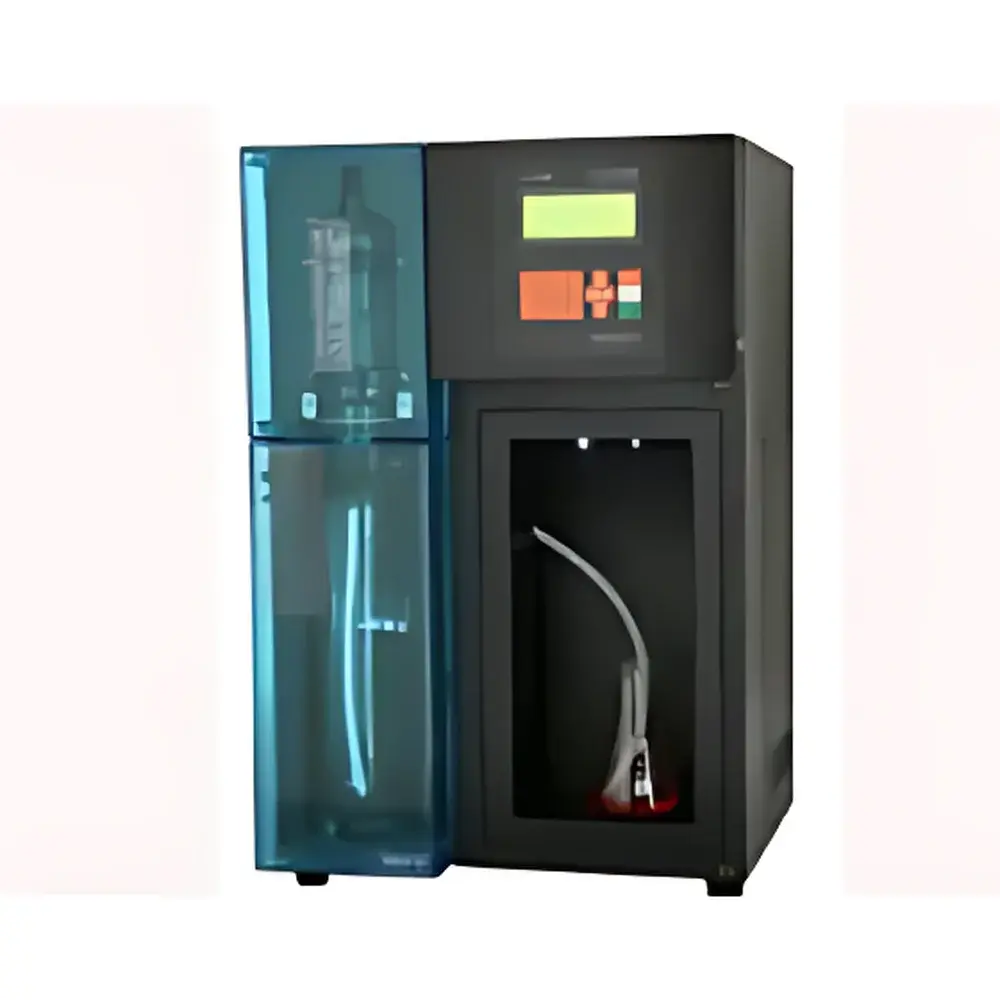
English Product Name
| Brand | Jihepu (Jinan Hopu) |
|---|---|
| Origin | Shandong, China |
| Manufacturer Type | Authorized Distributor |
| Country of Manufacture | China |
| Model | JK9830 |
| Price Range | USD 420–2,800 (FOB) |
| Instrument Type | Automated Kjeldahl Nitrogen Determinator |
| Nitrogen Determination Range | 0–200 mg N |
| Distillation Time | 3–5 min (at ≤18 °C cooling water temperature) |
| Repeatability (RSD) | ≤1% (at 30 mg N, 0.1 mol/L H⁺) |
| Sample Weight Capacity | ≤6 g (solid), ≤20 mL (liquid) |
| Recovery Rate | 99.5% ±0.5% |
| Power Consumption | 2000 W |
| Dimensions (L×W×H) | 420 × 430 × 700 mm |
| Net Weight | 32.6 kg |
Overview
The Jihepu JK9830 Automated Kjeldahl Nitrogen Determinator is a fully integrated, programmable system designed for precise and reproducible total nitrogen quantification via the classical Kjeldahl method. It implements standardized wet-chemical digestion followed by steam distillation, borate trapping, and titrimetric or colorimetric detection — in full compliance with ISO 8968-1, AOAC 981.10, ASTM D1142, and USP & EP monographs for nitrogen content determination. The instrument automates all critical steps: reagent dosing (sulfuric acid, sodium hydroxide, boric acid), steam generation and delivery, distillate collection, endpoint detection, and automatic termination — eliminating manual intervention and operator-induced variability. Its architecture follows a modular, service-oriented design philosophy, enabling rapid diagnostics, component-level replacement, and long-term operational stability in high-throughput laboratory environments such as QC labs in food, feed, agricultural, and environmental testing facilities.
Key Features
- Modular internal architecture — patented layout minimizes tubing length and junction points, reducing carryover risk and maintenance downtime.
- Color-coded fluid path identification system — uses standardized color rings and labels per reagent line (e.g., red for NaOH, blue for H₃BO₃), minimizing misconnection during servicing or reconfiguration.
- Corrosion-resistant self-priming diaphragm metering pumps — replace conventional air-pressure-driven systems; support remote reagent reservoir placement (e.g., under bench) and accommodate large-volume (≥5 L) acid/base containers.
- Chemically inert fluidic components — fluorosilicone and perfluoroelastomer (FFKM) tubing (imported from U.S. suppliers); CPC® quick-connect fittings (U.S.-made) ensure leak-free operation under sustained exposure to 98% H₂SO₄, 40% NaOH, and saturated boric acid solutions.
- Platinum-carbon fiber reinforced polymer steam chamber cover — injection-molded thermoplastic composite rated for continuous operation at ≤300 °C; eliminates thermal warping and steam leakage common with standard phenolic or PTFE-coated metal lids.
- Dedicated industrial PLC control module — custom firmware supports deterministic real-time sequencing, hardware-level interlocks, and audit-trail-capable event logging (compatible with GLP/GMP documentation requirements).
- 4.5-inch LCD touchscreen interface — Chinese-language menu navigation with intuitive icon-based workflow guidance; supports parameter recall, status monitoring, and error-code diagnostics without external software.
Sample Compatibility & Compliance
The JK9830 accommodates heterogeneous matrices including cereals, dairy powders, meat products, soil extracts, wastewater sludge digests, and pharmaceutical excipients. Solid samples up to 6 g and liquid samples up to 20 mL are processed within standardized 250–300 mL digestion tubes (compatible with standard Kjeldahl digestion blocks). All automated sequences adhere to AOAC Official Method 981.10 and ISO 5983-1 for protein nitrogen estimation. Safety interlocks include digestion tube presence detection, steam boiler low-water cutoff (120 °C), safety door engagement verification (5 mm tempered transparent polycarbonate), and ground-fault circuit interruption (GFCI) protection. These features collectively satisfy IEC 61010-1:2010 safety requirements for laboratory electrical equipment.
Software & Data Management
While the JK9830 operates autonomously via embedded PLC logic, it provides RS-232 and optional USB interfaces for integration into LIMS environments. Ten user-configurable analysis protocols can be stored locally — each defining precise volumes of digestant, alkali, and boric acid; distillation duration; cooling water activation timing; and titration endpoint criteria. Event logs record timestamped entries for reagent consumption, distillation start/stop, temperature excursions, and fault conditions. When paired with compliant titration modules (e.g., Metrohm 809 Titrando), raw data export supports FDA 21 CFR Part 11-compliant electronic signatures and audit trails via third-party validation packages.
Applications
This determinator is routinely deployed in accredited testing laboratories for: crude protein calculation in animal feed formulations (per AAFCO guidelines); quality control of milk powder and infant formula (in accordance with Codex Alimentarius STAN 206); nitrogen balance studies in agronomic soil analysis; regulatory compliance testing of fertilizer nitrogen content (ISO 5315); and impurity profiling in active pharmaceutical ingredients where residual ammonium salts must be quantified. Its 3–5 minute distillation cycle — validated at ≤18 °C coolant inlet temperature — enables throughput of ≥12 samples/hour without compromising recovery accuracy.
FAQ
What digestion equipment is compatible with the JK9830?
The system accepts standard 250–300 mL Kjeldahl digestion tubes (21 mm OD) and integrates seamlessly with programmable heating blocks (e.g., Jihepu HT-12) or microwave digestion systems meeting ISO 20539 specifications.
Does the JK9830 support direct titration output?
No — it delivers distillate to an external receiver vessel; quantitative analysis requires connection to an autotitrator or spectrophotometer. Optional analog voltage outputs (0–10 V) enable analog signal synchronization with titration endpoints.
Is method validation documentation available?
Yes — Jihepu provides IQ/OQ protocol templates, calibration checklists, and performance verification reports aligned with ISO/IEC 17025:2017 clause 7.7 requirements.
Can the instrument be operated in non-Chinese language environments?
The base firmware supports only Chinese UI; however, ASCII-based serial command sets (AT-style protocol) allow full remote control and data extraction in English-language LIMS integrations.
What maintenance intervals are recommended?
Daily: visual inspection of tubing integrity and reagent levels. Quarterly: calibration of metering pumps using gravimetric verification. Annually: steam generator descaling and CPC fitting torque verification per manufacturer’s service manual.





