
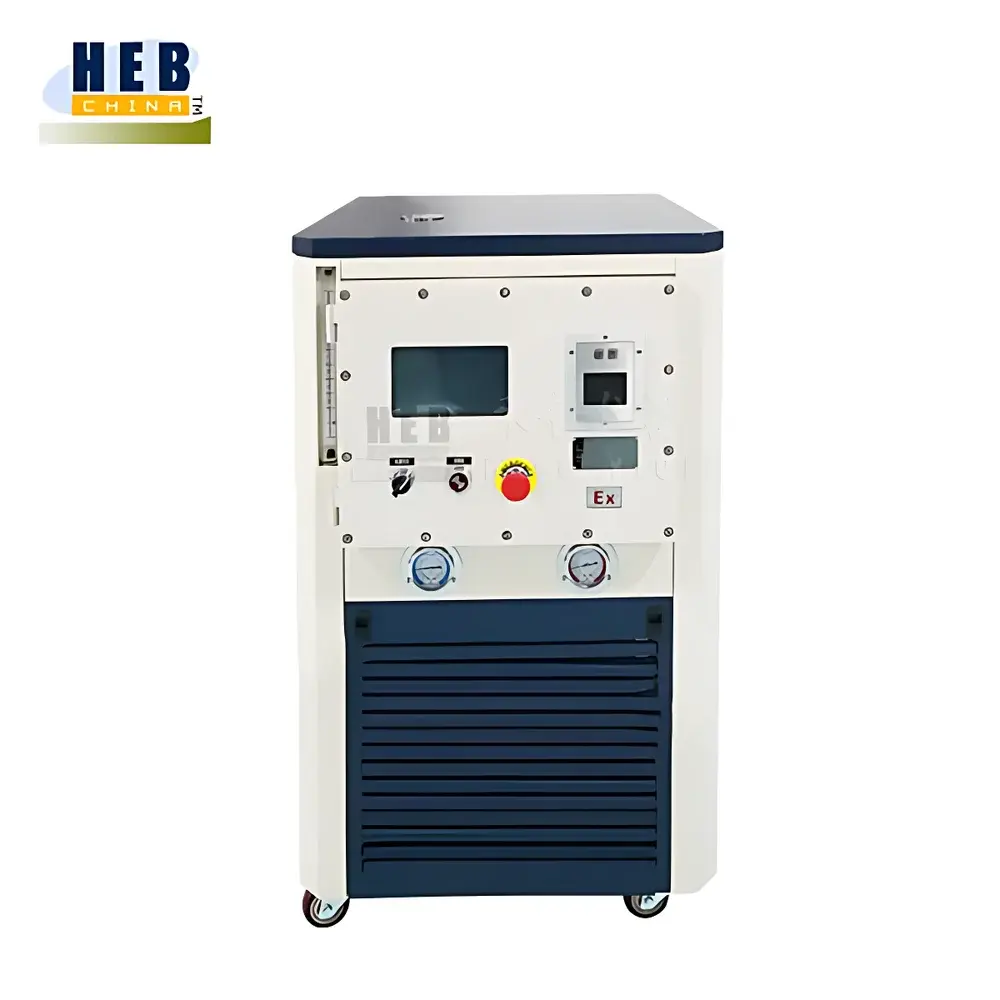
Jihepu ExGDSZ-50/-80+200 Explosion-Proof High-Low Temperature Circulating Chiller
| Brand | Jihepu |
|---|---|
| Origin | Shandong, China |
| Model | ExGDSZ-50/-80+200 |
| Temperature Range | −80 °C to +200 °C |
| Ambient Operating Conditions | 5–35 °C, ≤70% RH |
| Power Supply | 3-phase 380 V / 50 Hz |
| Total Power | 16.6 kW |
| Heating Power | 6 kW |
| Compressor Type | Dual hermetic compressors |
| Total Compressor Power | 10.29 kW |
| Refrigeration Capacity | 30.87 kW @ −40 °C |
| Circulation Pump | 250 W, 15 m head, 30 L/min flow rate, max pressure 0.4 MPa |
| Refrigerant | R22 |
| Temperature Control Accuracy | ±1 °C |
| Sensor | PT100 platinum resistance thermometer |
| Display | LCD with membrane keypad |
| Safety Protections | Delayed start, overcurrent, overheat, overtemperature, phase sequence, and phase loss protection |
| Enclosure Material | Cold-rolled steel with anti-corrosive powder coating |
| External Ports | 3/4″ BSP male threaded fittings (2×) |
| Included Accessories | Two 2 m stainless-steel braided hoses (3/4″) |
| Working Fluid | Premium-grade silicone oil (Class I) |
| Dimensions (W×D×H) | 950 × 650 × 1100 mm |
| Explosion Protection Rating | Ex d IIB T4 (IEC 60079-1), including flameproof control cabinet, explosion-proof circulation pump, fan, and tubing |
Overview
The Jihepu ExGDSZ-50/-80+200 Explosion-Proof High-Low Temperature Circulating Chiller is an engineered thermal management system designed for safe, precise, and stable temperature control of external reaction vessels—particularly in hazardous environments where flammable solvents, vapors, or reactive chemistries are present. It operates on a dual-mode thermodynamic principle: mechanical refrigeration via hermetically sealed compressors and direct resistive heating of the circulating heat-transfer fluid. The unit integrates a high-efficiency plate-type heat exchanger, thermostatic expansion valves, pressure-sensing safety cutoffs, and a robust dual-pump circulation architecture to maintain tight thermal stability across its full operational range of −80 °C to +200 °C. Its intrinsic safety design conforms to IEC 60079-1 (flameproof “d” enclosure standard), with all critical components—including the control cabinet, circulation pump, cooling fan, and fluid-handling tubing—certified to Ex d IIB T4 classification. This ensures reliable operation in Zone 1 and Zone 2 classified areas per ATEX and IECEx directives, making it suitable for pharmaceutical synthesis, fine chemical R&D, and pilot-scale process development under strict occupational health and safety regulations.
Key Features
- Dual hermetic compressors with total refrigeration capacity of 30.87 kW at −40 °C, enabling rapid cooldown from ambient to −80 °C while sustaining thermal load during exothermic reactions.
- Integrated 6 kW electric heating system with PID-controlled power modulation, ensuring uniform heating response without overshoot across the full +20 °C to +200 °C span.
- Explosion-proof architecture certified to Ex d IIB T4: flameproof enclosures prevent internal ignition propagation; all electrical interfaces, motor housings, and fluid pathways meet IEC 60079-0 and -1 requirements.
- High-flow, low-pulsation circulation pump (30 L/min, 15 m head, 0.4 MPa max pressure) optimized for compatibility with jacketed reactors, calorimeters, and distillation systems requiring consistent thermal transfer kinetics.
- LCD interface with real-time display of setpoint, actual bath temperature, compressor status, fault codes, and safety interlock states—supporting manual override and programmable ramp/soak profiles.
- Comprehensive multi-layer safety system: delayed startup sequencing, three-stage overtemperature cutoff (sensor, controller, mechanical thermostat), phase-loss detection, and pressure-actuated refrigerant circuit shutdown.
Sample Compatibility & Compliance
The ExGDSZ-50/-80+200 is compatible with standard laboratory and pilot-scale jacketed glass/metal reactors (e.g., 1–50 L volume), calorimetric cells, and analytical instrumentation requiring external thermal coupling. It is validated for use with Class I silicone oils meeting ISO 6743-12 specifications (e.g., Dow Corning PMX series), ensuring long-term thermal stability, low volatility, and non-reactivity with common organic and inorganic reagents. The unit complies with GB/T 20438 (Chinese functional safety standard), IEC 61000-6-2/6-4 (EMC immunity/emission), and meets essential requirements of the EU Machinery Directive 2006/42/EC. While not inherently 21 CFR Part 11 compliant, its audit-ready event log (timestamped temperature deviations, safety trips, and operator actions) supports GLP/GMP-aligned documentation workflows when integrated into validated lab infrastructure.
Software & Data Management
The chiller operates autonomously via embedded firmware with no external software dependency. All operational data—including temperature setpoints, actual values, compressor runtime, alarm history, and safety event timestamps—are stored in non-volatile memory for up to 30 days. Optional RS485 Modbus RTU communication enables integration with SCADA or LIMS platforms for centralized monitoring and batch record generation. Event logs include ISO 8601 timestamps and are exportable via USB-C port (optional adapter). No cloud connectivity or remote access functionality is implemented—consistent with industrial cybersecurity best practices for isolated process-critical equipment.
Applications
- Controlled-temperature synthesis of organometallic compounds and Grignard reagents under inert atmosphere, where solvent flash points necessitate Zone 1-rated thermal units.
- Reaction calorimetry (RC1, EasyMax) requiring simultaneous sub-zero initiation and high-temperature termination phases within a single experiment.
- Stability testing of APIs and intermediates per ICH Q1A(R3), using tightly controlled thermal ramps across −40 °C to +80 °C ranges.
- Cryogenic condensation trapping in vacuum distillation setups handling low-boiling solvents (e.g., diethyl ether, THF).
- Temperature calibration of PT100 probes, infrared sensors, and pressure transducers in metrology labs operating under hazardous area constraints.
FAQ
What explosion-proof certification does this unit hold?
It carries IECEx and CNEx certification to Ex d IIB T4, covering the main chassis, control cabinet, circulation pump, cooling fan, and all fluid-conveying components—validating suitability for gas groups IIB (e.g., acetone, ethanol) and surface temperature class T4 (≤135 °C).
Can it operate continuously at −80 °C with external heat load?
Yes, when paired with appropriate silicone oil (e.g., DC-704) and properly insulated reactor jackets, the unit maintains −80 °C steady-state with up to 1.2 kW thermal load, verified per ISO 5171 Annex B test protocol.
Is R22 refrigerant still serviceable under current environmental regulations?
R22 is restricted under Montreal Protocol Phase-Out schedules; however, this model remains supportable via licensed refrigerant recovery/recharge services and is compatible with approved drop-in replacements (e.g., R407F) subject to compressor oil compatibility verification.
What maintenance intervals are recommended?
Compressor oil analysis every 2,000 operating hours; refrigerant circuit leak check annually; silicone oil replacement every 12 months or after 500 h cumulative operation above +150 °C.
Does it support external temperature feedback control?
No—temperature regulation is based solely on internal PT100 sensor measurement. For reactor-jacket feedback control, a separate external PID controller with analog output is required to modulate the chiller’s heating/cooling enable signals.



