Gebra LactoStar Dairy Analyzer
| Brand | Funke |
|---|---|
| Origin | Germany |
| Manufacturer Type | Authorized Distributor |
| Origin Category | Imported |
| Model | LactoStar |
| Detection Parameters | Fat, Protein, Lactose, SNF (Solids-Not-Fat), Total Solids, Freezing Point |
| Automation Level | Fully Automatic |
| Throughput | 450 samples/hour |
| Fat Range | 0–15% |
| Repeatability | <1% RSD |
| Accuracy | <1% deviation vs. reference methods |
Overview
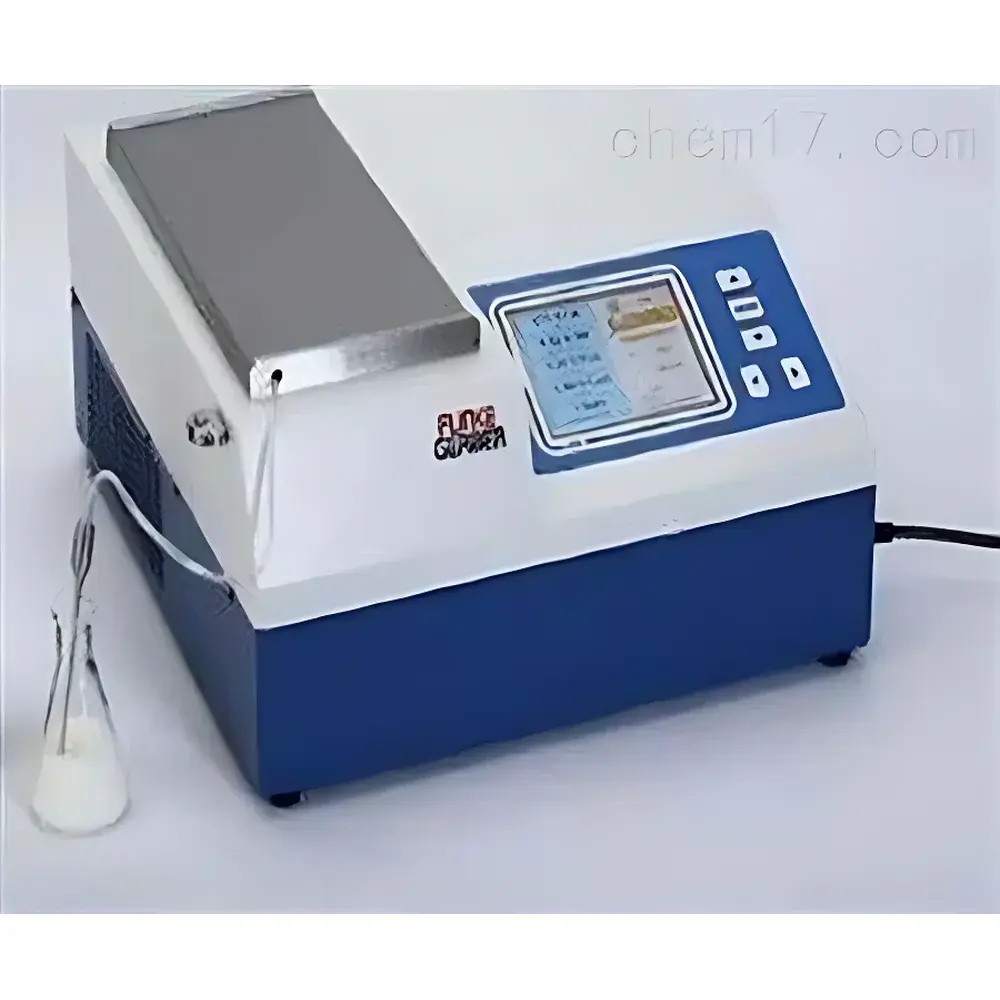
The Gebra LactoStar Dairy Analyzer is a fully automated, benchtop optical-thermal dual-mode instrument engineered for rapid, standardized compositional analysis of raw and pasteurized bovine milk. It operates on a hybrid measurement principle combining turbidimetric (blue-light absorption/scattering) and thermometric (differential thermal response) detection to simultaneously quantify fat, protein, lactose, solids-not-fat (SNF), total solids, and freezing point depression — all within a single 30-second cycle. Unlike near-infrared (NIR) or mid-IR spectrometers, the LactoStar does not rely on spectral calibration databases; instead, it uses physical property-based algorithms validated against ISO 9622 (IDF 141) and AOAC 991.18 reference methodologies. Its architecture is purpose-built for high-throughput dairy quality control laboratories operating under ISO/IEC 17025-accredited conditions, where traceability, operator independence, and minimal sample preparation are critical.
Key Features
- Fully integrated auto-wash, auto-zero, and auto-sampling system with programmable cleaning intervals (triggered after >5 min idle time)
- Dual-sensor measurement module: blue-light turbidimeter (for fat + protein co-determination via light scattering) and precision thermistor array (for fat-specific melting behavior and SNF-related thermal capacitance)
- Large backlit LCD display showing four-line menu navigation with intuitive five-key interface (up/down/left/right/enter)
- Onboard storage for up to 20 independent calibration profiles — enabling seamless switching between milk types (e.g., whole, skim, buffalo, goat) without recalibration
- No homogenization required: accepts non-homogenized raw milk; rejects samples exhibiting coagulation, acidity (pH 2 mm thickness
- Robust fluidic path constructed from food-grade PTFE and stainless steel 316; compliant with EC 1935/2004 for materials in contact with dairy products
Sample Compatibility & Compliance
The LactoStar is validated exclusively for unadulterated, non-fermented bovine milk meeting IDF Standard 102 criteria: no added water, preservatives, acids, colorants, starches, or salts. Fermented products (yogurt, kefir), whey, cheese curds, recombined milk, or UHT-treated milk with Maillard-induced browning are outside its validated scope. Measurement integrity requires sample temperature stabilization at 20 ± 1°C prior to loading. The analyzer conforms to IEC 61000-6-3 (EMC), IEC 61010-1 (safety), and supports GLP-compliant operation through audit-trail-enabled firmware (user action logging, calibration timestamping, result export with digital signature). While not FDA 21 CFR Part 11 certified out-of-the-box, its data export protocols (CSV, USB-stored .txt) are compatible with validated LIMS integration for regulated environments.
Software & Data Management
The embedded firmware provides menu-driven operation without external PC dependency. All measurements are timestamped and stored internally with full metadata: sample ID, calibration profile used, operator code, ambient temperature, and QC flag status. Data export occurs via USB mass-storage mode to standard FAT32-formatted drives; no proprietary drivers or cloud dependencies. Exported files include raw sensor outputs (turbidity voltage, thermal decay slope), calculated parameters, and pass/fail flags against user-defined specification limits (e.g., fat ≥3.2%, freezing point ≤−0.515°C). Optional RS-232 output enables direct connection to factory SCADA systems for real-time SPC charting.
Applications
- Dairy intake receiving: rapid verification of supplier milk compliance against contractual fat/protein/SNF specifications
- Process control in pasteurization lines: trending of compositional drift pre- and post-heating to detect thermal denaturation anomalies
- Quality assurance for standardized blends: confirming homogeneity before homogenization and packaging
- Freezing point screening for adulteration detection (water addition), aligned with Codex Alimentarius STAN 206-1999 Annex B
- Research labs conducting breed-specific milk composition studies (e.g., Jersey vs. Holstein profiling)
- Regulatory testing labs performing routine checks per national dairy standards (e.g., China GB 19301, EU Regulation (EC) No 1234/2007)
FAQ
Can the LactoStar analyze goat or sheep milk?
Yes — provided dedicated calibration profiles are developed using reference methods (e.g., Gerber for fat, Kjeldahl for protein) and stored in the instrument’s 20-profile memory.
Does it require daily recalibration?
No — zero-point stability is maintained for ≥8 hours under stable lab conditions (20–25°C, <60% RH); calibration verification is recommended per shift using certified reference milk.
What maintenance is required?
Daily wipe-down of sample inlet and sensor windows; monthly cleaning of fluidic lines with 1% NaOH solution; annual thermistor verification against NIST-traceable temperature standards.
Is it suitable for frozen milk analysis?
No — samples must be fully thawed and equilibrated to 20°C; ice crystals or phase separation invalidate turbidimetric readings.
How does it handle high-fat mastitis milk?
It reports elevated fat but flags abnormal turbidity-to-temperature ratio deviations, triggering an “Invalid Sample” alert — consistent with ISO 6579-1:2017 guidance on abnormal milk screening.
Related Products