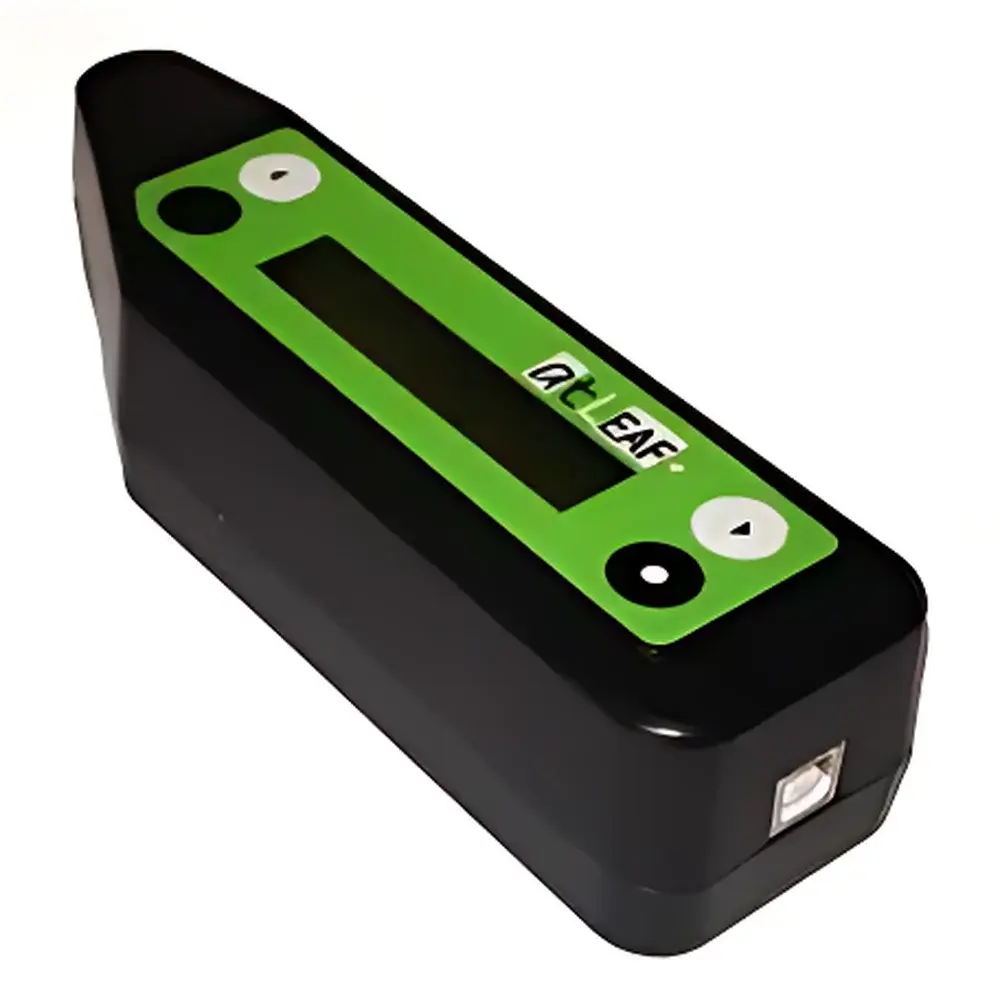
atLEAF+ Handheld Chlorophyll Meter by FT-Technologies
| Origin | USA |
|---|---|
| Manufacturer Type | Authorized Distributor |
| Origin Category | Imported Instrument |
| Model | atLEAF+ |
| Pricing | Available Upon Request |
Overview
The atLEAF+ Handheld Chlorophyll Meter is a field-deployable, non-destructive optical instrument engineered for rapid, in-situ quantification of relative chlorophyll content in intact green leaves. It operates on the principle of dual-wavelength absorbance differential photometry—measuring optical density at 660 nm (peak absorption band of chlorophyll a and b) and 940 nm (reference wavelength minimally affected by chlorophyll but sensitive to leaf structural properties such as thickness and water content). The resulting SPAD-like index (0–99.9 SPAD units) provides a standardized, unitless metric proportional to chlorophyll concentration per unit leaf area. Unlike destructive biochemical assays (e.g., acetone extraction followed by spectrophotometric analysis), the atLEAF+ enables repeated measurements on the same leaf over time, supporting longitudinal physiological monitoring under controlled or natural environmental conditions. Its compact form factor, single-button operation, and battery-powered design make it suitable for greenhouse screening, field phenotyping, agronomic trials, and ecological surveys where portability and operational simplicity are critical.
Key Features
- Non-invasive measurement: No leaf excision, clipping, or chemical treatment required—preserves sample integrity for follow-up assessments.
- Dual-wavelength optical sensor: Precisely calibrated 660 nm LED (chlorophyll-sensitive) and 940 nm LED (structural compensation) with matched spectral bandwidths and temperature-stabilized output.
- Integrated leaf clip with spring-loaded aperture: Ensures consistent light path geometry and pressure-independent contact across variable leaf thicknesses (minimum 3 mm leaf width accommodated).
- Onboard data management: Stores up to 5,000 measurement records with timestamp, location tag (via optional GPS pairing), and user-defined plant identifiers.
- Expandable plant library: Supports up to 500 custom species or cultivar names, enabling stratified data grouping and cross-experiment comparison.
- USB 2.0 interface: Enables bidirectional data transfer—download measurement logs to PC-based analysis software or upload preconfigured plant name sets to the device.
- Rugged industrial enclosure: IP54-rated housing with rubberized grip and scratch-resistant optical window for reliable operation in humid, dusty, or variable-temperature field environments.
Sample Compatibility & Compliance
The atLEAF+ is validated for use with dicotyledonous and monocotyledonous angiosperms exhibiting typical mesophyll anatomy and moderate epidermal wax deposition. It is not recommended for highly succulent, needle-like, or heavily pubescent leaves without empirical calibration against extractive reference methods. While the device does not perform absolute chlorophyll quantification (µg/cm²), its SPAD-equivalent output demonstrates high reproducibility (CV < 3.5% within-leaf, n = 10 readings) when used according to standardized protocols (e.g., mid-lamina sampling, avoidance of major veins, consistent orientation). The instrument complies with IEC 61000-4 electromagnetic compatibility standards and meets RoHS Directive 2011/65/EU requirements. Data export functionality supports traceability workflows aligned with GLP principles; however, native audit trail or electronic signature features are not implemented—users integrating atLEAF+ into regulated environments (e.g., USDA-ARS trials, ISO 17025-accredited labs) should document procedural controls and instrument calibration history separately.
Software & Data Management
The atLEAF+ includes proprietary Windows-compatible desktop software (v3.2+) for raw data visualization, statistical summary (mean, SD, min/max per plant ID), and CSV export compatible with R, Python (pandas), or MATLAB. The software permits batch renaming of measurement sessions, filtering by date range or species tag, and generation of scatter plots correlating SPAD values with external variables (e.g., nitrogen application rate, soil moisture sensor output). All stored data retain embedded metadata including firmware version, battery level at time of acquisition, and ambient light intensity (measured via integrated ambient sensor). No cloud synchronization or remote firmware update capability is provided—firmware upgrades require local USB connection and manual installation.
Applications
- Nitrogen status assessment in cereal crops (wheat, rice, maize) and horticultural species (tomato, lettuce, strawberry) to guide precision fertilization.
- Phenotypic screening of chlorophyll-deficient mutants or stress-tolerant lines in breeding programs.
- Monitoring photosynthetic capacity decline during drought, heat, or heavy metal exposure studies.
- Validating canopy-level remote sensing indices (e.g., NDVI, PRI) using ground-truth SPAD measurements.
- Educational use in undergraduate plant physiology laboratories for introducing non-destructive biophysical assessment techniques.
FAQ
Does the atLEAF+ provide absolute chlorophyll concentration values (e.g., µg/cm²)?
No. It reports a dimensionless SPAD-equivalent index (0–99.9) derived from normalized absorbance ratios. Conversion to absolute units requires species-specific calibration curves generated via solvent extraction.
Can measurements be taken under direct sunlight?
Yes—the optical system incorporates ambient light compensation. However, for highest repeatability, measurements should be performed under consistent lighting conditions or using the built-in shutter to exclude ambient interference.
Is the device compatible with Mac or Linux operating systems?
The official desktop software is Windows-only. Raw .csv exports can be opened on any platform; third-party Python scripts for automated parsing are available in public repositories.
What is the recommended calibration frequency?
FT-Technologies recommends annual verification against a certified reference standard (available through authorized service centers). Field users should perform daily zero-checks using the included dark cap before initiating measurement sessions.
How does leaf thickness affect atLEAF+ readings?
The 940 nm channel partially corrects for thickness variation, but extreme deviations (>0.5 mm) may introduce bias. For comparative studies, select leaves of similar developmental stage and anatomical maturity.