
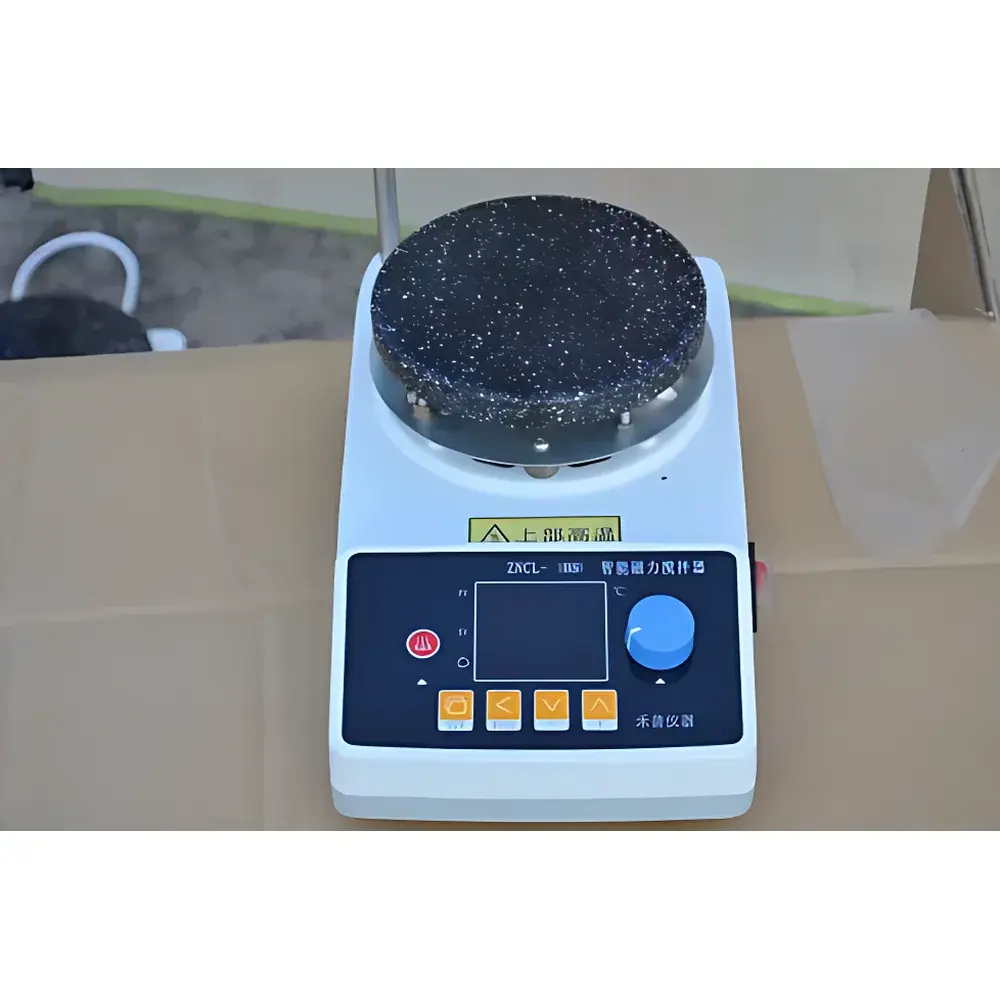
ZNCL-B Intelligent Magnetic Hotplate Stirrer
| Brand | Jihepu (Jinan Hepu) |
|---|---|
| Origin | Shandong, China |
| Model | ZNCL-B |
| Instrument Type | Magnetic Hotplate Stirrer |
| Max. Stirring Volume | 5 L |
| Speed Range | 50–1800 rpm, infinitely variable |
| Temperature Range | Ambient to 350 °C |
| Heating Surface Options | 140×140 mm, 180×180 mm, 230×230 mm, or 280×280 mm |
| Heating Power | 260–750 W |
| Motor Power | 40 W DC (14–24 V), PAPST brushless motor |
| Control Method | Fuzzy PID digital temperature control with dual thermocouple input (internal + external) |
| Temp. Accuracy | ±1 °C |
| Panel Material | Vacuum-coated TU2 electrolytic copper or black crystal ceramic |
| Enclosure | Flame-retardant reinforced PBT injection-molded housing |
| Safety Features | Thermocouple break protection (displays “HHHH”), grounded chassis, over-temperature cutoff, IP20-rated enclosure |
| Operating Humidity | 35–85% RH (non-condensing) |
| Power Supply | 220 V AC, 50 Hz, 15 A fuse (Φ5×20) |
Overview
The ZNCL-B Intelligent Magnetic Hotplate Stirrer is an integrated laboratory workstation engineered for precise, reproducible heating and stirring of liquid samples in glass vessels ranging from 50 mL to 10 L. Unlike conventional magnetic stirrers with passive hotplates, the ZNCL-B implements active thermal regulation via a high-stability Cr20Ni80 resistance heating element embedded beneath a vacuum-deposited TU2 copper or black crystal ceramic surface—delivering uniform heat distribution and rapid thermal response up to 350 °C surface temperature. Its core operational principle combines electromagnetic coupling (for torque transfer to PTFE- or glass-coated stir bars) with closed-loop fuzzy PID temperature control, enabling dynamic power modulation based on real-time deviation between setpoint and measured temperature. Designed for continuous-duty operation in QC labs, synthetic chemistry workflows, and material dissolution studies, the unit meets fundamental safety and performance expectations aligned with IEC 61010-1 (Laboratory Equipment Safety) and supports GLP-compliant documentation when paired with external data loggers.
Key Features
- Four standard heating surface sizes (140×140 mm, 180×180 mm, 230×230 mm, 280×280 mm) accommodate volumetric scalability from micro-scale reactions to large-volume digestions.
- Fuzzy PID temperature controller with auto-tuning function minimizes overshoot and stabilizes setpoints within ±1 °C—critical for temperature-sensitive crystallization or enzymatic assays.
- Dual thermocouple inputs support both internal (built-in) and external (immersion-type) sensing; external probe mode enables direct solution-phase temperature feedback, eliminating surface-to-liquid thermal lag.
- Brushless DC motor (PAPST series) delivers consistent torque across the full 50–1800 rpm range, with low acoustic emission (<45 dB(A)) and zero electrical arcing—ensuring compatibility with explosion-proof environments and long-term reliability under load.
- Ergonomic 30° inclined control panel with dual LED displays provides simultaneous readout of set temperature and actual temperature, plus speed setting and real-time rpm indication.
- Integrated safety architecture includes thermocouple failure detection (“HHHH” alarm), automatic cut-off upon open-circuit sensor condition, and chassis grounding compliance per IEC 61010-1 Class I requirements.
- Flame-retardant PBT polymer housing resists chemical splashes, thermal degradation up to 120 °C ambient, and mechanical impact—suitable for shared lab benches and mobile cart deployment.
Sample Compatibility & Compliance
The ZNCL-B accommodates standard and non-standard reaction vessels—including borosilicate glass beakers (50–10,000 mL), round-bottom flasks, and custom geometries—provided magnetic coupling remains effective (i.e., vessel wall thickness ≤ 15 mm and non-ferromagnetic). It is compatible with all commercially available magnetic stir bars (e.g., oval, cross-shaped, or flea-type), with optimal performance observed using PTFE-encapsulated bars rated for >300 °C. The device complies with CE marking requirements (EMC Directive 2014/30/EU and LVD Directive 2014/35/EU) and conforms to RoHS 2011/65/EU restrictions on hazardous substances. While not certified to ISO/IEC 17025 or FDA 21 CFR Part 11 out-of-the-box, its deterministic control logic, audit-ready parameter logging (via optional RS485 interface), and traceable calibration paths enable integration into GMP/GLP workflows when validated per internal SOPs.
Software & Data Management
The ZNCL-B operates as a standalone instrument with no embedded operating system or cloud connectivity. All control and monitoring functions are executed locally via hardware-based microcontroller firmware. Temperature and speed parameters are retained in non-volatile memory during power cycling. For regulatory traceability, users may connect an external RS485-to-USB converter (sold separately) to stream real-time temperature and rpm values to third-party SCADA or LIMS platforms. Data export is ASCII-formatted and time-stamped at user-defined intervals (1–60 s), supporting CSV ingestion into Excel, MATLAB, or LabArchives. No proprietary software installation is required; configuration remains accessible via front-panel buttons only—reducing cybersecurity exposure and simplifying qualification in regulated environments.
Applications
- Controlled-temperature solubility testing per USP and Ph. Eur. 2.9.30 for pharmaceutical excipients and APIs.
- Preparation of homogeneous catalyst suspensions in heterogeneous catalysis research.
- Standardized digestion protocols for environmental water and soil analysis (EPA Method 3015A, ISO 11466).
- Viscosity benchmarking of polymer solutions where shear history must be minimized prior to rheological measurement.
- Accelerated stability studies requiring isothermal hold conditions at elevated temperatures (e.g., 40–80 °C) over extended durations.
- Chemical synthesis workflows involving reflux, distillation setup pre-heating, or solvent removal under inert atmosphere.
FAQ
Does the ZNCL-B support external temperature probes?
Yes—removing the rubber seal on the rear panel activates the external thermocouple port. A type-K stainless steel probe must be inserted and secured with the locking nut; the system automatically switches to external feedback mode.
What is the maximum recommended viscosity for stable stirring?
For reliable vortex formation and homogeneity, kinematic viscosity should remain below 10,000 mm²/s (cSt) at operating temperature. Higher viscosities require larger stir bars and reduced rpm to prevent decoupling.
Can the unit operate without stirring while heating?
No—continuous motor rotation (even at minimum speed) is mandatory during heating to prevent thermal back-transfer to the motor assembly. This is a thermal protection requirement specified in the user manual.
Is calibration certificate included?
A factory calibration report (covering temperature accuracy at 100 °C, 200 °C, and 300 °C, and speed verification at 500 rpm and 1500 rpm) is provided with each unit. NIST-traceable recalibration services are available through authorized distributors.
What maintenance is required?
No scheduled maintenance is needed. Users should periodically inspect the heating surface for residue buildup and clean with ethanol-dampened lint-free cloth. Avoid abrasive cleaners or metal scrapers to preserve ceramic or copper coating integrity.



