
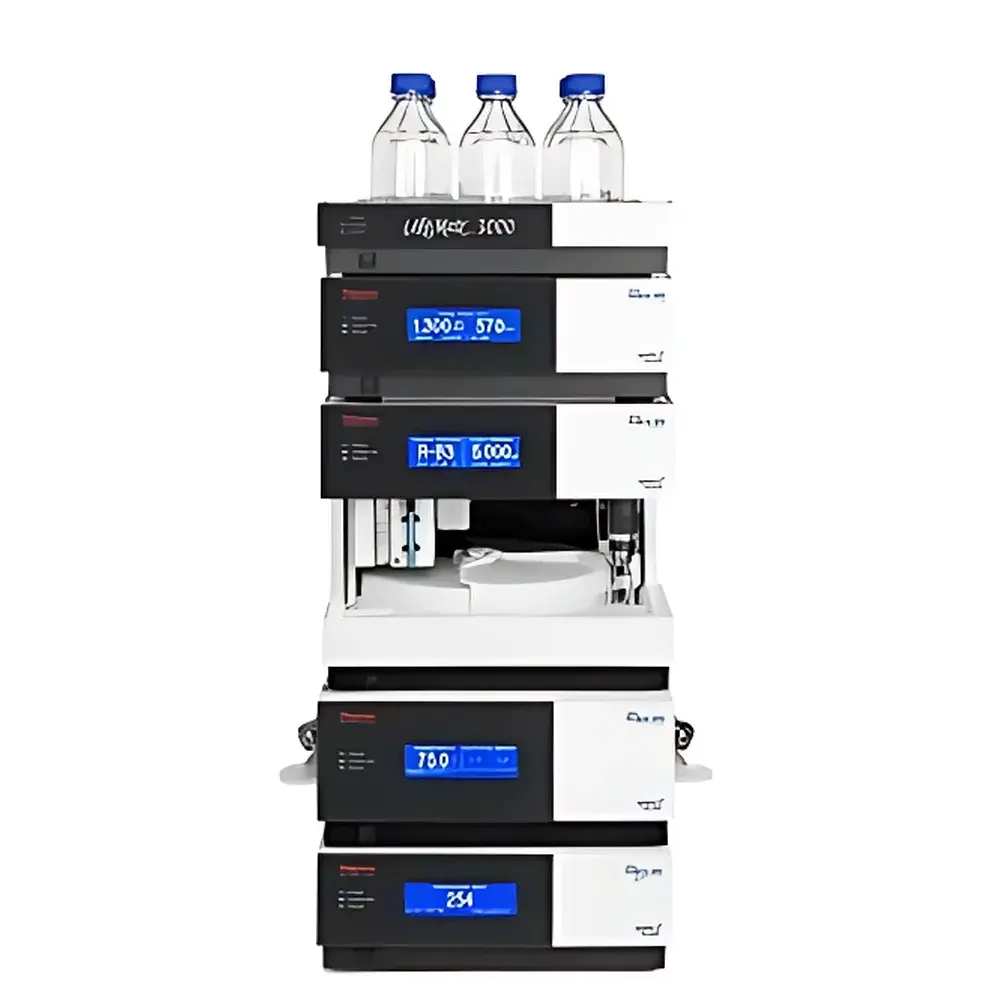
Thermo Fisher UltiMate 3000 Standard Dual LC System
| Brand | Thermo Fisher |
|---|---|
| Origin | USA |
| Manufacturer Type | Original Equipment Manufacturer (OEM) |
| Origin Category | Imported |
| Model | UltiMate 3000 Standard Dual LC System |
| Price Range | USD $25,000–$65,000 |
| Instrument Type | Multidimensional Liquid Chromatograph |
Overview
The Thermo Fisher UltiMate 3000 Standard Dual LC System is a high-performance, modular multidimensional liquid chromatography platform engineered for laboratories requiring enhanced throughput, method flexibility, and analytical robustness in both conventional HPLC and entry-level UHPLC applications. Built upon a dual-pump architecture with two independent quaternary gradient modules, the system enables true parallel or serial LC operation—including comprehensive 2D-LC (LC×LC), heart-cutting, comprehensive coupling, and back-flush gradient delivery—without hardware reconfiguration. Its design adheres to fundamental chromatographic principles: precise solvent mixing via SmartFlow™ technology ensures reproducible flow rates (<0.1% RSD), while SpinFlow™-enabled gradient delay volume optimization minimizes dwell volume variability across methods. The system operates at pressures up to 62 MPa (9000 psi), supporting columns packed with sub-2 µm particles and enabling high-resolution separations with improved peak capacity and retention time stability.
Key Features
- Two fully independent, integrated quaternary gradient pumps (DGP-3600SD), each delivering flow rates from 0.001 to 10 mL/min with pressure capability up to 62 MPa
- Ultra-low carryover autosampler (WPS-3000TSL/WPS-3000SL) featuring permanently fluidic-integrated sample loop and needle, achieving <0.005% cross-contamination
- Spacious, shared column compartment (TCC-3000RS) with programmable temperature control from 5 °C to 80 °C and support for up to two field-upgradable column switching valves
- Dionex™ Viper™ fingertight fitting system ensuring near-zero dead volume connections and consistent peak shape across extended run times
- Integrated six-channel membrane degasser (SRD-3600) minimizing baseline noise and bubble-induced retention shifts
- Back-gradient capability for post-column mobile phase homogenization—critical for compatibility with ESI-MS, charged aerosol detection (CAD), and other nebulizer-based detectors
Sample Compatibility & Compliance
The UltiMate 3000 Standard Dual LC System accommodates a broad range of sample matrices, including small-molecule pharmaceuticals, peptides, natural product extracts, food contaminants, cosmetic actives, and environmental analytes. Its modular detector interface supports simultaneous or sequential coupling with UV-Vis (DAD, MWD, VWD), fluorescence (FLD), refractive index (RID), charged aerosol (CAD), and mass spectrometry (via ESI, APCI, or nano-ESI sources). The system meets key regulatory requirements for GxP environments: Chromeleon CDS v7.x provides full 21 CFR Part 11 compliance—including electronic signatures, audit trails, user role management, and secure data archiving. It supports IQ/OQ/PQ documentation packages aligned with ISO/IEC 17025, ASTM E2500, and USP Analytical Instrument Qualification guidelines.
Software & Data Management
Chromeleon Chromatography Data System (CDS) versions 6.x and 7.x serve as the unified software backbone. Version 7.2 introduces eWorkflow-enabled method templating, automated system startup/shutdown sequences, and context-aware method switching—reducing operator dependency and inter-run downtime. The software integrates real-time system suitability monitoring, predictive maintenance alerts, and embedded validation tools for instrument performance verification. Remote access capabilities allow secure off-site instrument control and data review via TLS-encrypted web interfaces. All raw data, method files, audit logs, and report outputs are stored in a relational database structure compliant with ALCOA+ principles (Attributable, Legible, Contemporaneous, Original, Accurate, Complete, Consistent, Enduring, Available).
Applications
This dual LC architecture is routinely deployed in regulated QA/QC labs for release testing of active pharmaceutical ingredients (APIs) and finished dosage forms per ICH Q2(R2) guidelines. In food and beverage analysis, it enables simultaneous quantification of preservatives, sweeteners, mycotoxins, and pesticide residues using 2D-LC cleanup workflows. For personal care products, the system supports stability-indicating assays for surfactants and UV filters under forced degradation conditions. Its back-gradient functionality ensures stable ionization efficiency during LC-ESI-MS analysis of polar metabolites, while parallel pump operation accelerates method development cycles for orthogonal column screening per USP .
FAQ
Can this system perform both 1D and 2D-LC without hardware modification?
Yes—the dual-pump architecture and integrated valve manifold enable seamless transition between 1D isocratic/gradient, heart-cut 2D-LC, and comprehensive LC×LC configurations using software-defined method parameters.
Is Chromeleon CDS v7.2 compatible with networked lab environments?
Yes—it supports multi-user client-server deployment, centralized license management, and integration with LIMS via ASTM E1578-compliant interfaces.
What column dimensions and particle sizes are supported at maximum pressure?
The system supports columns from 2.1 mm to 4.6 mm ID and lengths up to 250 mm, with particle sizes ranging from 1.7 µm (UHPLC) to 10 µm (preparative HPLC), all within its 62 MPa operational limit.
How is system suitability assessed automatically?
Chromeleon’s built-in System Suitability Test (SST) module evaluates resolution, tailing factor, plate count, and %RSD of retention time and peak area against user-defined acceptance criteria—and flags deviations before sample injection.
Does the autosampler support cooled sample storage?
The WPS-3000TSL variant includes Peltier-cooled tray (4–40 °C), while the WPS-3000SL operates at ambient temperature; both maintain precision across 0.1–100 µL injection volumes.





