
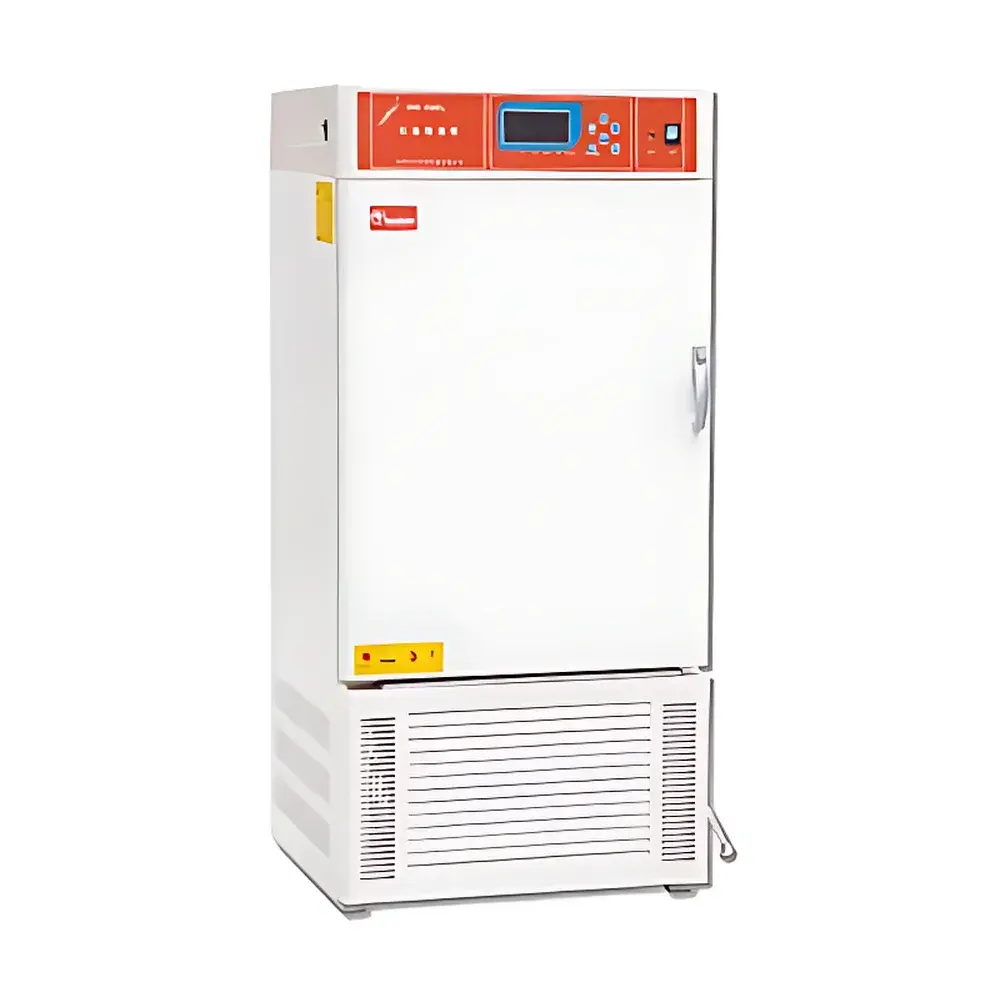
KRC-250CA Low-Temperature Biochemical Incubator
| Brand | Jihepu (Jinan Hepu) |
|---|---|
| Origin | Shandong, China |
| Model | KRC-250CA |
| Temperature Range | −20 °C to +65 °C |
| Temperature Uniformity | ±0.1 °C |
| Temperature Resolution | 0.1 °C |
| Power Supply | AC 220 V, 50 Hz |
| Input Power | 1300 W |
| Internal Chamber Dimensions (W×D×H) | 550 × 520 × 900 mm |
| External Dimensions (W×D×H) | 680 × 720 × 1540 mm |
| Standard Shelving | 3 adjustable stainless steel shelves |
| Test Port | Ø25 mm on left side |
| Refrigerant | R134a (environmentally compliant) |
| Operating Ambient | 5 °C to 35 °C, ≤80% RH (non-condensing) |
Overview
The KRC-250CA Low-Temperature Biochemical Incubator is an engineered environmental control system designed for precise, stable thermal management in life science laboratories. It operates on a dual-mode refrigeration-heating principle—employing a high-efficiency hermetic compressor with R134a refrigerant for sub-zero cooling and PTC resistive heating for accurate ambient-to-65 °C operation. Unlike standard CO₂ or humidified incubators, the KRC-250CA prioritizes temperature integrity over humidity control, making it ideal for applications where thermal stability—not moisture retention—is the primary performance criterion. Its operational range of −20 °C to +65 °C supports both cryogenic storage of reagents and elevated-temperature microbial cultivation, including psychrophilic, mesophilic, and thermotolerant strain propagation. The unit complies with general laboratory equipment safety standards per IEC 61010-1 and meets electromagnetic compatibility requirements under EN 61326-1 for Class B environments.
Key Features
- Stainless steel interior chamber (304 grade) with seamless, quarter-radius corners for contamination-resistant cleaning and ISO 14644-compliant maintenance;
- Microprocessor-based PID temperature controller with real-time digital display, 0.1 °C resolution, and ±0.1 °C uniformity (measured at five points in empty chamber per ASTM E145-21 Annex A3);
- Imported hermetic compressor and high-efficiency condenser assembly ensuring low-noise operation (<55 dB[A]) and extended service life under continuous duty cycles;
- Three independently adjustable stainless steel shelves with load capacity up to 15 kg per shelf; shelf spacing optimized for standard Petri dishes, flasks, and multiwell plates;
- Dedicated Ø25 mm access port on left chamber wall—sealed with removable silicone grommet—enabling integration with external sensors, data loggers, or probe-based monitoring systems;
- R134a refrigerant system certified under EU F-Gas Regulation (EU) No. 517/2014 and compatible with global ozone-depletion potential (ODP = 0) and global warming potential (GWP = 1430) compliance frameworks.
Sample Compatibility & Compliance
The KRC-250CA accommodates common life science consumables including 100–250 mL Erlenmeyer flasks, 90 mm Petri dishes, 15–50 mL conical tubes, and stacked cell culture racks (up to 150 mm height). Its chamber geometry supports passive airflow distribution without forced convection—minimizing shear stress on sensitive biological samples during long-term incubation. While not validated for GMP-grade sterile processing, the unit meets GLP-aligned documentation requirements for temperature mapping (IQ/OQ protocols available upon request) and is routinely deployed in QC labs conducting USP <1058> analytical instrument qualification for stability testing, reagent storage validation, and microbiological growth curve analysis per ISO 8573-1 and CLSI M22-A3 guidelines.
Software & Data Management
The embedded controller supports manual operation only—no onboard data logging or network interface is included as standard. However, the analog output signal (0–5 V DC proportional to chamber temperature) and optional RS-485 Modbus RTU interface (available via accessory kit) enable third-party integration with SCADA systems, LIMS platforms, or centralized lab monitoring software such as LabArchives, Thermo Fisher Connect, or Siemens Desigo CC. Optional accessories—including a programmable timer (1–9999 minutes), independent overtemperature cut-off module (IEC 60730-1 Class B), BOD-compatible power outlets, and thermal printer module—support audit-ready workflows aligned with FDA 21 CFR Part 11 Annex 11 expectations when paired with validated electronic record systems.
Applications
- Low-temperature storage and conditioning of enzyme solutions, antibodies, and lyophilized standards (−20 °C to 4 °C);
- Controlled-temperature microbial cultivation for pharmaceutical raw material bioburden testing (ISO 11737-1);
- Accelerated stability studies of diagnostic reagents per ICH Q1A(R2) guidelines;
- Pre-incubation of PCR master mixes and restriction enzyme digests requiring precise thermal equilibration;
- Environmental simulation for material compatibility testing of medical device packaging per ASTM F1980;
- Support of ASTM D5511 anaerobic biodegradation assays requiring sustained sub-ambient temperatures.
FAQ
Does the KRC-250CA support humidity control?
No. This model is a temperature-only incubator. Humidity regulation is not integrated and no humidification system is available as an option.
Is the unit suitable for use in cleanroom environments?
Yes—its stainless steel construction, smooth internal surfaces, and absence of particulate-shedding components meet baseline requirements for ISO Class 8 (Class 100,000) cleanrooms when installed with appropriate HVAC support.
Can the temperature sensor be calibrated externally?
Yes. The PT100 sensor is accessible via terminal block inside the rear control panel; calibration may be performed using NIST-traceable dry-block calibrators per ISO/IEC 17025 procedures.
What safety certifications does the unit carry?
It conforms to IEC 61010-1 (Safety Requirements for Electrical Equipment for Measurement, Control, and Laboratory Use) and EMC compliance per EN 61326-1. CE marking is applied for non-harmonized scope under manufacturer’s responsibility.
Is remote monitoring possible without optional hardware?
No. Native Ethernet/Wi-Fi connectivity is not provided. Remote supervision requires installation of the RS-485 communication module and configuration of external gateway infrastructure.



