
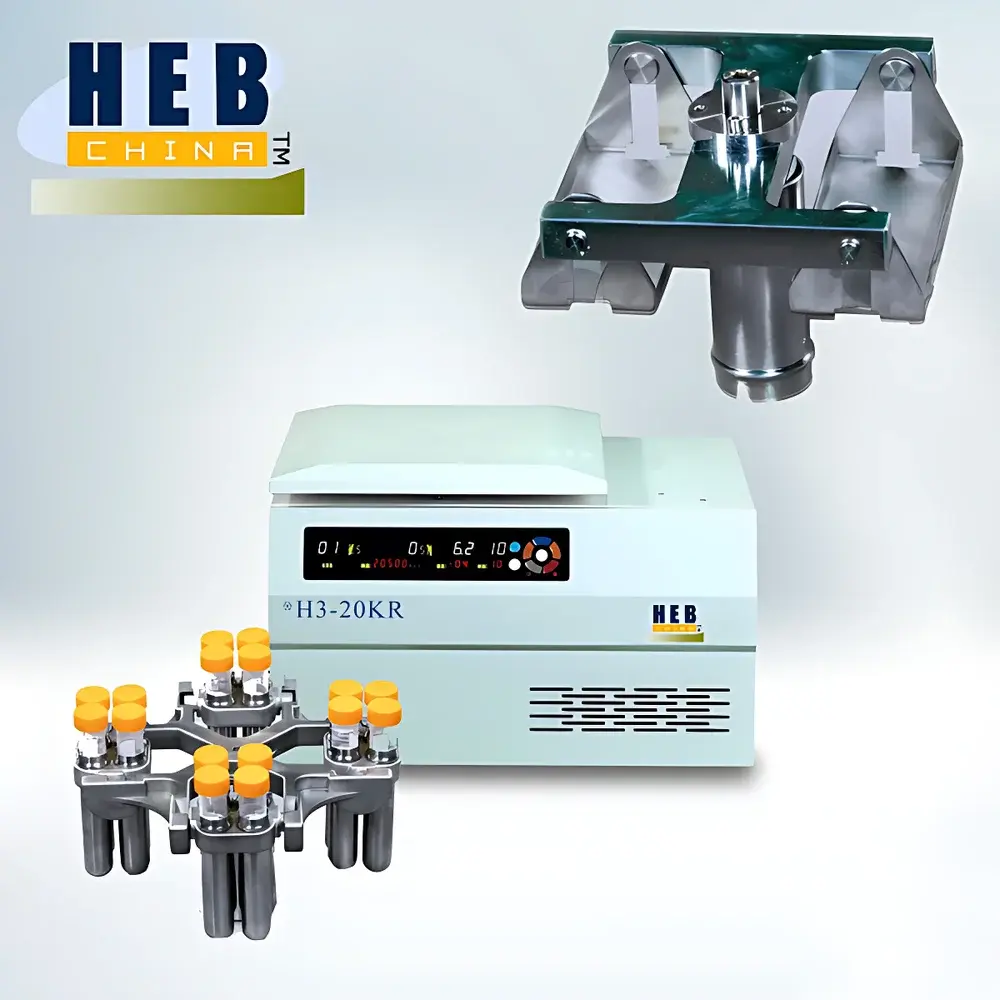
English Product Name
| Brand | Hepu |
|---|---|
| Origin | Shandong, China |
| Model | H3-20KR |
| Maximum Speed | 20,500 rpm |
| Maximum RCF | 31,785 × g |
| Maximum Capacity | 4 × 100 mL |
| Temperature Range | −20 °C to +40 °C |
| Temperature Accuracy | ±1.0 °C |
| Timer Range | 1–99 min |
| Speed Accuracy | ±20 rpm |
| Noise Level | ≤65 dB(A) |
| Power Supply | AC 220 V ±10%, 50 Hz, 15 A |
| Total Power | 1000 W |
| Dimensions (W×D×H) | 480 × 560 × 360 mm |
| Net Weight | 70 kg |
| Refrigeration System | High-efficiency eco-friendly compressor-based cooling |
| Rotor Auto-ID | Yes |
| Acceleration/Deceleration | 10 selectable profiles, including free-coast (≥540 s) |
Overview
The Hepu H3-20KR is a precision-engineered benchtop high-speed refrigerated centrifuge designed for demanding separation tasks in molecular biology, biochemistry, and clinical laboratories. It operates on the principle of sedimentation under controlled rotational force, enabling efficient isolation of subcellular components—including nucleic acids, proteins, organelles, and virus particles—based on differences in density, size, and shape. With a maximum speed of 20,500 rpm and an RCF of 31,785 × g, the H3-20KR meets the performance requirements for high-resolution pelleting and density-gradient centrifugation of biomacromolecules. Its integrated refrigeration system maintains sample temperature stability down to −4 °C even at peak rotational speeds, minimizing thermal denaturation and preserving labile analytes during extended runs. The unit complies with IEC 61010-1 safety standards for laboratory electrical equipment and incorporates structural safeguards aligned with ISO 13485-informed design practices for medical device–adjacent instrumentation.
Key Features
- High-torque brushless frequency-controlled motor ensures rapid acceleration and deceleration, reducing cycle time without compromising rotor integrity.
- Intelligent rotor auto-recognition system prevents overspeed operation by cross-referencing installed rotor specifications with preset safety limits.
- Multi-step programmable control: users define speed (rpm), RCF (×g), time (1–99 min), and independent acceleration/deceleration profiles (10 levels, including ultra-slow free-coast mode ≥540 s).
- Real-time RCF calculation and one-touch rpm/RCF conversion simplify protocol translation across instruments and literature references.
- Dual safety architecture: mechanical door interlock, imbalance detection, overspeed cutoff, and rotor lifetime tracking via cumulative run-hour logging.
- Energy-efficient refrigeration system uses environmentally compliant refrigerant and achieves stable chamber temperatures from −20 °C to +40 °C with ±1.0 °C accuracy; one-button precool function enables rapid thermal equilibration prior to sample loading.
- Large-format LED display with intuitive icon-based navigation supports multilingual interface configuration (English default) and real-time parameter feedback during operation.
Sample Compatibility & Compliance
The H3-20KR accommodates a comprehensive range of standard and specialized rotors—including fixed-angle, swing-out, and PCR plate carriers—supporting volumes from 0.2 mL microtubes to 100 mL conical tubes. Its validated rotor library includes 14 configurations optimized for common applications: high-yield plasmid prep (6 × 50 mL round-bottom), small-volume proteomics (36 × 1.5 mL), high-throughput cell harvesting (12 × 15 mL conical), and low-volume nucleic acid purification (8 × 50 mL conical). All rotors are certified to ISO 21501-4 for dimensional tolerance and dynamic balance. The centrifuge’s operational envelope satisfies key regulatory expectations for GLP-compliant workflows, including audit-trail-capable parameter logging (when paired with optional data export modules) and adherence to temperature stability criteria referenced in USP Analytical Instrument Qualification.
Software & Data Management
While the H3-20KR operates as a standalone instrument with embedded firmware, it supports USB-based parameter export for traceability and method archiving. Protocols—including speed, time, temperature setpoint, and ramp profiles—can be saved to internal memory (up to 99 user-defined programs) and recalled with password-protected access control. Optional RS-232 or Ethernet connectivity modules enable integration into centralized lab information management systems (LIMS) for automated run logging and electronic record retention. Firmware updates maintain compatibility with evolving cybersecurity best practices per NIST SP 800-53 Rev. 5 controls for laboratory hardware.
Applications
- Isolation of mitochondria, lysosomes, and nuclei from mammalian tissue homogenates using differential centrifugation protocols.
- Purification of genomic DNA and RNA from blood, cultured cells, or plant tissues via silica-membrane or phenol-chloroform extraction workflows.
- Concentration and buffer exchange of monoclonal antibodies and recombinant proteins using high-RCF pelleting followed by resuspension.
- Preparation of exosome-enriched fractions from cell culture supernatants or biofluids through sequential ultracentrifugation steps.
- Routine clinical specimen processing—including serum/plasma separation, PBMC isolation, and urine sediment analysis—in compliance with CLSI GP44-A4 guidelines.
FAQ
What is the minimum operating temperature achievable at maximum speed?
The refrigeration system maintains ≤−4 °C in the chamber during continuous operation at 20,500 rpm, verified per ISO 13732-1 thermal mapping procedures.
Does the H3-20KR support validation documentation for GMP environments?
Yes—factory-installed IQ/OQ documentation packages are available upon request, including calibration certificates traceable to NIST standards and test reports for temperature uniformity, speed accuracy, and acoustic emissions.
Can third-party rotors be used safely with this centrifuge?
No. Only Hepu-certified rotors with embedded RFID tags are recognized by the auto-ID system; unauthorized rotors will not initialize, preventing unsafe operation.
Is remote monitoring or network control supported out of the box?
Basic local operation only. Remote capability requires optional communication modules and external middleware integration; no built-in web server or cloud connectivity is provided.
How often does the refrigeration system require maintenance?
Compressor oil and refrigerant integrity should be verified annually by authorized service personnel; condenser coil cleaning is recommended every six months in high-dust environments.



