
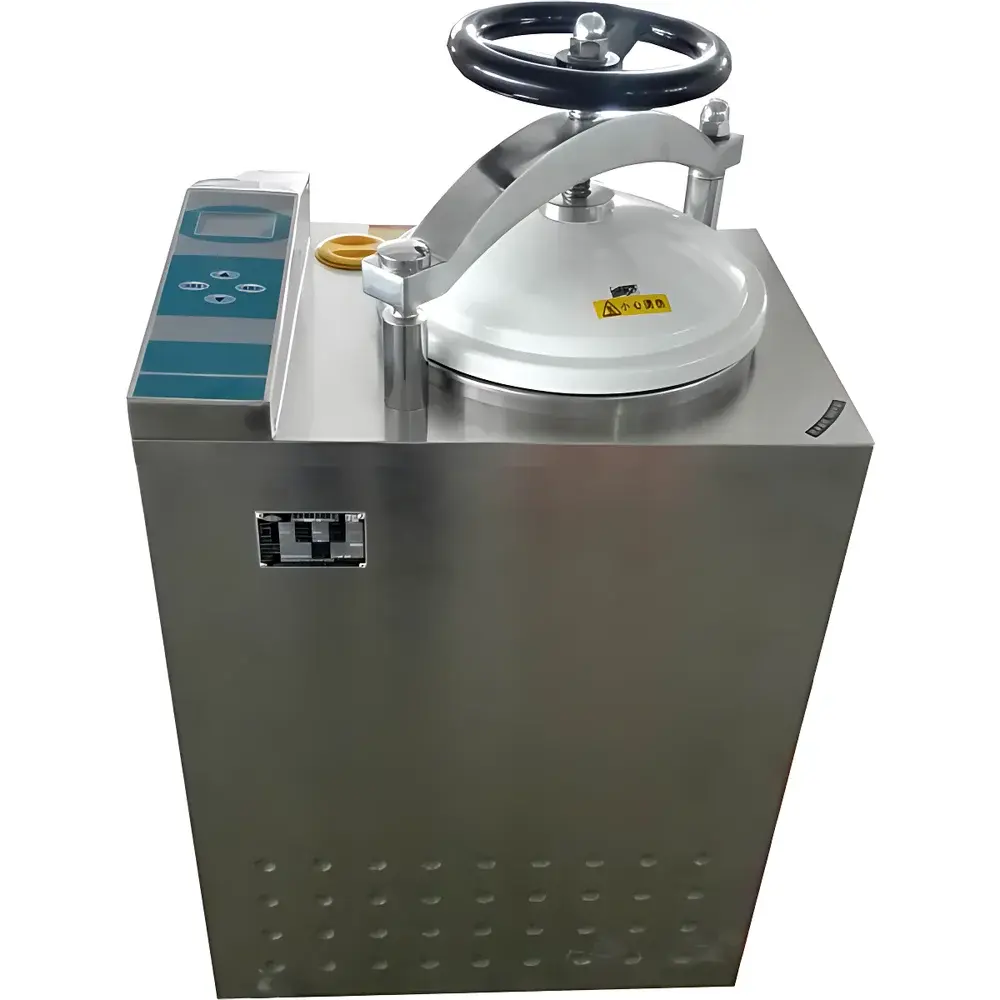
HePu LS-35HG Vertical Steam Autoclave
| Brand | HePu |
|---|---|
| Origin | Shandong, China |
| Model | LS-35HG |
| Sterilization Chamber Volume | 35 L (φ318 × 450 mm) |
| Maximum Operating Temperature | 134 °C |
| Maximum Working Pressure | 0.22 MPa |
| Temperature Uniformity | ≤ ±1 °C |
| Timer Range | 0–99 min or 0–99 h 59 min |
| Temperature Setting Range | 0–134 °C (sterilization), 50–101 °C (boiling) |
| Power / Voltage | 2500 W / AC 220 V, 50 Hz |
| External Dimensions | 600 × 410 × 1030 mm |
| Net Weight | 77 kg |
| Safety Interlock Activation Pressure | ≥0.027 MPa |
| Heating Method | External Steam Generator (Electric) |
| Chamber Material | Premium Stainless Steel (AISI 304 equivalent) |
| Compliance | Designed per GB 8599–2008 (Chinese National Standard for Large Steam Sterilizers), compatible with ISO 17665-1:2019 principles for moist heat sterilization validation |
Overview
The HePu LS-35HG Vertical Steam Autoclave is a fully automated, microprocessor-controlled gravity-displacement and steam-saturated sterilization system engineered for reliable terminal sterilization of heat-stable medical devices, laboratory glassware, culture media, textiles, and porous loads in clinical, academic, and industrial laboratories. It operates on the fundamental principle of saturated steam under controlled pressure and temperature to achieve microbial inactivation—primarily through protein denaturation and nucleic acid hydrolysis—validated against internationally recognized moist-heat sterilization kinetics (F0 methodology). With a certified effective chamber volume of 35 L and a maximum operating temperature of 134 °C at 0.22 MPa (≈2.2 bar gauge), the LS-35HG meets the thermal requirements for both routine sterilization (e.g., 121 °C/15 min) and accelerated high-temperature cycles (e.g., 134 °C/3–5 min), supporting cycle reproducibility and process consistency across daily operation.
Key Features
- Integrated external electric steam generator ensures rapid steam generation, high thermal efficiency, and stable pressure–temperature coupling without dependency on external boiler infrastructure.
- Full-cycle automation with programmable sequences: pre-vacuum air removal, sterilization hold, post-cycle exhaust, drying, and cooling—each phase monitored and logged in real time via the built-in LED interface.
- Steam recirculation design minimizes external steam discharge, maintaining ambient lab humidity and reducing condensate accumulation—ideal for confined or non-vented laboratory spaces.
- Multi-level safety architecture: mechanical pressure interlock (door remains locked until chamber pressure drops below 0.027 MPa), dual overpressure relief (spring-loaded safety valve + secondary pressure release port), dry-run protection with automatic power cutoff upon water level depletion, and residual-current circuit breaker (RCCB) integrated into the main power supply.
- Chamber constructed from corrosion-resistant austenitic stainless steel (equivalent to AISI 304), ensuring long-term structural integrity, ease of cleaning, and resistance to repeated thermal cycling and chemical exposure.
- Precise thermal control with ≤±1 °C temperature uniformity across the load zone—verified per standard load mapping protocols—supporting compliance with GLP and internal quality assurance requirements.
Sample Compatibility & Compliance
The LS-35HG accommodates a broad range of sterilizable materials including surgical instruments (wrapped/unwrapped), cotton gauze and linen packs, borosilicate glassware, stainless steel containers, agar-based and liquid microbiological media (with slow-cool mode enabled), and polymer-based lab consumables rated for autoclaving. Its gravity-displacement mechanism effectively evacuates ambient air prior to steam saturation, minimizing cold-spot formation—a critical factor for porous and hollow load types. While not certified to EN 285 or ISO 13485 out-of-the-box, the unit’s operational parameters align with foundational principles of ISO 17665-1:2019 (Sterilization of health care products — Moist heat — Part 1: Requirements for the development, validation and routine control of a sterilization process for medical devices). Users are advised to perform installation qualification (IQ), operational qualification (OQ), and performance qualification (PQ) using biological indicators (e.g., Geobacillus stearothermophilus spores) and thermocouple mapping prior to routine use, especially when supporting regulated workflows under GMP or CLIA frameworks.
Software & Data Management
The LS-35HG features an embedded microcontroller with non-volatile memory capable of storing up to 99 user-defined cycles—including preset modes for instruments, dressings, liquids, and custom protocols. All critical process parameters—chamber temperature, jacket pressure, elapsed time, phase status, and alarm events—are displayed in real time on the 4-digit LED interface and recorded sequentially during each run. Though the base model does not include USB export or Ethernet connectivity, its event log supports manual audit trail verification for internal QA documentation. For environments requiring electronic record retention compliant with FDA 21 CFR Part 11, third-party data loggers with calibrated Class I thermistors may be deployed in parallel to capture timestamped, tamper-evident thermal profiles suitable for regulatory review.
Applications
- Hospital central sterile supply departments (CSSD) for reprocessing reusable surgical kits and drapes.
- University and pharmaceutical research labs sterilizing Petri dishes, pipette tips, buffers, and growth media.
- Biotechnology facilities performing media preparation and component depyrogenation prior to aseptic processing.
- Veterinary clinics and diagnostic labs requiring validated decontamination of contaminated tools and sample containers.
- Quality control laboratories conducting routine bioburden reduction on environmental monitoring swabs and contact plates.
FAQ
What is the maximum recommended load configuration for optimal sterilization efficacy?
For gravity-displacement autoclaves like the LS-35HG, loads should not exceed 80% of chamber volume. Porous items must be placed loosely in perforated trays; liquids require dedicated slow-cool cycles to prevent boil-over and container rupture.
Does the LS-35HG support vacuum-assisted air removal?
No—it utilizes gravity displacement only. For loads containing lumens or dense textiles, supplementary pre-vacuum cycles or alternative vacuum-type autoclaves are recommended.
Can this unit be used for sterilizing wrapped instruments intended for surgical use?
Yes, provided packaging materials are validated for steam permeability (e.g., medical-grade paper-plastic pouches) and load configuration follows AAMI ST79 guidelines for wrapped item placement and orientation.
Is third-party validation support available for IQ/OQ/PQ documentation?
HePu provides technical specifications and cycle parameter templates; however, formal validation must be performed by qualified in-house or contracted metrology personnel using calibrated equipment traceable to national standards.
What maintenance intervals are recommended to sustain performance and safety compliance?
Daily: chamber inspection, gasket cleaning, drain line flushing. Monthly: safety valve functional test, door seal integrity check. Annually: full thermocouple calibration, pressure transducer verification, and electrical safety testing per IEC 61010-1.



