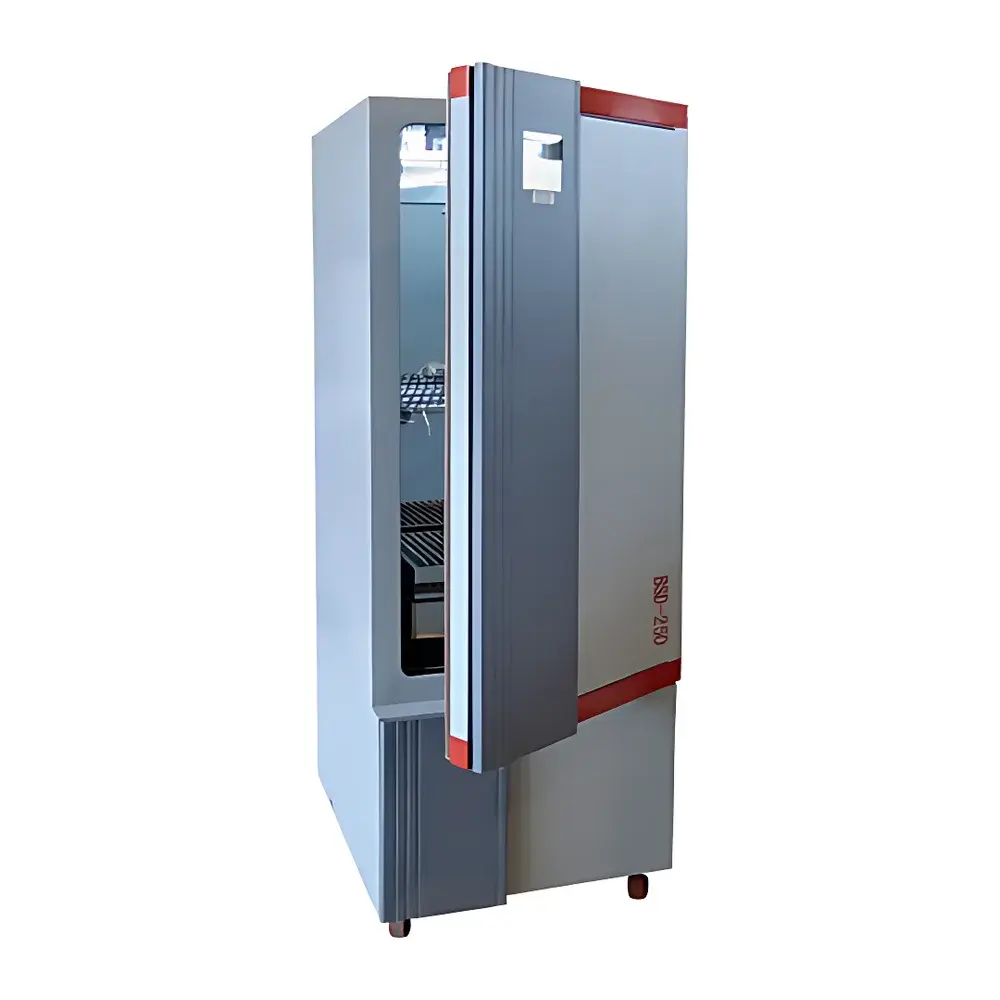
Heilongjiang HOPU BSD-400 Orbital Shaking Incubator
| Brand | Heilongjiang HOPU |
|---|---|
| Origin | Shandong, China |
| Model | BSD-400 |
| Temperature Range | 0–60 °C |
| Temperature Uniformity | ±1 °C |
| Humidity Range | 20–90 %RH |
| Chamber Capacity | 108 L |
| Temperature Resolution | 0.1 °C |
| Temperature Fluctuation | ±0.5 °C |
| Power Input | 1400 W |
| Timer Range | 0–9999 min |
| Interior Dimensions (W×D×H) | 600×640×1050 mm |
| External Dimensions (W×D×H) | 745×930×1695 mm |
| Shelf | 1 adjustable stainless steel tray |
| Shaking Mode | Orbital (0–220 rpm, amplitude 20 mm) or Reciprocating (0–300 cycles/min, amplitude 30 mm) |
| Platform Size | 500×500×200 mm |
| Interface | RS-485 |
| Programmability | 10 segments × 99 cycles |
| Frost-Free Defrost | Non-energy-consuming, automated |
| Air Exchange | Independent fresh-air inlet with manual on/off control |
Overview
The Heilongjiang HOPU BSD-400 Orbital Shaking Incubator is an integrated environmental chamber engineered for precise temperature-controlled cultivation of biological samples under dynamic agitation. Designed for laboratory environments requiring simultaneous thermal regulation and mechanical stimulation, it combines a microprocessor-based PID temperature control system with dual-mode shaking functionality—orbital rotation and reciprocating motion—to support aerobic microbial growth, suspension cell culture, enzyme kinetics assays, BOD testing, and seed germination studies. Its refrigerated architecture employs an eco-friendly R134a-free compressor system with an integrated, self-diagnosing cooling circuit and passive defrost technology that eliminates thermal interruption during long-term operation. The chamber maintains stable setpoints across its full 0–60 °C range while sustaining humidity levels between 20–90 %RH—critical for extended viability of hygroscopic cultures and plant tissue explants.
Key Features
- Intelligent microcomputer controller with backlit LCD interface displaying real-time temperature, elapsed time, and programmable cycle status; supports 10-segment × 99-cycle ramp/soak profiles
- Dual-shaking configuration: selectable orbital mode (0–220 rpm, 20 mm amplitude) or reciprocating mode (0–300 cpm, 30 mm amplitude), both independently adjustable via front-panel controls
- Optimized air circulation system featuring centrifugal blower and proprietary duct design to achieve ±1 °C temperature uniformity across the 108 L working volume
- Independent fresh-air inlet valve allows manual activation/deactivation to regulate internal O2/CO2 exchange without compromising thermal stability
- Double-layer observation window with inner tempered glass and outer insulated acrylic panel minimizes heat loss while enabling non-intrusive sample monitoring
- Stainless steel interior (mirror-finish 304 grade) with removable, height-adjustable shelf; cold-rolled steel exterior with electrostatic epoxy coating for corrosion resistance
- Comprehensive safety architecture: over-temperature alarm, automatic power recovery after blackout, parameter retention during system reset, and multi-level compressor protection
Sample Compatibility & Compliance
The BSD-400 accommodates standard Erlenmeyer flasks (up to 2 L), petri dishes, multi-well plates, and custom bioreactor vessels on its 500 × 500 mm platform. Its sealed chamber design meets requirements for containment of low-risk biological agents (BSL-1/BSL-2 compliant workflows). While not certified to ISO 13485 or FDA 21 CFR Part 11 out-of-the-box, the RS-485 serial interface enables integration with validated LIMS or ELN systems supporting audit-trail generation, user-access logging, and electronic signature protocols per GLP/GMP Annex 11 guidance. Humidity control aligns with ASTM D4332 for conditioning of biological specimens prior to analysis.
Software & Data Management
Data acquisition and remote supervision are enabled through the RS-485 port using Modbus RTU protocol. Compatible third-party software packages (e.g., LabVIEW, MATLAB, or custom Python scripts via USB-to-RS485 adapters) can log temperature, humidity, shaking speed, and runtime parameters at user-defined intervals. Optional accessories—including thermal printer modules (supporting trend curve output), GPRS-enabled SMS alert units (for out-of-specification notifications), and PC-based monitoring dashboards—extend traceability and operational oversight. All programmable settings persist in non-volatile memory, ensuring continuity after unexpected shutdowns or maintenance resets.
Applications
- Biochemical oxygen demand (BOD5) determination per APHA Standard Methods 5210B
- Microbial culture expansion for antibiotic susceptibility testing (AST) and fermentation optimization
- Suspension-based mammalian or insect cell propagation under controlled aeration
- Plant tissue culture and callus induction under regulated photoperiod-agnostic conditions
- Environmental toxicity screening using algal growth inhibition assays (OECD 201)
- Enzyme activity profiling requiring constant agitation and thermal stabilization
- Standardization of reference strains in QC laboratories adhering to CLSI M22-A3 guidelines
FAQ
Does the BSD-400 support CO2 concentration control?
No—this model does not include gas mixing or infrared CO2 sensing capabilities. It is designed for ambient-air applications only.
Can the shaking platform accommodate multiple flask sizes simultaneously?
Yes—the 500 × 500 mm platform accepts standard clamping fixtures or universal rubber mats for secure mounting of heterogeneous vessel configurations.
Is the humidity sensor calibrated traceable to NIST standards?
Factory calibration is performed using saturated salt solutions per ISO 4618; certificate of conformance is provided. NIST-traceable recalibration requires external service.
What is the maximum load capacity of the shaking platform?
The platform supports up to 15 kg evenly distributed mass at 220 rpm orbital speed; load derating applies above 180 rpm for prolonged operation.
How often does the automated defrost cycle activate?
Defrost occurs passively during compressor off-cycles and requires no scheduled intervention; frequency depends on ambient humidity and setpoint delta.