
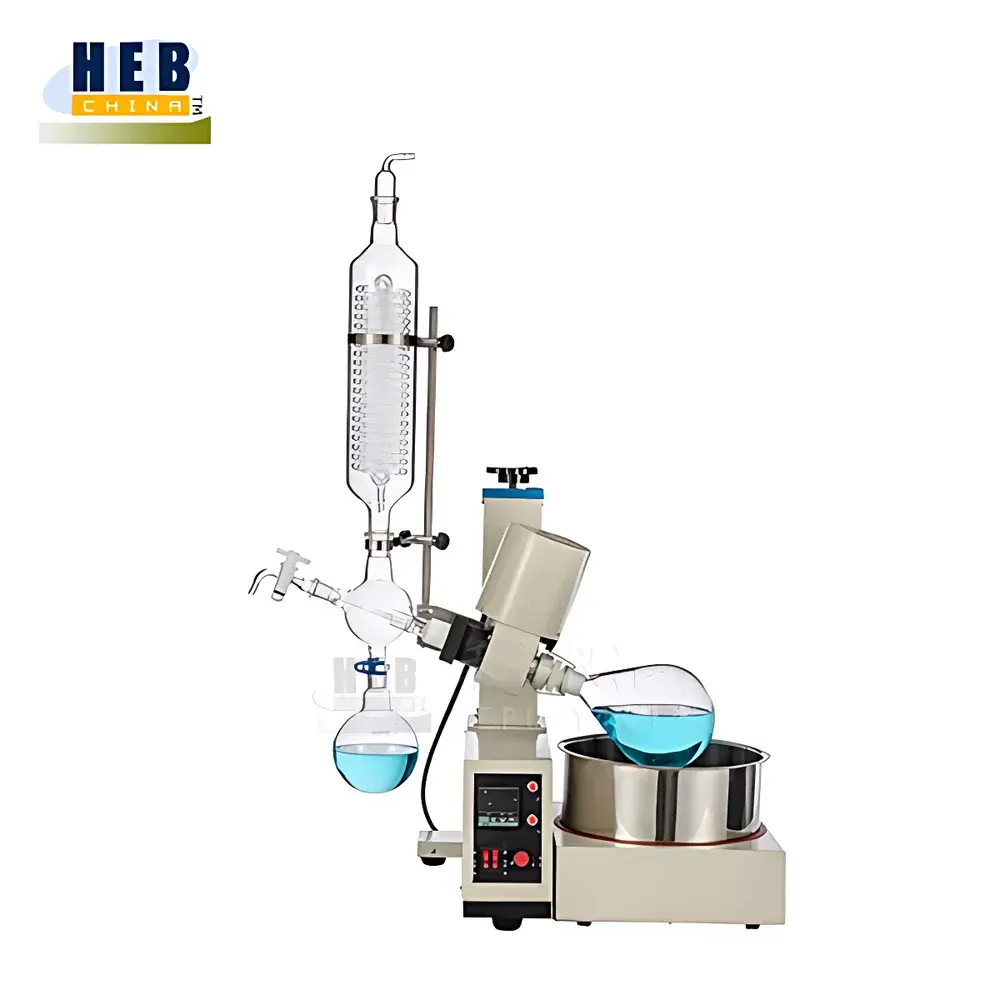
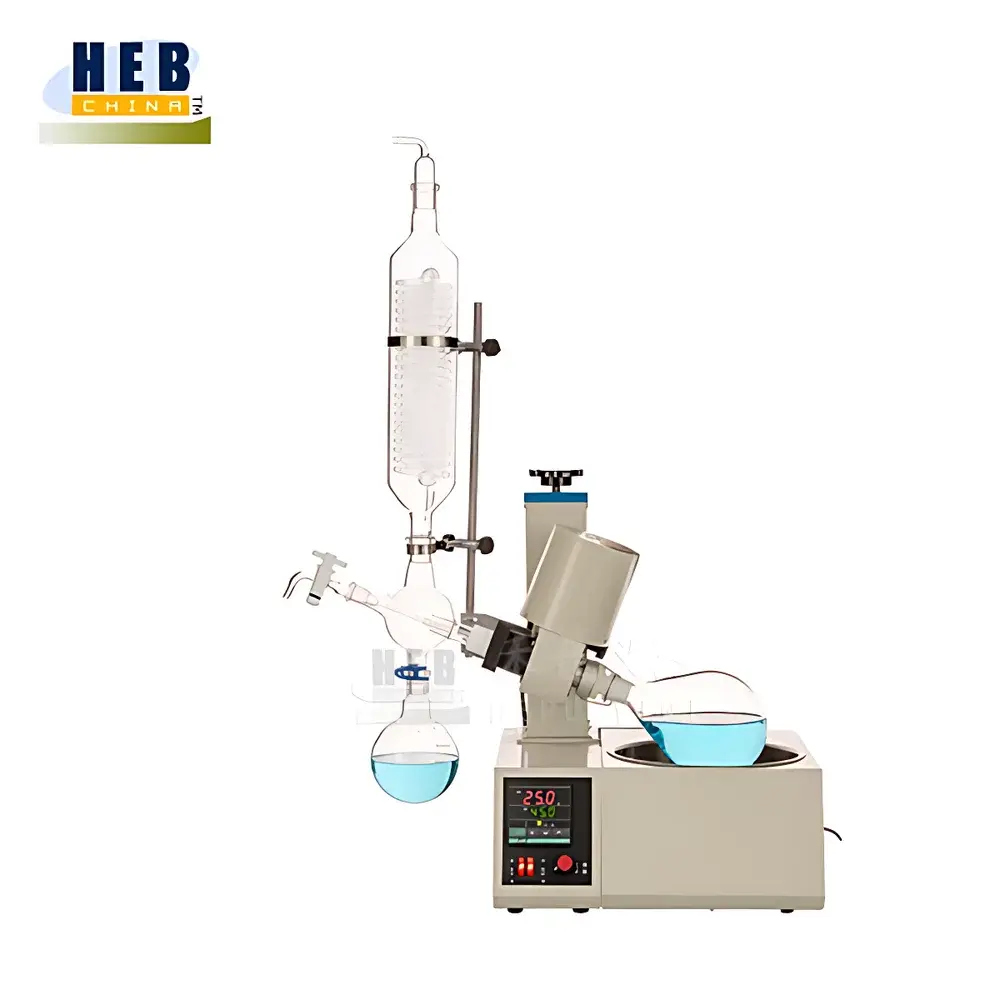
Jihepu RE-5299 Rotary Evaporator
| Brand | Jihepu |
|---|---|
| Origin | Shandong, China |
| Model | RE-5299 |
| Capacity | 1 L |
| Ultimate Vacuum | 0.098 MPa |
| Rotation Speed | 0–120 rpm |
| Temperature Control Range | 0–99 °C |
| Temperature Accuracy | ±1 °C |
| Condenser Cooling Area | 0.11 m² |
| Power Supply | 220 V / 50 Hz (optional 110 V / 60 Hz) |
| Heating Power | 1 kW |
| Motor Power | 30 W |
| Lifting Power | 15 W |
| Evaporation Rate | 20 mL/min |
| Rotating Flask | 1000 mL (Φ131 mm, 24/40 standard taper) |
| Collection Flask | 500 mL (Φ105 mm, 35/40 spherical joint) |
| Condenser Dimensions | Φ85 × 460 mm |
| Water Bath Volume | ~6.8 L (Φ250 × 140 mm) |
| Overall Dimensions | 770 × 440 × 1005 mm (L×W×H) |
| Net Weight | 21 kg |
Overview
The Jihepu RE-5299 Rotary Evaporator is a precision-engineered laboratory instrument designed for efficient solvent removal, concentration, crystallization, and recovery under controlled vacuum and temperature conditions. Operating on the principle of thin-film evaporation, it rotates a sample-containing flask at a constant speed while applying uniform conductive heating via an intelligent water bath and maintaining sub-atmospheric pressure. This configuration maximizes surface area exposure, enhances heat transfer efficiency, and minimizes thermal degradation—making it especially suitable for thermally labile compounds such as pharmaceutical intermediates, natural product extracts, and biopolymer solutions. Constructed with full compatibility between process-critical components and common organic solvents, the RE-5299 meets functional requirements for routine purification workflows in QC laboratories, R&D facilities, and pilot-scale synthesis environments.
Key Features
- Robust support frame fabricated from corrosion-resistant powder-coated aluminum alloy, ensuring long-term structural integrity and stability during operation.
- High-vacuum sealing system combining PTFE gaskets with imported fluorocarbon elastomer O-rings, rated for sustained operation at ≤0.098 MPa absolute pressure.
- All glass components manufactured from GG-17 borosilicate glass (operating range: −80 °C to +250 °C), offering superior thermal shock resistance and chemical inertness against acids, bases, and halogenated solvents.
- Vertical double-layer coiled condenser with optimized surface area (0.11 m²) and integrated feed tube, delivering high condensate recovery efficiency (>95% typical for low-boiling solvents like acetone or ethyl acetate).
- Digital microprocessor-based temperature controller with Cu50 platinum resistance sensor, enabling precise setpoint regulation within ±1 °C across the 0–99 °C range; optional extended range up to 400 °C available with metal-heated bath configuration.
- Stepless electronic speed control (0–120 rpm) with intuitive rotary dial interface and real-time RPM feedback, facilitating reproducible film formation across varying viscosities.
- Motorized vertical lift mechanism (0–150 mm travel) with overload protection and automatic positioning memory, reducing manual handling and improving operator ergonomics.
- Stainless steel water bath tank (grade 304) with integrated heater, digital display, and overheat cutoff fuse for fail-safe thermal management.
- Modular inlet/outlet ports conforming to ISO 2852 and DIN 12905 standards: 10 mm push-fit vacuum port (compatible with diaphragm and rotary vane pumps), dual 12 × 8 mm quick-connect fittings for chiller or recirculating coolant lines, and standardized 19/22 taper feed valve for continuous addition under vacuum.
Sample Compatibility & Compliance
The RE-5299 is compatible with a broad spectrum of organic and aqueous solvent systems—including methanol, dichloromethane, toluene, THF, DMF, and water-based buffers—provided vapor pressures and boiling points fall within its operational envelope (typically <150 °C at ≤0.098 MPa). Its all-glass/PTFE wetted path complies with USP , ISO 10993-1 (biocompatibility), and EU Directive 2002/72/EC for food-contact materials. While not certified to GLP or GMP out-of-the-box, the unit supports audit-ready documentation when integrated into validated SOPs—particularly when paired with external vacuum controllers logging pressure trends or data-acquisition-enabled chillers meeting FDA 21 CFR Part 11 requirements for electronic records.
Software & Data Management
The RE-5299 operates as a standalone analog-digital hybrid system with no embedded firmware or network connectivity. All critical parameters—bath temperature, rotation speed, and lift position—are monitored and adjusted locally via front-panel controls and LED displays. For traceable process recording, users may integrate third-party USB data loggers connected to the Cu50 sensor output or employ external PLCs interfacing through 4–20 mA analog signals (available via optional expansion module). When deployed in regulated environments, this architecture enables alignment with ALCOA+ principles (Attributable, Legible, Contemporaneous, Original, Accurate, Complete, Consistent, Enduring, Available) through manual logbooks or validated LIMS interfaces.
Applications
- Solvent removal following column chromatography or liquid–liquid extraction in synthetic organic chemistry labs.
- Concentration of heat-sensitive biomolecules—including peptides, enzymes, and plant-derived terpenoids—without denaturation.
- Recovery and reuse of expensive or hazardous solvents (e.g., chloroform, DCM) in compliance with ISO 14001 waste minimization protocols.
- Preparative-scale dehydration of hygroscopic APIs prior to lyophilization or solid-state characterization.
- Routine QC testing of residual solvent content per ICH Q3C guidelines using headspace-GC calibration curves generated from evaporated standards.
FAQ
What vacuum level is required for optimal performance?
The RE-5299 achieves maximum evaporation efficiency at ≤0.098 MPa (≤20 mbar absolute); however, lower pressures (e.g., ≤0.01 MPa) are recommended for high-boiling-point solvents or viscous samples to reduce bumping and improve film uniformity.
Can the unit be operated continuously for extended periods?
Yes—designed for unattended 8–12 hour runs when paired with a stable chiller supply and vacuum source; periodic inspection of PTFE seals and bath fluid level is advised every 4 hours.
Is the water bath compatible with silicone oil or other heating media?
Standard configuration uses water only; silicone oil heating requires retrofitting with a high-temp bath vessel and upgraded temperature sensor (Cu100 or PT100), available as factory option.
Does the RE-5299 support remote monitoring or automation?
No native Ethernet or RS-485 interface exists; however, analog outputs (0–5 V or 4–20 mA) for temperature and RPM can be routed to SCADA systems via external signal conditioners.
What maintenance intervals are recommended for long-term reliability?
Inspect and replace PTFE seals every 6 months under daily use; clean condenser coils weekly with ethanol; calibrate bath temperature sensor annually using NIST-traceable reference thermometers.



