
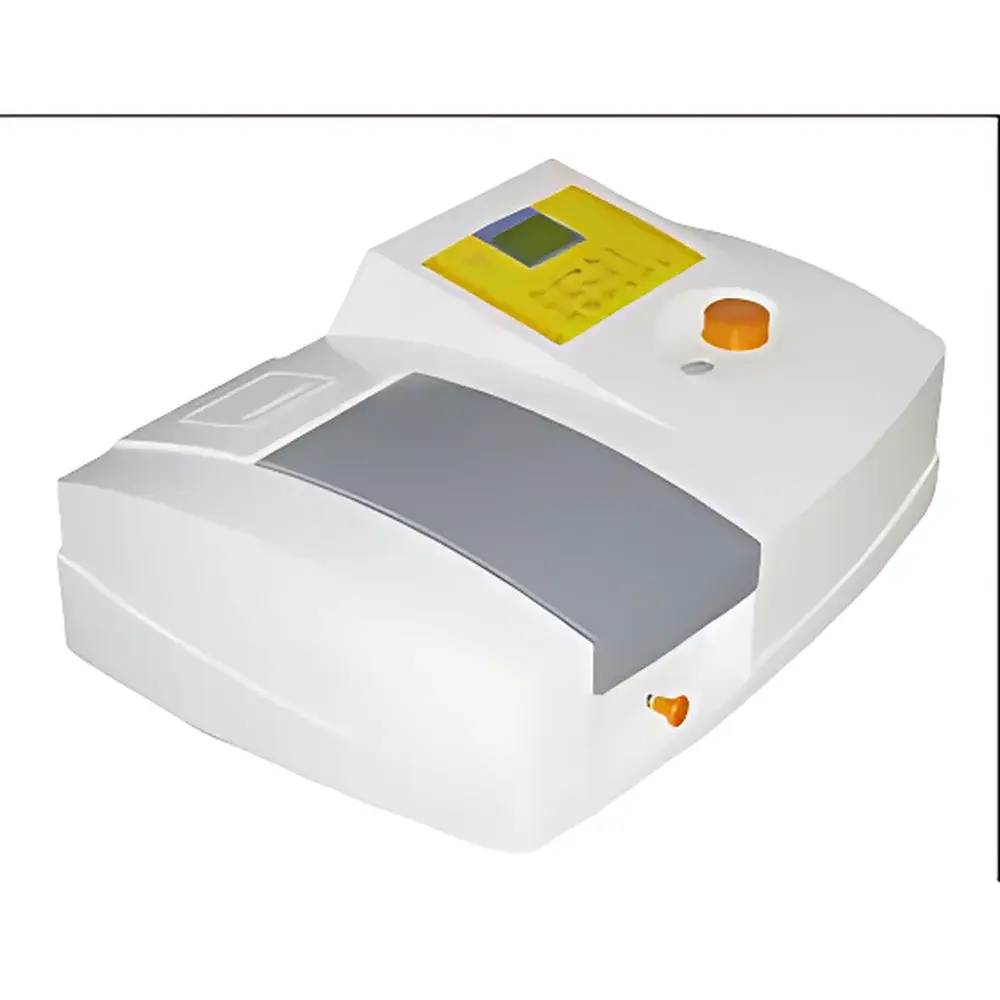
HePu DR8500 Multi-Parameter Water Quality Analyzer
| Brand | HePu (Jihepu) |
|---|---|
| Origin | Shandong, China |
| Manufacturer Type | Authorized Distributor |
| Instrument Type | Benchtop Laboratory Water Quality Analyzer |
| Detection Parameters | COD, Total Phosphorus, Total Nitrogen, Ammonia-N, Turbidity |
| Wavelength Range | 200–1000 nm |
| COD Range | 5–5000 mg/L (segmented) |
| TP | 0–30 mg/L (segmented) |
| TN | 0–50 mg/L (segmented) |
| NH₃-N | 0–50 mg/L (segmented) |
| Turbidity | 0.5–500 NTU |
| Digestion Temperature Control | 0–200 °C |
| Precision | ±0.2 °C at 165 °C |
| Timer Range | 0–99 h 59 min (multi-channel support) |
| Chloride Interference Tolerance | [Cl⁻] < 1000 mg/L (dilution or high-chloride reagents available) |
| Data Storage Capacity | 1000 measurement sets |
| Calibration Options | Up to 7-point non-linear concentration calibration in C-mode |
| Preloaded Method Library | ≥100 EPA/ISO/GB-compliant water quality parameters |
| Interface | USB for PC connectivity and optional thermal printer |
| Display | Backlit LCD with real-time clock, unit, status, and menu navigation |
Overview
The HePu DR8500 Multi-Parameter Water Quality Analyzer is a benchtop spectrophotometric instrument engineered for precise, standardized analysis of key regulatory water quality parameters in environmental, municipal, and industrial laboratories. It operates on the principle of absorbance photometry—measuring light attenuation at user-selectable wavelengths (200–1000 nm) following colorimetric reactions between analytes and certified reagents. Designed in accordance with Chinese national standards (e.g., HJ/T 399–2007 for COD, HJ 636–2012 for TN, GB 11893–1989 for TP), the DR8500 supports method validation under GLP-compliant workflows and integrates seamlessly into QA/QC protocols for wastewater discharge monitoring, drinking water safety verification, and surface/groundwater assessment. Its modular architecture combines an integrated digestion system with a dual-beam optical path and grating-based monochromator, minimizing stray light interference and ensuring long-term photometric stability across repeated measurements.
Key Features
- Grating monochromator with 1 nm spectral resolution and wavelength accuracy ±1 nm across 200–1000 nm range
- Dual independent optical channels enabling simultaneous reference/sample beam detection for enhanced baseline correction
- Microprocessor-controlled digestion block (12-position) with programmable temperature (0–200 °C) and timer (0–99 h 59 min), featuring overtemperature cut-off and energy-efficient heating algorithms
- Preloaded calibration curves for >100 standard methods—including COD, ammonia nitrogen (Nessler/salicylate), total phosphorus (ascorbic acid-molybdenum blue), total nitrogen (alkaline persulfate digestion), and turbidity (Formazin standard traceability)
- Seven-point non-linear calibration capability in concentration mode (C-mode), supporting polynomial fitting for complex reaction kinetics
- Internal memory stores up to 1000 datasets with timestamp, operator ID (user-defined), parameter name, result, unit, and digestion conditions
- Self-diagnostic system with error code display (e.g., E01: lamp failure; E05: digestion overtemp; E12: cuvette misalignment) and automatic power-loss data retention
Sample Compatibility & Compliance
The DR8500 accepts standard 10 mm, 20 mm, and 50 mm rectangular cuvettes as well as 16 mm round digestion vials. It accommodates liquid samples with suspended solids ≤500 mg/L (pre-filtration recommended for turbidity-critical assays). All digestion and colorimetric protocols align with ISO 6060 (COD), ISO 11905-1 (ammonia), ISO 11905-2 (total nitrogen), ISO 8245 (total organic carbon proxy), and US EPA Methods 410.4, 350.1, 351.2, and 100.1 where applicable. The instrument’s firmware supports audit trail generation (operator log, method version, calibration history) required for ISO/IEC 17025 accreditation and internal GMP/GLP documentation. Reagent kits are manufactured under ISO 9001-certified processes and include lot-specific certificate of analysis (CoA) traceable to NIST SRM equivalents.
Software & Data Management
USB interface enables bidirectional communication with Windows-based HePu LabLink software (v3.2+), which provides method configuration, calibration curve management, report generation (PDF/CSV/XLSX), and electronic signature support compliant with FDA 21 CFR Part 11 requirements. Data export includes raw absorbance values, digestion logs, and QC flagging (e.g., “out-of-range blank”, “calibration drift warning”). The embedded operating system supports multi-user login with role-based access control (administrator/operator/viewer), password-protected method editing, and automatic firmware update via USB drive. All stored data retain full metadata—date/time stamp, digestion temperature/duration, selected wavelength, and reagent batch number—for full analytical traceability.
Applications
- Regulatory compliance testing for municipal wastewater treatment plants (WWTPs) per local discharge permits (e.g., DB11/307–2013)
- Source water and finished drinking water analysis in accordance with GB 5749–2022
- Industrial effluent monitoring for electroplating, pharmaceutical, food processing, and textile sectors
- Environmental impact assessment (EIA) field labs and third-party testing organizations
- Educational laboratories for undergraduate and graduate-level environmental chemistry instruction
- Research applications requiring reproducible nutrient speciation (e.g., NO₃⁻ vs. NH₄⁺ differentiation via selective digestion)
FAQ
Does the DR8500 meet international calibration traceability requirements?
Yes—the optical system is factory-calibrated using NIST-traceable neutral density filters and mercury-argon emission line standards; wavelength accuracy is verified at 253.7 nm, 435.8 nm, and 546.1 nm.
Can the instrument be used for low-concentration ammonia analysis in ultrapure water?
Yes—when paired with the optional salicylate method kit and quartz cuvettes, the DR8500 achieves a detection limit of 0.02 mg/L NH₃-N with inter-day RSD <3.5% (n=12).
Is method validation documentation provided with the system?
Yes—each shipment includes a Method Validation Report summarizing linearity (r² ≥0.999), LOD/LOQ, spike recovery (85–115%), and precision (RSD ≤2.8%) for all preloaded parameters.
What digesters are compatible with the DR8500?
The integrated 12-hole digester is optimized for HePu-certified digestion vials (16 mm OD). External microwave or block digesters may be used if calibrated against the DR8500’s reference digestion profile.
How often does the tungsten-halogen lamp require replacement?
Lamp lifetime exceeds 2000 hours under typical usage; the system monitors cumulative on-time and displays a maintenance alert at 1800 hours.
Related Products







