
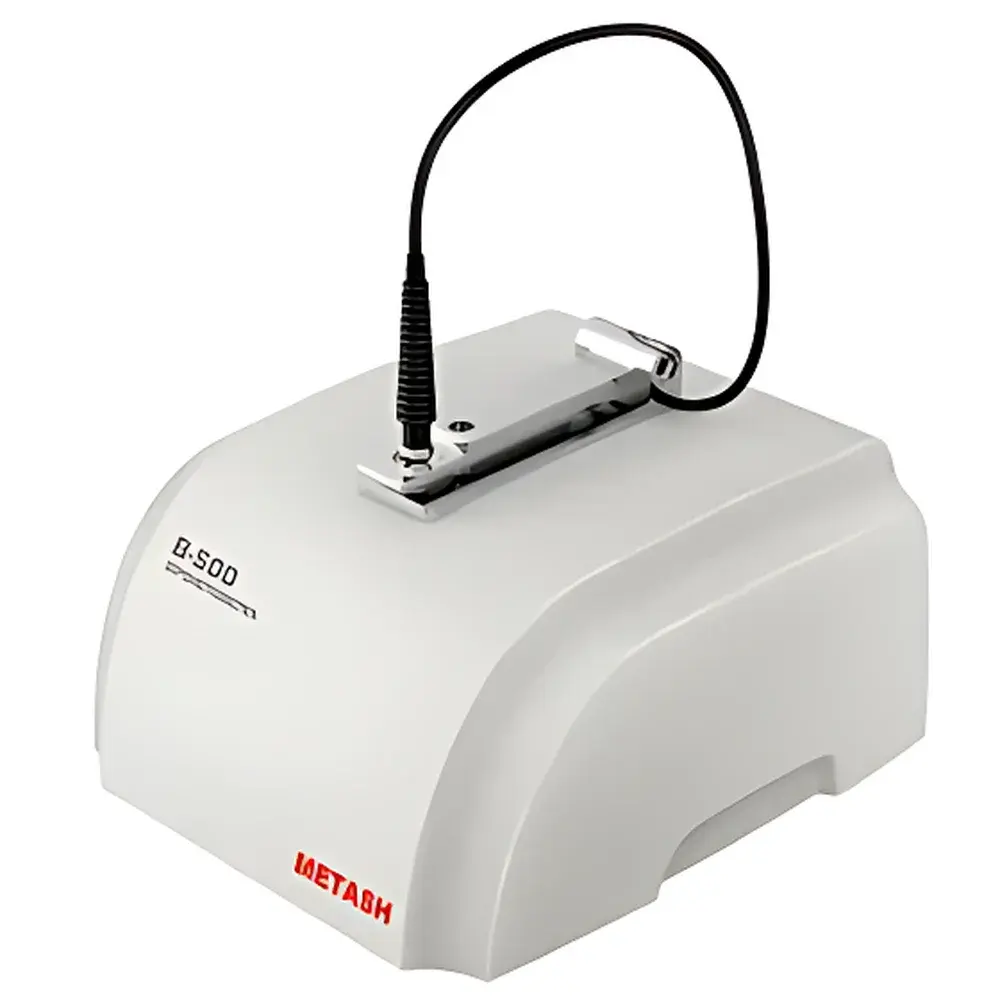
B-500 Ultra-Micro UV-Vis Spectrophotometer
| Brand | Jihepu (Jinan Hepu) |
|---|---|
| Origin | Shandong, China |
| Model | B-500 |
| Optical Design | Dual-Beam |
| Detector | Photomultiplier Tube (PMT) |
| Wavelength Range | 190–850 nm |
| Wavelength Accuracy | ±2 nm |
| Spectral Bandwidth | 1 nm |
| Stray Light | ≤0.1% |
| Absorbance Accuracy | ±2% at 257 nm |
| Absorbance Precision | ±0.002 AU (1 mm pathlength) |
| Absorbance Range | 0.02–300 AU (equivalent to 10 mm pathlength) |
| Minimum Sample Volume | 1–2 µL |
| Measurement Speed | 2–5 seconds per sample |
| DNA Detection Limit | ~2 ng/µL (dsDNA) |
| DNA Upper Limit | ≥15,000 ng/µL (dsDNA) |
| Protein Range | 0.1–100 mg/mL (BSA, 200/400 nm selectable) |
| Resolution | <1.8 nm |
| Light Source | Long-life Xenon Lamp |
| Automation | Automatic Wavelength Scanning |
| Software | Integrated Data Analysis Suite (≥1,000 sample storage per session, full-spectrum scan capability) |
Overview
The B-500 Ultra-Micro UV-Vis Spectrophotometer is a dual-beam, xenon lamp–based analytical instrument engineered for rapid, label-free quantification and spectral characterization of nucleic acids and proteins directly from microliter-volume samples. Unlike conventional cuvette-based systems requiring dilution and extensive sample preparation, the B-500 employs fixed-pathlength microfluidic measurement geometry—typically 0.05–1.0 mm effective pathlength—to enable direct absorbance measurement of 1–2 µL native samples across the full ultraviolet-to-visible range (190–850 nm). Its optical architecture integrates a high-stability xenon light source, precision monochromator with 1 nm spectral bandwidth, and low-noise photomultiplier tube (PMT) detection, ensuring high signal-to-noise ratio and reproducible photometric performance. The system operates without warm-up time, supporting immediate analysis after power-on—a critical advantage in high-throughput molecular biology laboratories where workflow continuity and instrument availability are paramount.
Key Features
- Dual-beam optical design compensates for source drift and environmental fluctuations, enhancing long-term baseline stability and measurement repeatability.
- Xenon arc lamp provides continuous, intense output from deep UV (190 nm) through visible wavelengths, eliminating the need for lamp switching or spectral gaps common in deuterium/tungsten hybrid sources.
- Automated wavelength scanning with ≤1.8 nm optical resolution enables high-fidelity spectral acquisition for peak identification, purity assessment (e.g., A260/A280, A260/A230), and secondary structure inference in proteins.
- Fixed micro-volume measurement stage eliminates capillary alignment errors and cross-contamination risks associated with variable-pathlength systems; cleaning requires only a single lint-free wipe between samples.
- Onboard absorbance calibration traceable to NIST-traceable standards ensures compliance with internal quality control protocols and supports audit readiness under GLP/GMP frameworks.
- Real-time thermal stabilization maintains detector and optical bench temperature within ±0.5°C, minimizing thermal noise during extended spectral scans.
Sample Compatibility & Compliance
The B-500 accommodates a broad range of biological and chemical samples without dilution—including genomic DNA, plasmid preparations, RNA isolates, purified antibodies, recombinant enzymes, and small-molecule solutions in aqueous or low-conductivity buffers. Its 1–2 µL volume requirement reduces consumption of precious clinical or synthetic samples by >95% compared to standard 1 mL cuvette assays. Instrument design conforms to IEC 61010-1 for electrical safety and electromagnetic compatibility (EMC). While not certified to ISO/IEC 17025 as a standalone testing laboratory, the B-500 supports data integrity requirements aligned with FDA 21 CFR Part 11 when used with validated software configurations—including electronic signatures, audit trails, and user-access controls. Routine verification follows ASTM E275 and USP guidelines for spectrophotometer performance qualification.
Software & Data Management
The integrated analysis software provides a secure, Windows-compatible interface for instrument control, spectral acquisition, and quantitative reporting. Each measurement session stores ≥1,000 sample records with timestamp, operator ID, wavelength metadata, and raw absorbance spectra. Built-in algorithms automatically calculate nucleic acid concentration (ng/µL), purity ratios, molar extinction coefficients, and protein concentration using user-selectable extinction models (e.g., BSA at 280 nm or 200/400 nm dual-wavelength correction). Export formats include CSV, PDF, and XML for LIMS integration. Audit trail functionality logs all parameter changes, data deletions, and software updates—supporting retrospective review during regulatory inspections. Data backups are encrypted and compatible with network-attached storage (NAS) and enterprise backup systems.
Applications
- Quantitative QC of DNA/RNA extracts prior to NGS library preparation, qPCR, or CRISPR editing workflows.
- Routine assessment of protein yield and aggregation state during purification (e.g., SEC fractions, IMAC eluates).
- Verification of oligonucleotide synthesis success and desalting efficiency via A260/A230 ratio analysis.
- Monitoring enzymatic reaction kinetics via time-resolved absorbance at defined wavelengths (e.g., NADH at 340 nm).
- Characterization of nanoparticle suspensions (e.g., gold nanospheres) through localized surface plasmon resonance (LSPR) profiling.
- Educational use in undergraduate biochemistry labs for hands-on spectroscopic principles and Beer–Lambert law validation.
FAQ
Does the B-500 require routine lamp alignment or wavelength recalibration?
No. The xenon lamp and monochromator are factory-aligned and thermally stabilized; wavelength accuracy remains within ±2 nm over 12 months without user intervention.
Can the instrument measure samples in high-salt or viscous buffers?
Yes—within limits. Samples with conductivity <150 mS/cm and viscosity <20 cP are compatible; higher values may require manual cleaning of the measurement stage post-run.
Is the software compliant with 21 CFR Part 11 for regulated environments?
The base software includes audit trail, user roles, and electronic signature capabilities; full Part 11 compliance requires site-specific validation documentation and IT infrastructure controls.
What maintenance is required beyond daily wiping?
Annual PM includes PMT gain verification, lamp intensity profiling, and optical path cleanliness inspection—performed by certified field service engineers.
How does the B-500 handle bubbles or debris in the sample droplet?
The system performs real-time optical homogeneity check during measurement; anomalous scatter profiles trigger automatic rejection and prompt user re-sampling.





