
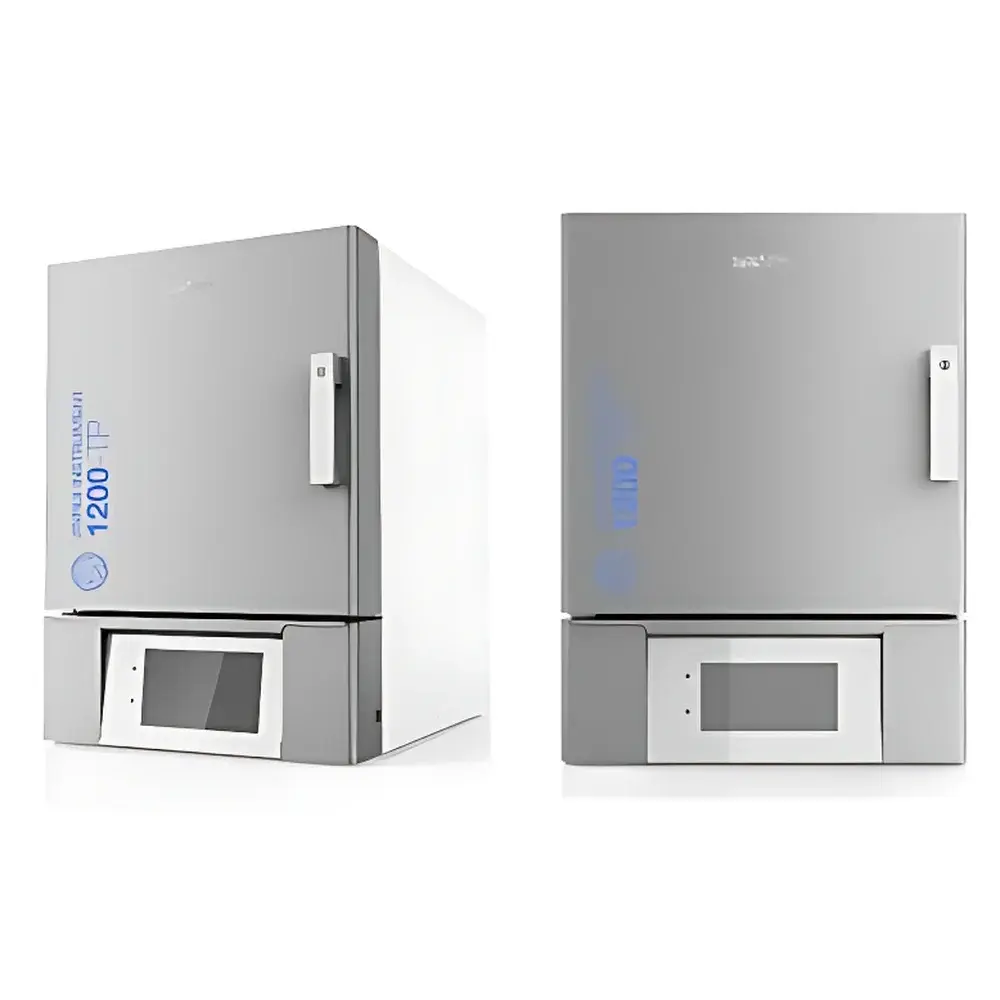
Jihepu SX2-12GDP High-Performance Box-Type Muffle Furnace
| Brand | Jihepu |
|---|---|
| Origin | Shandong, China |
| Model | SX2-12GDP |
| Maximum Temperature | 1200 °C |
| Temperature Control Accuracy | ±1 °C |
| Rated Power | 12 kW |
| Heating Rate (to Max Temp) | 15 °C/min |
| Heating Modes | Single-Point & Multi-Stage Programmable Ramp (1–40 Segments) |
| Internal Chamber Dimensions | 930 × 700 × 845 mm |
| Chamber Lining Material | Al₂O₃ Refractory Ceramic |
| Thermocouple Type | K-Type Stainless Steel Sheathed |
| Control Interface | 5.5-inch Color Touchscreen (Bilingual: English/Chinese) |
| Power Supply | AC 380 V / 50 Hz |
| Compliance | GB/T 10066.1–2004, JJG 701–2008 |
Overview
The Jihepu SX2-12GDP is a high-reliability, laboratory-grade box-type muffle furnace engineered for precise thermal processing in materials science, metallurgy, geochemistry, and quality control laboratories. Operating on resistive heating principles, it delivers uniform, contamination-free heating within a fully insulated alumina (Al₂O₃) chamber—eliminating catalytic interference from external atmospheres and enabling inert or air-based thermal treatments up to 1200 °C. Its robust mechanical architecture—including dual-layer door sealing, automatic power cutoff upon door opening, and high-integrity 304 stainless steel front framing—meets fundamental safety requirements for unattended operation in ISO/IEC 17025-accredited labs and GMP-aligned R&D environments. Designed for reproducibility across repeated thermal cycles, the furnace supports standardized procedures such as ASTM E1111 (ash content determination), ISO 562 (volatile matter analysis in coal), and USP heavy metals testing protocols where controlled ramp-and-hold thermal profiles are mandatory.
Key Features
- Double-door mechanical design: Inner sliding door maintains positive pressure seal against thermal leakage; outer door provides structural support, thermal shielding, and aesthetic finish.
- Automated safety interlock: Main heating circuit de-energizes immediately upon door opening and re-engages only after full closure—compliant with IEC 61000-6-2 electromagnetic immunity and EN 61000-6-3 emission standards.
- High-purity Al₂O₃ chamber lining (≥95% alumina content): Offers excellent thermal shock resistance, low thermal conductivity, and chemical inertness toward oxides, carbonates, and silicates.
- Dual K-type thermocouples: Primary chamber sensor for process control + independent overtemperature protection sensor mounted on outer casing—ensuring redundancy per IEC 61508 functional safety guidelines.
- Industrial-grade solid-state relays and imported AC contactors: Deliver stable zero-crossing switching, minimize electrical noise, and extend component service life under continuous 12 kW load conditions.
- Front-panel hot-zone construction using 304 stainless steel: Resists oxidation at sustained >800 °C surface temperatures while maintaining dimensional stability and cleanability.
Sample Compatibility & Compliance
The SX2-12GDP accommodates crucibles, boats, and sintering trays made of alumina, silicon carbide, or platinum—compatible with standard ceramic, metallic, polymer, and geological samples. Its sealed muffle configuration prevents cross-contamination during ashing, calcination, sintering, or loss-on-ignition (LOI) assays. The furnace conforms to national metrological verification regulations JJG 701–2008 (high-temperature furnaces) and general safety standard GB/T 10066.1–2004. While not certified to UL or CE for direct export without local adaptation, its control logic architecture supports future validation for FDA 21 CFR Part 11 compliance when integrated with audit-trail-enabled data logging systems.
Software & Data Management
The 5.5-inch capacitive touchscreen interface supports bilingual (English/Chinese) operation and implements a structured, tab-based workflow for program creation. Users define up to 40 temperature-time segments using spreadsheet-style input—enabling precise replication of complex thermal profiles (e.g., preheat → dwell → ramp → cool). Nine programmable timer-based shutdown slots allow scheduled termination between 1 and 999 minutes. PID auto-tuning ensures minimal overshoot and stable setpoint maintenance. All programs are stored non-volatily and support import/export via USB—facilitating method transfer between instruments. Optional RS485 Modbus RTU output enables integration into centralized lab information management systems (LIMS) for automated data capture and electronic record retention.
Applications
- Thermal gravimetric analysis (TGA) sample preparation and residue stabilization
- Ash content determination in food, feed, pharmaceutical excipients, and environmental solids (ASTM D2974, ISO 1171)
- Calcination of catalyst precursors, battery cathode materials (e.g., LiCoO₂), and ceramic powders
- Heat treatment of metallographic specimens prior to microstructural evaluation
- Volatiles quantification in coal, biomass, and municipal solid waste according to ISO 562 and ASTM D3175
- Pre-firing of refractory test bars and ceramic green bodies per ASTM C20 and ISO 5013
FAQ
What is the maximum recommended continuous operating temperature?
The furnace is rated for continuous use at 1100 °C; 1200 °C is the absolute upper limit for short-duration (<30 min) calibration or qualification runs.
Can the furnace be used under inert gas atmosphere?
Yes—optional quartz or stainless steel gas inlet/outlet ports can be installed; however, standard configuration is air-atmosphere only. Gas compatibility requires third-party purge system integration and pressure-rated modifications.
Is the temperature controller compliant with GLP data integrity requirements?
The embedded controller logs timestamps and setpoints internally but lacks built-in electronic signature or audit trail functionality. Full 21 CFR Part 11 compliance requires external validated data acquisition software and user access controls.
What maintenance intervals are recommended for long-term reliability?
Inspect door gasket integrity every 200 operating hours; verify thermocouple calibration annually or per ISO/IEC 17025 internal procedure; replace heating elements only upon measured resistance deviation >15% from nominal value.
Does the furnace support remote monitoring or Ethernet connectivity?
No native Ethernet or Wi-Fi interface is included. Remote status monitoring and control require external PLC interfacing via RS485 Modbus or analog 4–20 mA signal conversion modules.



