
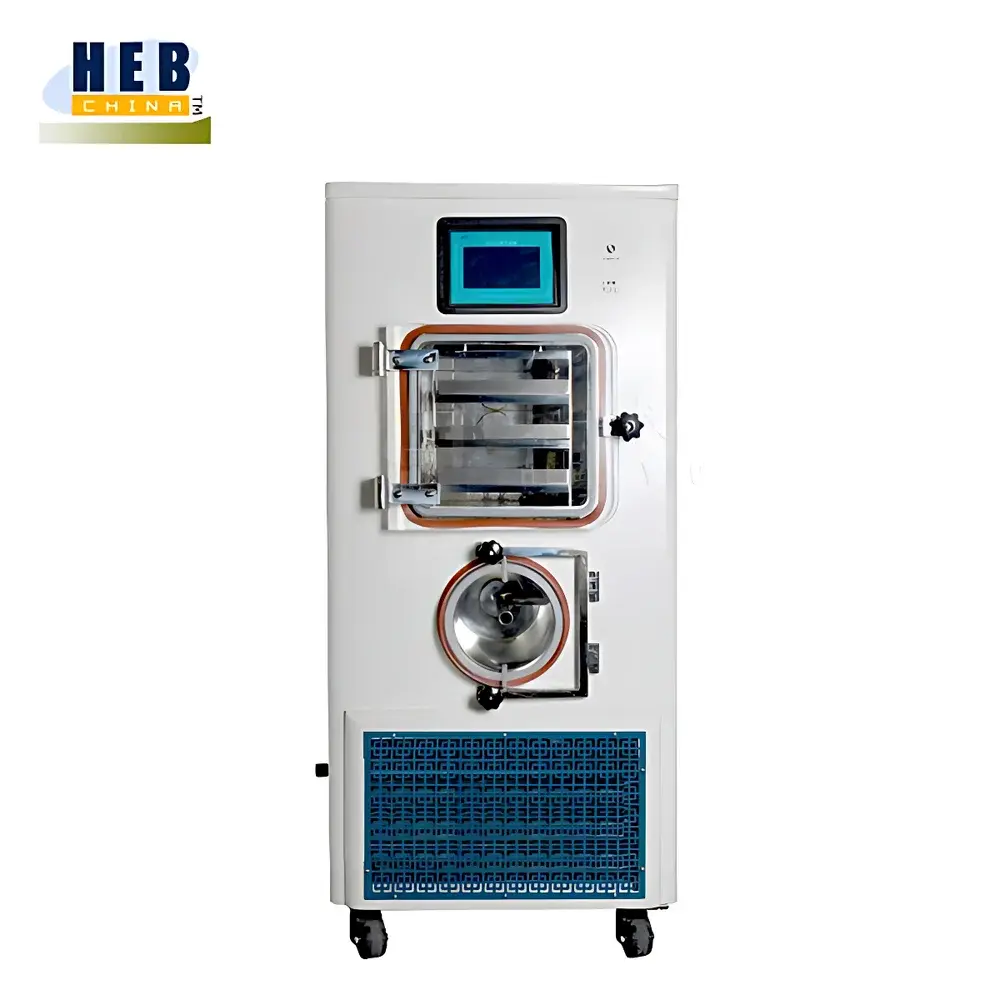
HePu ZLGJ-20 Benchtop Vacuum Freeze Dryer
| [Brand | HePu |
|---|---|
| Origin | Shandong, China |
| Model | ZLGJ-20 |
| Type | Standard Shelf-Type Freeze Dryer |
| Application | Pilot-Scale Lyophilization |
| Lyophilization Area | 0.3 m² |
| Ultimate Vacuum | ≤10 Pa (empty chamber) |
| Condenser Temperature | ≤−75 °C (no-load) |
| Water Capture Capacity | 4 kg/24 h |
| Pumping Speed | 4 L/s |
| Shelf Temperature Range | −50 °C to +70 °C |
| Shelf Configuration | 3+1 adjustable shelves (spacing: 50 mm |
| shelf size | 270 × 400 × 15 mm) |
| Dimensions (W×D×H) | 800 × 800 × 1550 mm |
| Power Supply | 220 VAC, 50 Hz |
| Total Power Consumption | 3500 W |
| Cooling Method | Air-Cooled |
| Defrost Mode | High-Temperature Electric Defrost |
| Included Accessories | 3 stainless steel trays (265 × 395 × 30 mm) |
| Operating Ambient | 10–30 °C, RH ≤70%, non-corrosive/non-explosive environment] |
Overview
The HePu ZLGJ-20 is a pilot-scale, shelf-type vacuum freeze dryer engineered for reproducible lyophilization of temperature-sensitive biologicals, pharmaceuticals, and research-grade samples in academic, QC, and early-development laboratory environments. It operates on the fundamental principle of sublimation—removing water from frozen materials under deep vacuum while maintaining product integrity through precise thermal control. Unlike continuous or industrial systems, the ZLGJ-20 integrates a robust air-cooled condenser, multi-segment programmable shelf heating, and real-time process monitoring to support method development, small-batch validation, and GxP-aligned process documentation. Its design complies with core operational prerequisites for ISO 22000, ICH Q5C, and USP <1211> lyophilization guidance—particularly where controlled nucleation, consistent primary drying rates, and post-process traceability are required.
Key Features
- Aerospace-grade acrylic viewing door & cold trap lid: Optically clear, high-impact PMMA construction ensures vacuum integrity up to 10 Pa without micro-leakage or distortion during extended cycles.
- 7-inch industrial color touchscreen HMI: Intuitive interface with embedded logic enables full-cycle programming without reference manuals; supports dual-mode operation—manual mode for parameter optimization and automatic mode for validated protocols.
- International-brand hermetic refrigeration compressor: Delivers stable condenser performance at ≤−75 °C (no-load), minimizing thermal drift during long-duration primary drying phases.
- High-vacuum diaphragm valves: Integrated inert gas inlet (N₂/Ar-compatible) and drain valve allow controlled backfilling and solvent recovery—critical for oxygen-sensitive APIs and sterile intermediates.
- Multi-stage shelf temperature control: Supports both standard ramp-hold profiles and smooth gradient control, enabling fine-tuned annealing, eutectic stabilization, and secondary drying optimization.
- Comprehensive real-time monitoring: Simultaneous display and logging of shelf temperature (±0.5 °C accuracy), condenser temperature, chamber pressure (capacitance manometer), and cycle phase status.
- Process data management: Internal storage for up to 40 user-defined protocols (36 segments each); exportable CSV logs with timestamps for audit-ready review and statistical process analysis.
- User-access hierarchy: Password-protected administrator, operator, and viewer roles align with FDA 21 CFR Part 11 requirements for electronic records and signatures.
- Electric hot-gas defrost system: Rapid, uniform condenser regeneration without manual intervention—reducing downtime between consecutive batches by >40% versus passive air-thaw methods.
Sample Compatibility & Compliance
The ZLGJ-20 accommodates standard stainless-steel trays (265 × 395 × 30 mm) across four independently spaced shelves (3+1 configuration, 50 mm pitch), supporting vial arrays, bulk solutions, and tissue specimens. Its 0.3 m² drying area is optimized for batch sizes ranging from 1–4 L total volume (equivalent to ~200–800 standard 10-mL serum vials). The system meets essential environmental and safety standards per IEC 61010-1 (electrical safety), GB/T 28850–2012 (Chinese national freeze dryer specification), and ISO 13485–2016 (for medical device manufacturing support). While not certified for GMP production, its architecture—including non-volatile memory, event-driven alarm logging, and configurable audit trails—facilitates qualification under GLP and pre-GMP workflows.
Software & Data Management
Embedded firmware provides deterministic cycle execution with millisecond-level timing resolution. All critical parameters—including shelf setpoints, vacuum setpoints, and segment durations—are stored with checksum validation. Data export occurs via USB 2.0 port in time-stamped CSV format, compatible with MATLAB, JMP, and LabArchives for trend analysis and regulatory submission packages. Optional Ethernet connectivity (via external module) enables remote supervision and integration into centralized lab informatics platforms. Audit trail functionality records user login/logout events, parameter modifications, and emergency stops—supporting compliance with ALCOA+ principles for data integrity in regulated laboratories.
Applications
- Lyophilization of monoclonal antibodies, vaccines, and enzyme formulations during formulation development
- Stabilization of probiotics, botanical extracts, and diagnostic reagents for shelf-life extension
- Preparation of calibration standards and reference materials requiring low-residual moisture content (<1.5% w/w)
- Drying of microbial cultures, fungal spores, and cryopreserved cell lines for long-term biobanking
- Method scouting and DOE-based optimization of freezing rate, primary drying slope, and shelf temperature ramping profiles
- Support of analytical workflows including residual moisture analysis (Karl Fischer), cake structure evaluation (SEM), and reconstitution time testing
FAQ
What is the maximum sample volume this unit can handle per cycle?
Based on 0.3 m² drying area and typical loading density (10–15 mL per 100 cm²), the ZLGJ-20 supports up to 4 L of aqueous solution or equivalent solid mass—ideal for pilot batches prior to scale-up.
Does the system support automated pressure rise tests (PRT) for endpoint detection?
No—the ZLGJ-20 does not include integrated PRT logic; however, vacuum decay trends and condenser temperature stabilization can be manually interpreted as drying endpoints using exported log data.
Can shelf temperature be controlled independently per layer?
No—shelves operate in unison under a single PID loop; temperature uniformity across layers is maintained within ±1.5 °C at steady state.
Is the unit suitable for organic solvent removal (e.g., acetone, ethanol)?
Yes—provided the solvent’s vapor pressure at −75 °C is negligible and compatibility with silicone gaskets and PMMA viewport is confirmed; consult material safety data sheets before use.
What maintenance intervals are recommended for the vacuum pump and refrigeration system?
Oil change every 500 operating hours for the rotary vane pump; annual inspection of refrigerant charge and condenser coil cleanliness is advised under continuous operation.



