
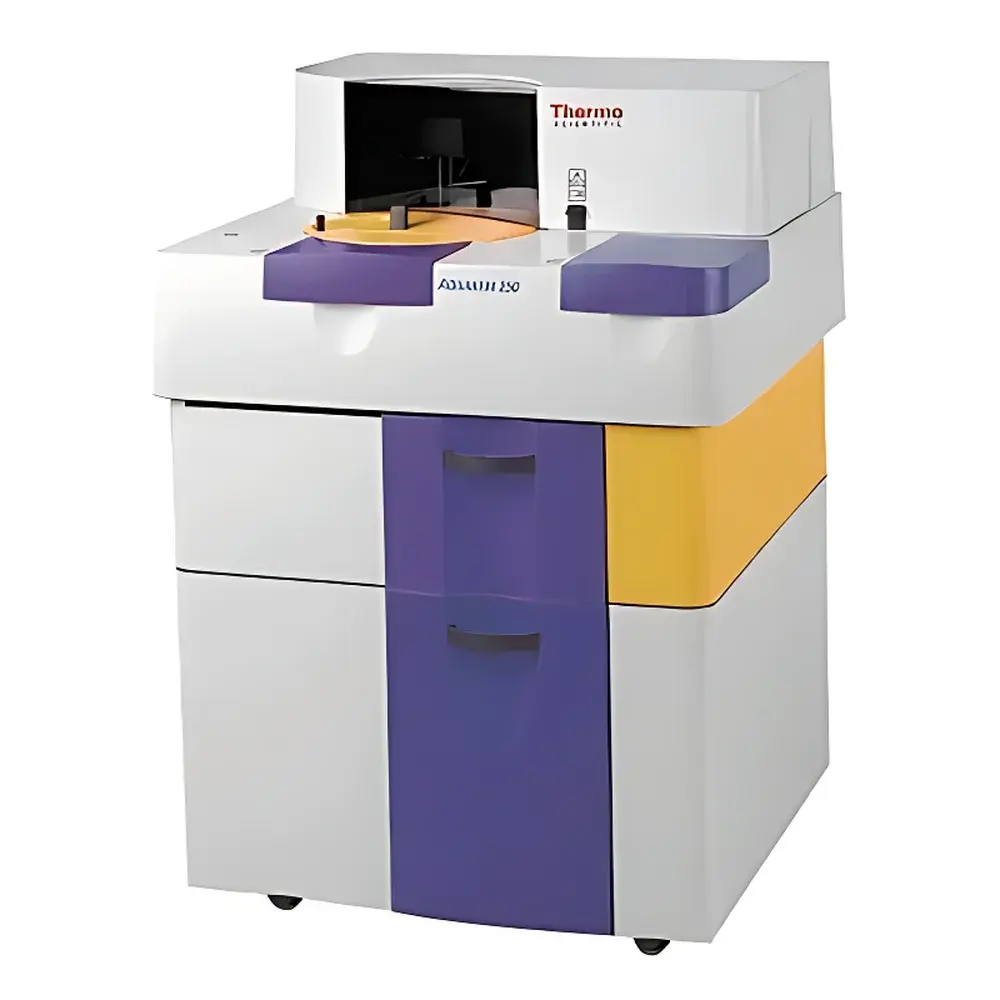
Thermo Fisher Aquakem250 Discrete Automated Water Quality Analyzer
| Brand | Thermo Fisher |
|---|---|
| Origin | Finland |
| Manufacturer | Thermo Fisher Scientific |
| Product Type | Imported |
| Model | Aquakem250 |
| Instrument Category | Laboratory Water Quality Analyzer |
| Detection Speed | 250 tests/hour |
| Sample Positions | 84 |
| Refrigerated Reagent Positions | 35 |
| Wavelength Range | 340–880 nm |
| Maximum Reagents per Test | 4 |
| Cadmium Reduction Module | Optional |
| Barcode Reader | Integrated |
| Sample/Reagent Dispensing | Fully Automated with Internal/External Tip Washing |
| Dilution Capability | Auto Primary & Secondary Dilution |
| Stirring | Independent Stir Bars with Dedicated Wash Station |
| Reagent Flexibility | User-Defined Methods and Custom Reagent Preparation Supported |
Overview
The Thermo Fisher Aquakem250 Discrete Automated Water Quality Analyzer is a high-throughput, open-platform discrete analyzer engineered for precision, flexibility, and regulatory compliance in environmental testing laboratories. Unlike continuous-flow or segmented-flow analyzers, the Aquakem250 employs true discrete analysis—where each sample and reagent are processed in individual cuvettes under precisely controlled reaction conditions. This architecture eliminates cross-contamination, enables independent optimization of reaction kinetics per parameter, and supports simultaneous multi-parameter analysis across heterogeneous sample matrices (e.g., wastewater, surface water, drinking water, and industrial effluents). The system’s optical detection module features a monochromator-based spectrophotometer covering 340–880 nm, delivering high photometric accuracy for colorimetric, enzymatic, and reduction-based methods—including nitrate determination via integrated cadmium column reduction.
Key Features
- Throughput & Efficiency: Delivers up to 250 determinations per hour—scalable across single- or multi-parameter test profiles without compromising analytical integrity.
- Discrete Reaction Architecture: Each sample-reagent combination reacts in a dedicated, optically clear cuvette; eliminates carryover, allows variable incubation times, and supports kinetic and endpoint measurements.
- Flexible Sample Handling: 84-position sample carousel accommodates standard 13–16 mm tubes or microtubes; integrated barcode reader enables full traceability from sample receipt to report generation.
- Reagent Management: 35 refrigerated reagent positions (4–10 °C); real-time reagent volume monitoring; fully automated dispensing with dual-wash (internal + external tip rinse) ensures reproducible delivery and minimizes contamination risk.
- Advanced Mixing & Dilution: Independent stir bars with dedicated wash station ensure complete homogenization without cross-sample residue; auto primary and secondary dilution extends dynamic range for high-concentration analytes (e.g., phosphate, ammonia).
- Modular Expansion: Optional cadmium reduction module provides ISO 10301-compliant nitrate quantification by converting NO₃⁻ to NO₂⁻ prior to diazotization; regenerated cadmium columns reduce consumable costs and support >500 analyses per column.
Sample Compatibility & Compliance
The Aquakem250 is validated for use with raw and treated waters per EPA Methods 353.2, 354.1, and 365.2; ISO standards 6878 (phosphate), 7890-1 (nitrate/nitrite), and 15683 (ammonia); and ASTM D3867 (total phosphorus). Its open method architecture permits implementation of client-developed or modified protocols—including adaptations for saline matrices, turbid samples, or low-level metal speciation when coupled with pre-concentration modules. All hardware and software components comply with IEC 61000-6-3 (EMC), IEC 61010-1 (safety), and EU RoHS directives. The system supports audit-ready operation under GLP and GMP frameworks through configurable user access levels, electronic signatures, and full audit trail logging per FDA 21 CFR Part 11 requirements.
Software & Data Management
Aquakem Control Software (v5.x) provides intuitive workflow configuration, method editor, and QC tracking tools. It supports LIMS integration via ASTM E1384 or HL7 messaging, enabling bidirectional data exchange for sample assignment, result export, and instrument status reporting. Calibration curves—including multi-point non-linear fits (e.g., quadratic, log-log)—are stored permanently per method and can be recalled without recalibration. The software enforces QC rules per Westgard multirule criteria and automatically flags outliers, drift, or calibration failure. Raw absorbance data, reaction kinetics plots, and dilution logs are archived in vendor-neutral formats (CSV, PDF, XML) for third-party statistical review or regulatory submission.
Applications
- Regulatory compliance testing for nutrients (NO₃⁻, NO₂⁻, NH₄⁺, PO₄³⁻, total P, total N)
- Organic load assessment (COD, TOC via persulfate oxidation)
- Heavy metal screening (Cr, Cu, Ni, Zn) using colorimetric chelation assays
- Chlorine residual analysis (free & total chlorine via DPD method)
- Alkalinity and hardness titration (automated endpoint detection)
- Method development labs requiring rapid prototyping of new EPA or ISO-aligned procedures
FAQ
Is the Aquakem250 compliant with EPA and ISO regulatory methods?
Yes—the system is pre-validated for over 40 standard methods including EPA 353.2 (nitrate), EPA 365.2 (phosphate), ISO 7890-1 (nitrite), and ISO 15683 (ammonia). Full validation documentation and method transfer kits are provided.
Can users develop and validate custom analytical methods?
Absolutely. The open architecture supports full method definition: reaction sequence, timing, wavelength, temperature, reagent volumes, and calibration logic. Validation templates and performance qualification (PQ) checklists are included.
What maintenance is required for the cadmium reduction module?
Cadmium columns are regenerated in situ using ascorbic acid and HCl; typical service life exceeds 500 analyses. Column performance is monitored via daily blank checks and integrated flow-pressure diagnostics.
Does the system support unattended overnight operation?
Yes—integrated sample cooling (optional), reagent refrigeration, and power-fail recovery enable 24/7 batch processing. System status alerts are configurable via email or SNMP traps.
How is data integrity ensured during long-term deployment?
All user actions, calibration events, result modifications, and instrument errors are timestamped and cryptographically hashed in an immutable audit trail. Backup archives are encrypted and compatible with enterprise backup solutions.







