
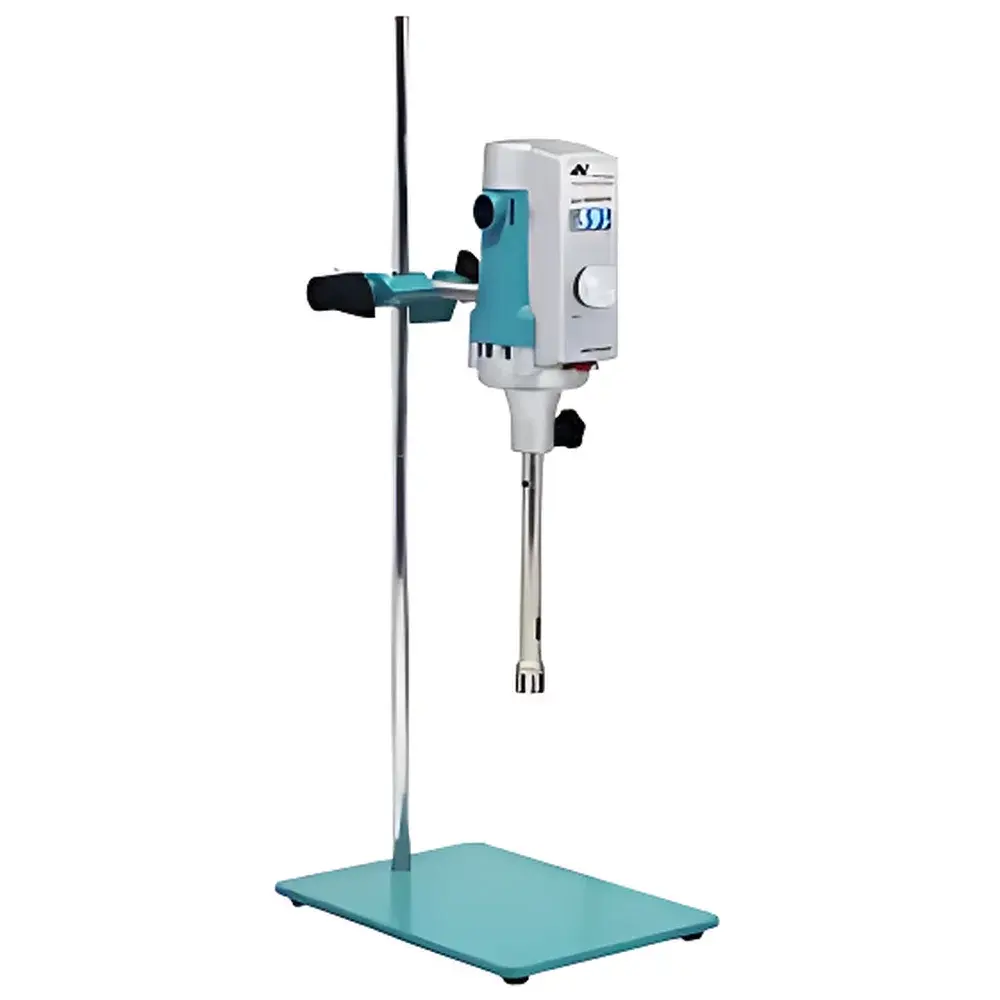
Jihepu AD500S-H Laboratory High-Shear Dispersing & Homogenizing Mixer
| Brand | Jihepu |
|---|---|
| Origin | Shandong, China |
| Model | AD500S-H |
| Type | Probe-type rotor-stator homogenizer |
| Dimensions (W×D×H) | 215 × 310 × 720 mm |
| Weight | 8.7 kg (net), 10 kg (gross) |
| Rated Voltage | AC 220 V |
| Frequency | 50/60 Hz |
| Input Power | 850 W |
| Output Power | 500 W |
| Rated Torque | 17.1 N·cm |
| Speed Range (no-load) | 2000–28,000 rpm |
| Speed Display Resolution | ±10 rpm (LED digital) |
| Timer Range | 1–1000 min |
| Dynamic Speed Monitoring | Yes |
| Speed Memory Function | Yes |
| Overload Protection | Yes |
| Rotor Tip Speed | 12–26 m/s (model-dependent) |
| Max. Operating Temperature | 120 °C |
| Max. Ambient Temperature | ≤40 °C |
| Max. Relative Humidity | ≤80 % |
| Working Head Material | ASTM A276 SS316 stainless steel |
| Bearing Material | PTFE |
| Compatible Probe Sizes | 12G, 18G, 24G, 30G, 36G |
| Water-Based Processing Capacity per Probe | 30–13,000 mL |
| Max. Viscosity Handling | 1000–7000 mPa·s |
| Minimum Immersion Depth | 35–65 mm |
| Stator Diameter | 12–36 mm |
| Working Head Length | 215–238 mm |
Overview
The Jihepu AD500S-H is a precision-engineered laboratory-scale high-shear dispersing and homogenizing mixer designed for reproducible, scalable processing of complex multiphase systems. It operates on the rotor-stator principle—a well-established hydrodynamic mechanism in colloid and dispersion science—where high rotational energy is converted into intense mechanical shear, cavitation, turbulent flow, and interfacial disruption within a precisely engineered narrow gap between rotating and stationary elements. This enables efficient particle size reduction, droplet breakup, phase stabilization, and uniform dispersion across viscous and non-Newtonian media. Unlike continuous-flow systems, the AD500S-H functions in batch mode, making it ideal for formulation development, small-batch synthesis, and process optimization where sample integrity, traceability, and parameter control are critical. Its architecture supports GLP-compliant documentation when integrated with external logging tools, and its design aligns with fundamental engineering requirements for lab-scale homogenization defined in ISO 13320 (laser diffraction) and ASTM D2703 (emulsion stability testing) methodologies.
Key Features
- Digitally controlled variable-speed drive with real-time RPM feedback and ±10 rpm resolution, enabling precise replication of shear history across experiments.
- Five interchangeable SS316 rotor-stator probe assemblies (12G to 36G), each calibrated for distinct throughput and viscosity ranges—ensuring optimal energy transfer without excessive heat generation or foaming.
- PTFE-sealed bearings and fully passivated wetted surfaces comply with USP Class VI biocompatibility standards for pharmaceutical and cosmetic applications.
- Integrated overload protection, dynamic speed monitoring, and automatic torque compensation prevent motor stall during high-viscosity operation and extend service life.
- Robust aluminum-alloy chassis with vibration-damping feet ensures mechanical stability at maximum rotational speeds (up to 28,000 rpm), minimizing harmonic resonance and preserving sample homogeneity.
- LED-based digital interface with programmable timer (1–1000 min) and last-set speed memory allows unattended operation while maintaining experimental continuity across multiple sessions.
Sample Compatibility & Compliance
The AD500S-H accommodates aqueous, oil-in-water, water-in-oil, and solvent-based systems with viscosities up to 7000 mPa·s—covering formulations typical in topical dermatological products (e.g., ointments, creams), functional food emulsions (e.g., mayonnaise analogs, nutraceutical suspensions), industrial coatings (e.g., pigment dispersions in acrylic resins), and nanomaterial slurries (e.g., graphene oxide or TiO₂ suspensions). All wetted components meet ASTM A276 specifications for SS316 stainless steel, ensuring corrosion resistance against organic acids, alkaline buffers, and mild oxidizers. The device is compatible with standard laboratory glassware (e.g., beakers, jacketed vessels) and can be mounted on universal stands for vertical immersion depth control. While not certified to IEC 61000-6-2/6-4 for EMC or CE-marked for EU market placement, its electrical safety design conforms to GB 4793.1–2007 (Chinese equivalent of IEC 61010-1), and operational parameters support alignment with FDA 21 CFR Part 11 data integrity principles when paired with validated external recording software.
Software & Data Management
The AD500S-H operates as a standalone instrument with no embedded firmware or proprietary software stack. All operational parameters—including speed setpoint, elapsed time, and real-time RPM—are displayed locally via LED interface. For traceable data capture, users may integrate external USB or RS-232 data loggers compliant with ISO/IEC 17025 calibration protocols. The unit’s analog tachometer output (0–10 V DC proportional to RPM) supports synchronization with third-party acquisition systems (e.g., LabVIEW, MATLAB, or ELN platforms such as Benchling or LabArchives). Speed memory and timer functionality facilitate repeatable protocol execution—critical for DoE (Design of Experiments) workflows in QC labs or R&D settings requiring strict adherence to SOPs under GMP/GLP frameworks.
Applications
- Emulsion formation and stabilization in cosmetic formulations (e.g., sunscreen lotions, cleansing oils) where droplet size distribution directly impacts SPF efficacy and sensory profile.
- Preparation of nanostructured lipid carriers (NLCs) and solid lipid nanoparticles (SLNs) for controlled drug delivery, leveraging high-shear-induced crystallinity modulation.
- Dispersion of carbon black, titanium dioxide, or iron oxide pigments into polymer matrices for rheology-controlled inkjet inks and conductive pastes.
- Homogenization of microbial cell lysates prior to chromatographic analysis or protein purification—achieving >95% lysis efficiency for Gram-negative bacteria at optimized shear rates.
- Deagglomeration of ceramic nanopowders (e.g., Al₂O₃, ZrO₂) in ethanol or ethylene glycol for slip casting or tape-casting processes.
FAQ
What is the maximum recommended operating temperature for the working head?
The SS316 probe assemblies are rated for continuous operation up to 120 °C; however, thermal expansion effects on rotor-stator clearance should be evaluated empirically for prolonged use above 80 °C.
Can the AD500S-H be used for sterile processing?
While the probe heads are autoclavable (121 °C, 20 min, saturated steam), the main unit is not IP-rated and must remain outside biosafety cabinets or laminar flow hoods; sterilization requires disassembly and separate treatment of wetted components.
Is there a validated method for correlating RPM to shear rate?
Shear rate (s⁻¹) depends on probe geometry, gap width, and fluid rheology; approximate values can be derived using γ̇ ≈ π·N·D / h (where N = rev/s, D = rotor diameter, h = stator-rotor gap); for accurate quantification, rheometric validation with model fluids (e.g., xanthan gum solutions) is advised.
How often should the PTFE bearings be inspected or replaced?
Under normal use (≤4 hrs/day, <5000 rpm average), inspection every 500 operating hours is recommended; replacement intervals vary with abrasive load and are typically 1,200–2,000 hours for low-viscosity aqueous systems.
Does the device support external footswitch or start/stop signaling?
No native I/O ports exist; however, the power input circuit can be interrupted via externally wired relay modules compatible with TTL or dry-contact triggers for integration into automated lab workflows.



