
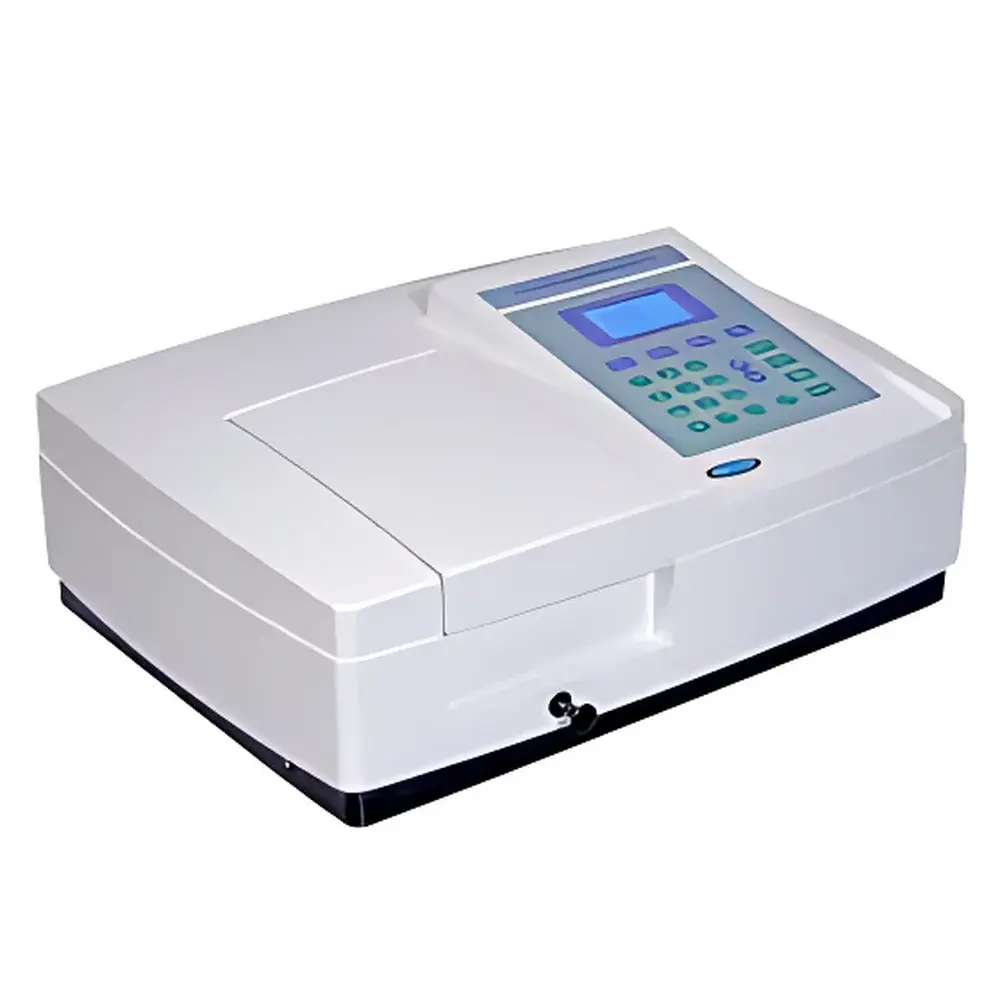
V-5800 Dual-Beam UV-Vis Spectrophotometer
| Brand | Jihepu |
|---|---|
| Origin | Shandong, China |
| Model | V-5800 |
| Optical System | Dual-beam ratio-monitoring |
| Detector | Photodiode array |
| Wavelength Range | 190–1100 nm |
| Wavelength Accuracy | ±0.5 nm |
| Spectral Bandwidth | 2 nm |
| Stray Light | ≤0.05%T |
| Wavelength Repeatability | ≤0.2 nm |
| Photometric Accuracy | ±0.3%T |
| Photometric Repeatability | ≤0.15%T |
| Baseline Flatness | ±0.001 A |
| Drift | ±0.001 A/h (at 500 nm) |
| Noise | ±0.0005 A/h |
| Photometric Range | 0–200%T, –0.3–3 A, 0–9999 C |
| Data Interface | USB |
| Display | 128×64 LCD |
| Light Sources | Long-life imported tungsten & deuterium lamps |
| Dimensions | 460×380×180 mm |
| Weight | 18 kg |
Overview
The Jihepu V-5800 Dual-Beam UV-Vis Spectrophotometer is a precision optical instrument engineered for quantitative and qualitative analysis across research laboratories, quality control environments, and educational institutions. It operates on the fundamental principle of Beer–Lambert law-based absorbance measurement, utilizing a dual-beam ratio-monitoring optical architecture to continuously compare sample and reference beam intensities in real time. This design inherently compensates for source intensity drift, detector sensitivity fluctuations, and environmental thermal variations—ensuring high photometric stability and long-term measurement reproducibility. The instrument covers the full ultraviolet through visible spectral range (190–1100 nm), enabling applications from nucleic acid quantification at 260 nm to colorimetric assays in the near-infrared region. Its 2 nm spectral bandwidth supports adequate resolution for routine molecular absorption studies without compromising signal-to-noise performance.
Key Features
- Dual-beam optical system with real-time reference beam correction, minimizing baseline drift and enhancing measurement robustness under variable ambient conditions.
- Synchronous sine-bar wavelength drive mechanism ensures high wavelength accuracy (±0.5 nm) and exceptional repeatability (≤0.2 nm), critical for method transfer and regulatory compliance.
- 24-bit high-speed analog-to-digital conversion provides enhanced dynamic range and low-noise signal acquisition (±0.0005 A/h), supporting precise low-absorbance measurements.
- Modular lamp design with plug-in tungsten and deuterium sources allows rapid lamp replacement without optical realignment—reducing downtime and maintenance complexity.
- Suspended optical bench architecture mounted on an 8 mm machined aluminum base minimizes mechanical deformation and vibration-induced misalignment, contributing to long-term optical stability.
- Integrated self-calibration routines perform automatic wavelength verification and offset correction, ensuring traceable operation between scheduled maintenance intervals.
Sample Compatibility & Compliance
The V-5800 accommodates standard 10 mm pathlength cuvettes (glass, quartz, or plastic), as well as optional micro-volume adapters and flow cells for specialized workflows. Its photometric accuracy (±0.3%T) and stray light performance (≤0.05%T at 220 nm) meet the minimum requirements specified in ISO 6223, ASTM E275, and USP for UV-Vis spectrophotometers used in pharmaceutical and chemical testing. While the base model does not include 21 CFR Part 11-compliant audit trail functionality, its data export capability via USB interface enables integration into validated laboratory information management systems (LIMS) when paired with compliant third-party software. The instrument conforms to IEC 61010-1 safety standards and electromagnetic compatibility (EMC) requirements per EN 61326-1.
Software & Data Management
The optional V-5800PC configuration includes Jihepu’s proprietary UV-Vis scanning software, compatible with Windows OS. It supports full-spectrum scanning, fixed-wavelength kinetic monitoring, multi-point quantitative analysis using up to 200 stored calibration curves, and DNA/protein concentration calculation using predefined extinction coefficients. All acquired spectra and measurement logs are timestamped and exportable in CSV or ASCII format for downstream statistical analysis or reporting. Data persistence is maintained across power cycles, with internal memory retaining up to 200 test results and 200 calibration profiles—accessible via numeric ID recall. The software interface supports user-defined method templates, facilitating SOP-driven operation in GLP or GMP-aligned environments.
Applications
- Quantitative analysis of organic and inorganic compounds via standard curve methodology in environmental, food, and beverage testing labs.
- Enzyme kinetics and protein-ligand binding studies requiring high temporal resolution and photometric precision.
- Pharmaceutical assay validation and dissolution testing in accordance with USP monographs.
- Educational instruction in analytical chemistry, where reliability, ease of use, and spectral visualization support foundational spectroscopic learning.
- Water quality assessment—including nitrate, phosphate, and heavy metal ion detection—using established colorimetric protocols.
- Quality assurance of dyes, pigments, and optical filters via transmittance and absorbance profiling across the UV-Vis range.
FAQ
What is the maximum scan speed supported by the V-5800?
The instrument performs full-range scans (190–1100 nm) at selectable speeds up to 3000 nm/min, with resolution configurable in 0.1 nm increments.
Does the V-5800 support GLP-compliant data integrity practices?
While the embedded firmware does not provide electronic signatures or audit trails, raw data files retain timestamps and user-assigned identifiers—enabling traceability when managed within a validated LIMS or ELN platform.
Can the V-5800 be operated without a PC?
Yes—the standalone mode supports direct absorbance, %T, and concentration measurements via the front-panel LCD and keypad, with onboard storage for recent results and calibration curves.
Is quartz cuvette compatibility confirmed across the entire wavelength range?
Quartz cuvettes are required for measurements below 350 nm; the instrument’s optical path is fully optimized for fused silica transmission down to 190 nm.
What maintenance intervals are recommended for optimal performance?
Lamp replacement is typically required every 1,000–2,000 hours of operation; annual verification of wavelength accuracy and photometric linearity is advised per ISO/IEC 17025 guidelines.



