
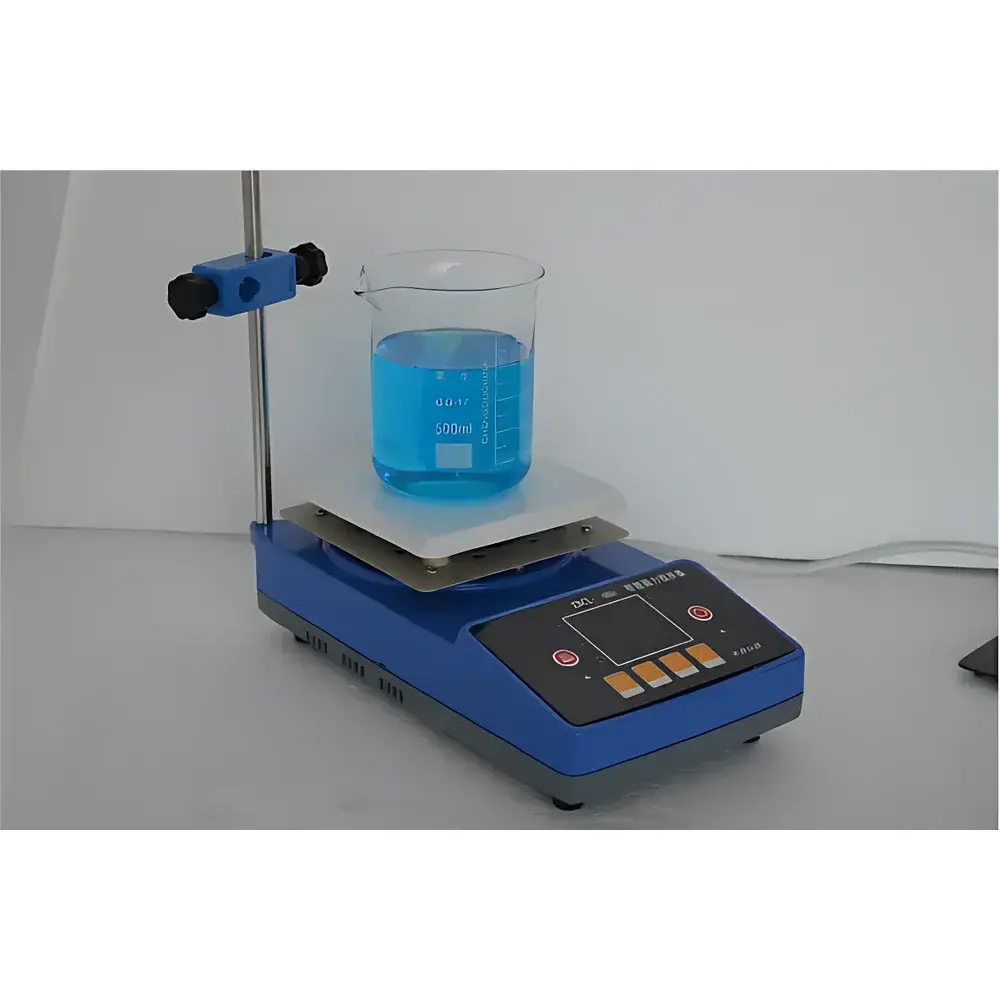
Jihepu ZNCL-BS Intelligent Digital Magnetic Hotplate Stirrer
| Brand | Jihepu |
|---|---|
| Origin | Shandong, China |
| Model | ZNCL-BS |
| Stirring Capacity | 5 L (max) |
| Speed Range | 50–1800 rpm, stepless adjustment |
| Heating Temperature Range | Ambient to 350 °C |
| Heating Plate Dimensions | 140×140 mm / 180×180 mm / 230×230 mm / 280×280 mm (configurable) |
| Heating Power | 260–750 W (model-dependent) |
| Motor Power | 40 W, DC 14–24 V, brushless |
| Control Accuracy | ±1 °C |
| Display | Dual digital LED (temperature & speed) |
| Control Algorithm | Fuzzy PID with auto-tuning |
| Safety Features | Thermocouple failure protection (display “HHHH”), overheat cutoff, insulated PBT housing |
| Input Voltage | 220 V AC, 50 Hz, 160–240 V wide-range compatible |
Overview
The Jihepu ZNCL-BS Intelligent Digital Magnetic Hotplate Stirrer is an integrated laboratory instrument engineered for precise, reproducible heating and magnetic stirring of liquid samples in glass vessels ranging from 50 mL to 10 L. Unlike conventional hotplate stirrers relying on simple on/off or proportional control, the ZNCL-BS employs a dual-sensor fuzzy PID temperature regulation system—capable of internal thermocouple (built-in ceramic sensor) or external thermocouple (optional stainless-steel probe) feedback—to achieve stable thermal equilibrium with minimal overshoot (<1 °C deviation). Its core operation combines contactless magnetic coupling (via rotating permanent magnet array beneath the heated surface) with resistive heating through Cr20Ni80 alloy heating elements embedded beneath a vacuum-deposited TU2 electrolytic copper or black crystal ceramic top plate. This architecture ensures uniform heat distribution, chemical resistance, and long-term dimensional stability under repeated thermal cycling up to 350 °C—making it suitable for solvent reflux, catalyst activation, polymerization initiation, and dissolution testing in regulated environments.
Key Features
- High-temperature ceramic or vacuum-coated copper heating surface (140×140 mm to 280×280 mm options), corrosion-resistant and non-porous for easy decontamination.
- Brushless DC motor (PAPST-series equivalent) delivering quiet, spark-free operation with extended service life (>10,000 hours MTBF) and consistent torque across full speed range (50–1800 rpm).
- Dual independent digital displays: real-time temperature (PV) and setpoint (SV), plus rotational speed (r/min); all controlled via intuitive single-button interface with directional keys.
- Fuzzy PID algorithm with automatic self-tuning (AT mode): dynamically adapts control parameters during startup or when load mass, vessel geometry, or ambient conditions change—reducing stabilization time and thermal inertia effects.
- Robust safety architecture: thermocouple open-circuit detection (“HHHH” display + heater disable), over-temperature cutoff, wide-input voltage tolerance (160–240 V AC), and flame-retardant PBT polymer housing rated UL94 V-0.
- Ergonomic 30° inclined control panel optimized for seated and standing operator positions; rear-mounted universal rod clamp with adjustable cross-arm for secure flask fixation.
Sample Compatibility & Compliance
The ZNCL-BS accommodates standard and custom reaction vessels—including round-bottom flasks, beakers, and jacketed reactors—from 50 mL to 10 L volume. Its flat, inert heating surface supports borosilicate glass, quartz, and PTFE-coated containers without risk of adhesion or thermal stress cracking. The instrument meets general electrical safety requirements per IEC 61010-1 (2010) for laboratory equipment and incorporates design features aligned with GLP-compliant workflows: audit-trail-capable parameter logging (when paired with optional RS232/USB data interface), traceable temperature calibration points, and repeatable ramp-hold profiles. While not certified to FDA 21 CFR Part 11 out-of-the-box, its deterministic control logic and hardware-enforced safety interlocks support validation protocols required in pharmaceutical QC labs operating under USP , ISO 17025, or ASTM E2913-21 guidelines for thermal process verification.
Software & Data Management
The ZNCL-BS operates as a standalone analog-digital hybrid controller with no embedded OS or network stack. All operational parameters—including setpoints, ramp rates, hold durations, and AT status—are stored in non-volatile memory and persist through power cycles. Optional serial communication modules (RS232 or USB-to-serial) enable integration with third-party lab information systems (LIMS) or PC-based acquisition software (e.g., LabVIEW, MATLAB, or custom Python scripts using PySerial) for time-stamped data export (CSV/TXT) of temperature and speed trajectories. Firmware updates are performed via physical programmer interface; no cloud connectivity or remote access capabilities are implemented—ensuring data sovereignty and minimizing cybersecurity exposure in regulated facilities.
Applications
This hotplate stirrer is routinely deployed in synthetic chemistry labs for Grignard reagent preparation, esterification reactions, and Suzuki couplings requiring strict thermal control below solvent boiling points. In materials science, it enables homogeneous dispersion of nanomaterials (e.g., graphene oxide, metal oxides) in viscous polymer precursors at elevated temperatures. Quality control laboratories utilize it for dissolution testing per USP , extractables/leachables studies, and buffer equilibration prior to HPLC or titration analysis. Its ability to maintain ±1 °C stability over multi-hour periods—without active cooling—makes it appropriate for accelerated stability trials (ICH Q1A) and enzymatic assays where thermal drift must remain below kinetic sensitivity thresholds.
FAQ
What is the maximum recommended vessel size for stable stirring at 1800 rpm?
For optimal vortex formation and thermal homogeneity, use vessels ≤2 L at full speed; larger volumes (up to 5 L) require speeds ≤800 rpm to prevent splashing and ensure magnetic coupling integrity.
Can the ZNCL-BS be used with non-aqueous solvents such as DMF or chlorobenzene?
Yes—provided the vessel is chemically compatible and sealed appropriately; however, always verify flash point and vapor pressure against the 350 °C surface limit and ensure adequate fume hood ventilation.
Is external thermocouple calibration traceable to NIST standards?
The instrument accepts standard K-type thermocouples; users must perform field calibration using NIST-traceable reference probes per ISO/IEC 17025 procedures—the device itself does not include factory calibration certificates.
Does the unit support programmable temperature ramps?
No—ramp functionality is not built into the base firmware; however, external programmable controllers (e.g., Eurotherm, Watlow) can be interfaced via analog 0–10 V output (optional module) for multi-stage thermal profiles.
What maintenance is required to sustain ±1 °C accuracy over time?
Annual verification of thermocouple response time and zero-offset drift is recommended; clean the heating surface with ethanol after each use and inspect the magnetic stir bar for demagnetization every 6 months in high-throughput settings.



