
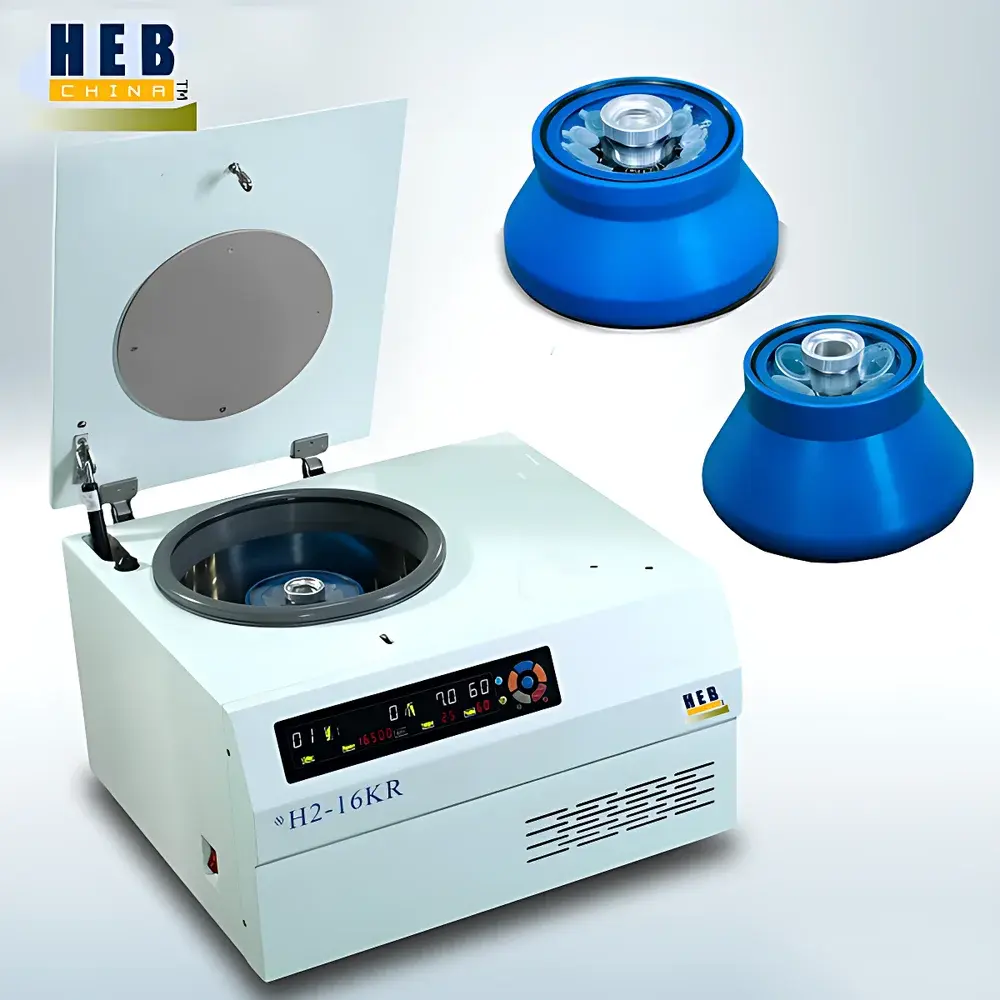
Hepu H2-16KR Benchtop High-Speed Refrigerated Centrifuge
| Brand | Hepu |
|---|---|
| Origin | Shandong, China |
| Model | H2-16KR |
| Instrument Type | Benchtop Centrifuge |
| Speed Range | 10,000–30,000 rpm (Max. 16,500 rpm) |
| Max. RCF | 18,757 × g |
| Max. Capacity | 6 × 50 mL |
| Temperature Range | –20 °C to +40 °C |
| Temp. Stability | ±1.0 °C |
| Timer | 1–99 min |
| Acceleration/Deceleration | 10 selectable ramps (Ramp 9: free deceleration >540 s) |
| Power Supply | AC 220 V ±10 %, 50 Hz, 10 A |
| Noise Level | ≤65 dB(A) |
| Dimensions (W×D×H) | 480 × 560 × 360 mm |
| Net Weight | 65 kg |
Overview
The Hepu H2-16KR is a benchtop high-speed refrigerated centrifuge engineered for precision separation of biomolecules—including nucleic acids, proteins, organelles, and viral particles—in research and clinical laboratory environments. It operates on the principle of sedimentation under controlled gravitational force (RCF), where rotational acceleration induces differential migration of particles based on size, density, and shape within a liquid medium. Its refrigerated architecture maintains sample integrity during extended high-speed runs, with temperature stabilization from –20 °C to +40 °C—critical for thermolabile biological samples such as plasmid DNA, ribonucleoprotein complexes, and membrane vesicles. Designed for compact laboratory footprints, the H2-16KR integrates robust mechanical construction, intelligent rotor recognition, and real-time parameter adjustment without interrupting operation—making it suitable for routine PCR prep, cell lysate clarification, and preparative ultracentrifugation workflows in molecular biology, immunology, and clinical diagnostics.
Key Features
- Stainless steel centrifuge chamber and fully welded steel frame ensure structural rigidity, corrosion resistance, and long-term operational stability.
- Brushless AC frequency-controlled motor delivers smooth acceleration/deceleration profiles, low vibration, and acoustic performance ≤65 dB(A) at maximum speed.
- Intelligent rotor auto-detection system identifies installed rotor type and enforces speed limits based on certified RCF ratings—preventing over-speed operation and enhancing user safety.
- Multi-segment acceleration and deceleration control (10 programmable ramps) enables optimized pelleting of sensitive analytes; Ramp 9 provides extended free-coast deceleration (>540 s) for fragile precipitates or gradient-based separations.
- High-contrast color LED display presents real-time values for speed (rpm), RCF (×g), time remaining, and chamber temperature—with one-touch toggle between rpm and RCF units.
- Electronic lid interlock with automatic engagement ensures secure closure prior to rotation and immediate rotor stop upon lid opening—compliant with IEC 61010-2-020 safety standards for centrifuges.
- High-efficiency eco-refrigeration system uses environmentally compliant refrigerant to maintain chamber temperature ≤–4 °C even at 16,500 rpm, supporting cold-sensitive protocols such as RNase inhibition or mitochondrial isolation.
- One-touch pre-cooling function initiates rapid chamber cooldown before sample loading—reducing thermal equilibration time and preserving sample viability.
Sample Compatibility & Compliance
The H2-16KR accommodates standard conical-bottom tubes (1.5–50 mL), including polypropylene, polycarbonate, and borosilicate glass formats. Compatible rotors include fixed-angle configurations optimized for high-RCF pelleting (e.g., 24 × 1.5/2.2 mL at 14,000 rpm / 18,757 × g). The instrument meets essential electrical and mechanical safety requirements per IEC 61010-1 and IEC 61010-2-020. While not validated for GMP/GLP-regulated production environments, its design supports audit-ready documentation practices—including timestamped run logs (via optional USB export), parameter traceability, and consistent thermal performance—aligning with internal quality procedures in academic, clinical, and contract research laboratories. It is routinely deployed in workflows referenced by ISO 15189 (medical laboratories), CLSI EP05-A3 (precision evaluation), and USP (analytical instrument qualification).
Software & Data Management
The H2-16KR operates via an embedded microcontroller interface with no external PC dependency. All operational parameters—including speed, time, temperature, ramp profiles, and rotor ID—are stored in non-volatile memory for recall across sessions. Run history (date/time, rotor used, final RCF, duration) is retained for up to 100 cycles and exportable via USB flash drive in CSV format for integration into LIMS or electronic lab notebooks. Though lacking network connectivity or 21 CFR Part 11-compliant electronic signatures, its deterministic control logic, hardware-enforced safety limits, and immutable parameter logging support basic ALCOA+ data integrity principles (Attributable, Legible, Contemporaneous, Original, Accurate) for research-grade documentation.
Applications
- Preparative isolation of genomic DNA, plasmid DNA, and total RNA from mammalian, bacterial, and plant tissues.
- Clarification of cell lysates and purification of inclusion bodies prior to chromatographic analysis.
- Subcellular fractionation—including nuclear, mitochondrial, and microsomal pellet enrichment—under controlled cold conditions.
- Virus concentration and purification from culture supernatants or clinical specimens (e.g., serum, CSF).
- Antibody purification via PEG precipitation and subsequent high-speed pelleting.
- Routine clinical applications: serum/plasma separation, PBMC isolation, and urine sediment analysis.
FAQ
What is the maximum relative centrifugal force (RCF) achievable with the H2-16KR?
The H2-16KR achieves a maximum RCF of 18,757 × g when using the 24-position angle rotor (3) at 14,000 rpm.
Does the centrifuge support continuous temperature monitoring during operation?
Yes—the integrated Pt100 sensor continuously measures chamber temperature and displays real-time values with ±1.0 °C accuracy.
Can I modify time or temperature while the rotor is spinning?
Yes, all parameters—including timer, setpoint temperature, and acceleration/deceleration ramps—can be adjusted dynamically without stopping the run.
Is rotor calibration required before first use?
No calibration is needed; rotor identification is performed automatically via embedded RFID tags or mechanical coding, and speed/RCF calculations are factory-traceable.
What safety certifications does the H2-16KR comply with?
It conforms to IEC 61010-1 (general safety) and IEC 61010-2-020 (particular safety requirements for centrifuges), including mechanical balance detection, overspeed protection, and lid-lock verification.



