
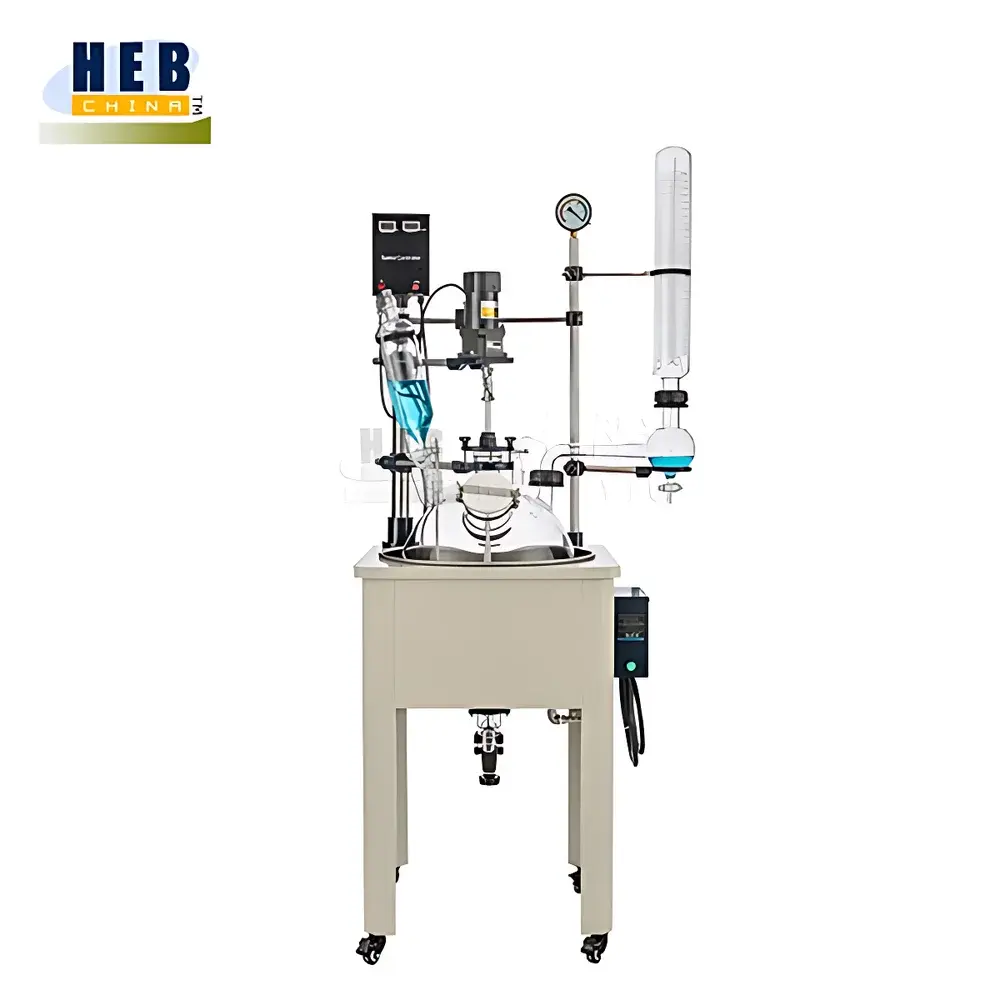
HePu F-30L Single-Layer Glass Reactor
| [Brand | HePu (Jihepu) |
|---|---|
| Origin | Shandong, China |
| Model | F-30L |
| Capacity | 30 L |
| Vessel Material | Borosilicate Glass (GG-17) |
| Operating Pressure | Low-pressure |
| Vacuum Degree | 0.098 MPa |
| Temperature Range | −80 °C to +250 °C |
| Stirring Speed | 0–450 rpm |
| Stirring Power | 120 W, 220 V / 50 Hz |
| Heating Power | 8 kW, 380 V / 50 Hz |
| Overall Dimensions (W×D×H) | 750 × 590 × 2160 mm |
| Net Weight | Not specified |
| Sealing | PTFE-lined flange seals (Ø80 mm) |
| Stirrer Shaft Diameter | 15 mm |
| Stirrer Type | Anchor-type stainless steel blade with PTFE coating |
| Base Mobility | Casters with brakes |
| Compliance | Designed for laboratory-scale synthesis under GLP-aligned operational conditions] |
Overview
The HePu F-30L Single-Layer Glass Reactor is a modular, bench-to-pilot scale chemical reaction system engineered for controlled synthesis, reflux, distillation, and temperature-sensitive batch processing in research and development laboratories. Its core design follows classical jacketless reactor architecture, where thermal management is achieved via external heating mantles or internal cooling coils—enabling precise, non-invasive temperature regulation without compromising optical access or chemical inertness. The reactor operates under low-pressure conditions with a validated vacuum capability of up to 0.098 MPa (equivalent to ~20 mbar absolute), supporting solvent removal, reduced-boiling-point reactions, and moisture-sensitive chemistry. All wetted surfaces—including the 30 L spherical reaction vessel—are fabricated from ASTM E438 Type I, Class A borosilicate glass (GG-17), ensuring high thermal shock resistance (ΔT ≥ 120 °C), low coefficient of thermal expansion (3.3 × 10⁻⁶/K), and exceptional chemical durability against acids, alkalis, and organic solvents. Structural support is provided by a rigid frame combining powder-coated carbon steel and aluminum alloy components, optimized for static stability and mobile repositioning.
Key Features
- Borosilicate glass (GG-17) vessel with seven standardized ground-glass ports (including 34/40, 50/60, and Ø120 mm flanged interfaces) for flexible integration of condensers, dropping funnels, thermowells, and inert gas inlets.
- PTFE-sealed Ø80 mm flanged stirring port with ceramic-bearing-supported shaft and anchor-type agitator (15 mm diameter, PTFE-coated stainless steel), delivering uniform shear distribution and minimal dead volume.
- Electronically controlled infinite-speed DC motor drive (0–450 rpm), equipped with torque-enhancing 3:1 gear reduction and digital RPM display—eliminating brush arcing and enabling long-term continuous operation.
- Integrated PT100 temperature sensor with digital readout, calibrated for direct in-vessel measurement across −80 °C to +250 °C range; compatible with external PID controllers for closed-loop thermal regulation.
- Large-diameter (Ø120 mm) top-access cleaning port and angled bottom discharge valve (glass-bodied, PTFE-seated) to minimize residue retention and simplify CIP procedures.
- Mobility system featuring heavy-duty locking casters (braked swivel type), allowing safe relocation within fume hoods or shared lab spaces without disassembly.
- Modular auxiliary compatibility: optional electric heating mantle (8 kW, 380 V), copper cooling coil (custom-wound), explosion-proof motor/inverter (EX-rated, 180 W), and mechanical seal upgrade kits.
Sample Compatibility & Compliance
The F-30L reactor accommodates heterogeneous and homogeneous reaction mixtures—including slurries, viscous polymer solutions, catalytic suspensions, and air/moisture-sensitive organometallic systems—without material degradation or leaching. Its GG-17 glass construction complies with ISO 3585 for laboratory glassware and meets dimensional tolerances per DIN 12350 for interchangeability with standard Schott, Kimble, and Chemglass accessories. While not certified to ASME BPVC Section VIII or PED 2014/68/EU, the unit is intended for non-pressurized or low-pressure (<0.1 MPa gauge) operation in accordance with OSHA 1910.119 process safety guidelines for laboratory-scale equipment. Vacuum integrity has been verified per ASTM E1357–90 (Standard Test Method for Determining Vacuum Integrity of Glass Apparatus). Documentation supports traceable calibration of temperature and rotational sensors for GLP-compliant recordkeeping.
Software & Data Management
This analog-digital hybrid reactor does not include embedded firmware or proprietary software. However, its analog outputs (0–10 V or 4–20 mA signals from PT100 and tachometer circuits) are compatible with third-party data acquisition systems (e.g., LabVIEW, Delta Tau PMAC, or Eurotherm 2408) for time-stamped logging of temperature, agitation speed, and vacuum level. Optional RS485 Modbus RTU interface modules can be retrofitted to enable integration into centralized lab monitoring networks compliant with FDA 21 CFR Part 11 requirements when paired with audit-trail-enabled SCADA platforms. All user-adjustable parameters—stirring speed setpoint, target temperature, and vacuum threshold—are manually configured and mechanically locked to prevent unintended changes during unattended operation.
Applications
- Small-batch synthesis of fine chemicals, pharmaceutical intermediates, and specialty polymers under inert atmosphere or reduced pressure.
- Controlled reflux and fractional distillation of heat-labile compounds using dual-path condensers and precision drip addition via 2 L constant-pressure funnel.
- Kinetic studies requiring real-time temperature profiling and reproducible agitation profiles (e.g., crystallization induction time measurement).
- Process development for scale-up to pilot reactors, leveraging identical glass-surface chemistry and geometric similarity (aspect ratio ~1.2).
- Teaching laboratories for demonstrating reaction engineering principles—including mass transfer limitations, heat balance modeling, and vacuum-assisted purification workflows.
FAQ
What is the maximum allowable operating temperature for the GG-17 glass vessel?
The borosilicate glass body is rated for continuous service up to +250 °C; short-term excursions to +300 °C are permissible under static, non-pressurized conditions.
Can this reactor be used for hydrogenation reactions under H₂ pressure?
No—it is designed exclusively for atmospheric or sub-atmospheric operation. Pressurized hydrogenation requires dual-layer (jacketed) reactors with ASME-certified pressure vessels and specialized gas-handling manifolds.
Is the PTFE sealing system resistant to hydrofluoric acid (HF)?
Standard PTFE exhibits limited resistance to anhydrous HF at elevated temperatures; for HF-containing systems, optional perfluoroelastomer (FFKM) gaskets or fused quartz adapters are recommended.
Does the unit include validation documentation for IQ/OQ protocols?
Factory test reports (leak testing, temperature uniformity mapping, vacuum decay rate) are supplied; full GMP-compliant qualification packages require site-specific execution by the end user’s QA team.
What maintenance intervals are recommended for the stirring motor and gearbox?
Lubrication-free operation is specified; biannual visual inspection of shaft runout, seal compression, and caster locking mechanisms is advised per manufacturer’s preventive maintenance schedule.



