
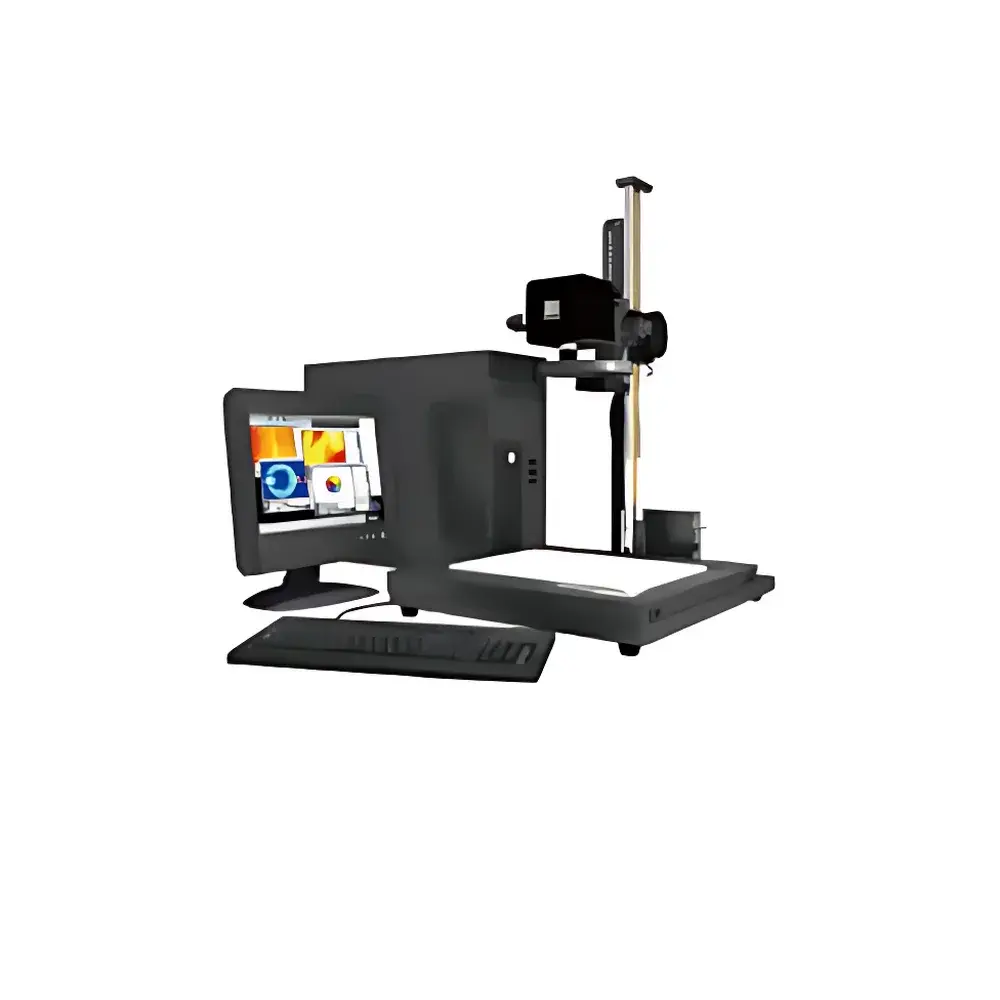
WPA-KAMAKIRI Online Birefringence and Residual Stress Analyzer
| Brand | Photonic Lattice |
|---|---|
| Origin | Japan |
| Model | WPA-KAMAKIRI |
| Output | Retardation [nm], Fast Axis Orientation [°] |
| Measurement Wavelengths | 523 nm, 543 nm, 575 nm |
| Birefringence Range | 0–3000 nm (extendable to 10,000 nm with optional high-retardation optics) |
| Fast Axis Range | 0–180° |
| Repeatability | <1 nm |
| Measurable Area | 97 × 77 mm to 2900 × 2310 mm |
| Compliance | CE-marked optical metrology system for industrial QA/QC environments |
| Software | KAMAKIRI Control Suite v4.x with real-time polarization analysis engine |
Overview
The WPA-KAMAKIRI Online Birefringence and Residual Stress Analyzer is a high-speed, non-contact polarimetric imaging system engineered for in-line, real-time quantification of optical retardation and fast-axis orientation in transparent and semi-transparent polymer films, laminates, and molded components. Developed through a strategic integration of Photonic Lattice’s proprietary micropolarizer array technology and high-sensitivity CCD sensors from Photron — a global leader in ultra-high-speed imaging — the WPA-KAMAKIRI implements full-Stokes or Mueller matrix-based polarization analysis at production-line speeds. Unlike conventional single-point or scanning ellipsometers, this system captures spatially resolved birefringence maps across meter-scale substrates in a single exposure, enabling process-critical feedback on molecular orientation, thermal history, and mechanical stress distribution during roll-to-roll coating, extrusion, stretching, or thermoforming operations.
Key Features
- Simultaneous multi-wavelength retardation measurement at 523 nm, 543 nm, and 575 nm — enabling dispersion-corrected birefringence evaluation and identification of wavelength-dependent stress artifacts.
- Real-time pixel-level computation of retardation (0–3000 nm standard; up to 10,000 nm with optional high-dynamic-range optical module) and fast-axis angle (0–180°) with <1 nm repeatability under controlled environmental conditions.
- Large-field-of-view capability: configurable imaging area from 97 × 77 mm (for lab validation) up to 2900 × 2310 mm (for wide-web film inspection), supporting both fixed-mount and gantry-integrated installations.
- Integrated calibration traceability: factory-calibrated against NIST-traceable retardation standards; supports user-initiated recalibration using certified quarter-wave and half-wave reference plates.
- Ruggedized industrial housing rated IP54, compatible with ambient temperature fluctuations (15–35 °C) and humidity levels ≤70% RH non-condensing — designed for continuous operation in cleanroom-adjacent manufacturing zones.
Sample Compatibility & Compliance
The WPA-KAMAKIRI is validated for quantitative birefringence assessment of optically anisotropic materials including triacetyl cellulose (TAC), polycarbonate (PC), cyclo-olefin copolymer (COC), polymethyl methacrylate (PMMA), polyethylene terephthalate (PET), polyethylene naphthalate (PEN), polystyrene (PS), polyimide (PI), and fused silica or borosilicate glass substrates. It complies with ISO 11477 (Plastics — Determination of birefringence), ASTM D899 (Standard Test Method for Optical Anisotropy of Transparent Plastics), and JIS K 7131 (Testing methods for optical properties of plastics). Data acquisition and storage protocols support GLP/GMP-aligned audit trails, including timestamped operator ID, instrument configuration logs, and raw polarization image archiving — fully compatible with FDA 21 CFR Part 11 requirements when deployed with validated software configuration and electronic signature modules.
Software & Data Management
The KAMAKIRI Control Suite v4.x provides a deterministic, deterministic acquisition pipeline with dual operating modes: (1) real-time streaming mode for live process monitoring with customizable alarm thresholds on retardation deviation or axis misalignment; and (2) batch analysis mode for post-process statistical mapping (e.g., Cpk, σ-map, gradient vector fields). All measurements are stored in HDF5 format with embedded metadata (wavelength, exposure time, lens ID, calibration epoch), ensuring FAIR (Findable, Accessible, Interoperable, Reusable) data principles. Export options include CSV (tabular metrics), TIFF (8/16-bit retardation and orientation maps), and JSON (machine-readable configuration + results) — interoperable with MES platforms such as Siemens Opcenter, Rockwell FactoryTalk, and custom Python-based SPC dashboards via RESTful API.
Applications
- Roll-to-roll quality assurance of phase-difference compensation films used in LCD and OLED display stacks.
- In-process monitoring of uniaxial/biaxial stretching parameters in PET and TAC film production lines.
- Residual stress profiling in injection-molded optical lenses and light-guide plates to prevent warpage-induced wavefront distortion.
- Validation of annealing efficacy in glass substrates prior to AR coating deposition.
- Development and qualification of bio-based or recycled polymer formulations where crystallinity-induced birefringence must remain within specification limits.
FAQ
Is the WPA-KAMAKIRI suitable for measuring birefringence in curved or textured surfaces?
The system requires optically flat, parallel-faced samples for accurate quantitative retardation mapping. Curved substrates introduce path-length variation and depolarization effects that exceed the correction capacity of the current optical model; however, localized flat regions on molded parts (e.g., lens center zones) can be assessed with appropriate fixturing.
Can measurement data be integrated into our existing SCADA system?
Yes — the KAMAKIRI Control Suite includes OPC UA server functionality and supports Modbus TCP register mapping for direct integration with major SCADA and DCS platforms without middleware.
What maintenance is required for long-term accuracy stability?
Annual recalibration against certified retardation standards is recommended. No consumables are involved; the micropolarizer array and sensor assembly are hermetically sealed and warrantied for 5 years under normal industrial use conditions.
Does the system support automated pass/fail judgment based on user-defined tolerances?
Yes — the software allows definition of spatial ROI masks and per-pixel or zone-averaged tolerance bands for retardation and axis angle, with configurable binary output signals (TTL or Ethernet/IP) for PLC-triggered sorting or rejection logic.





