
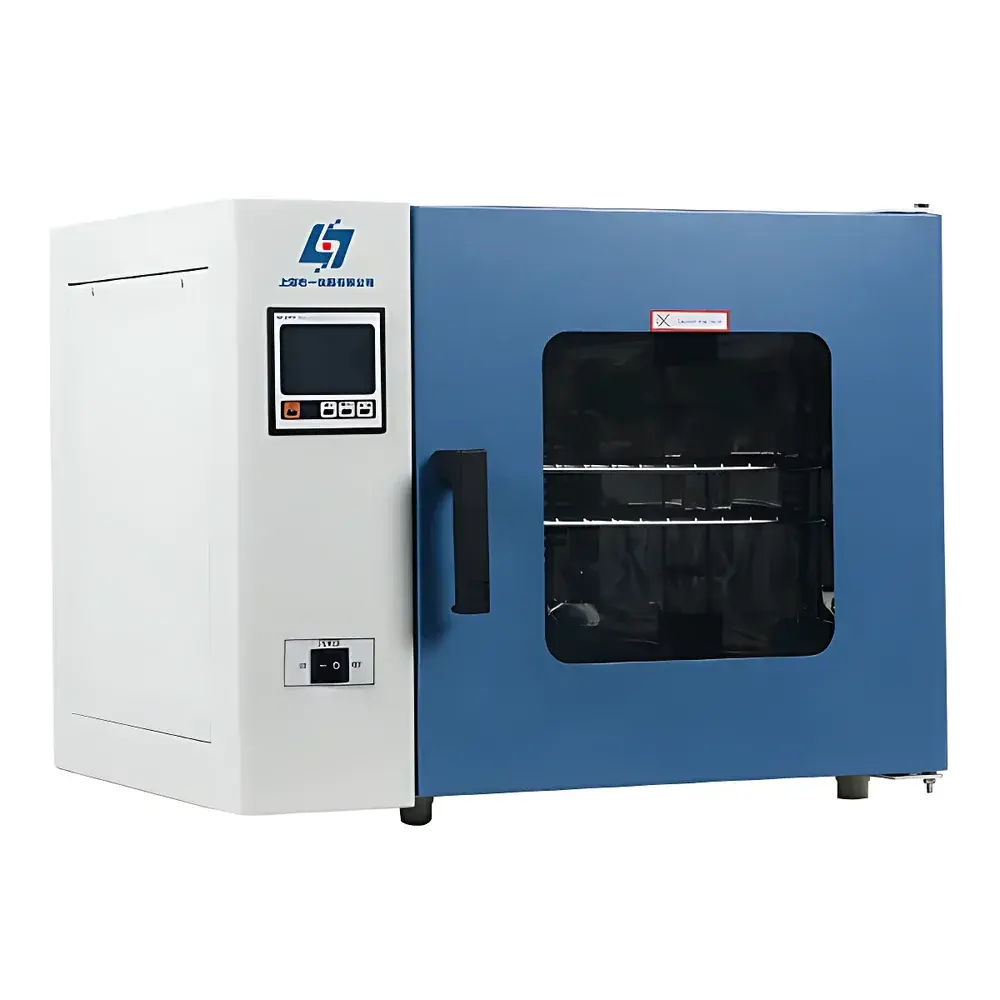
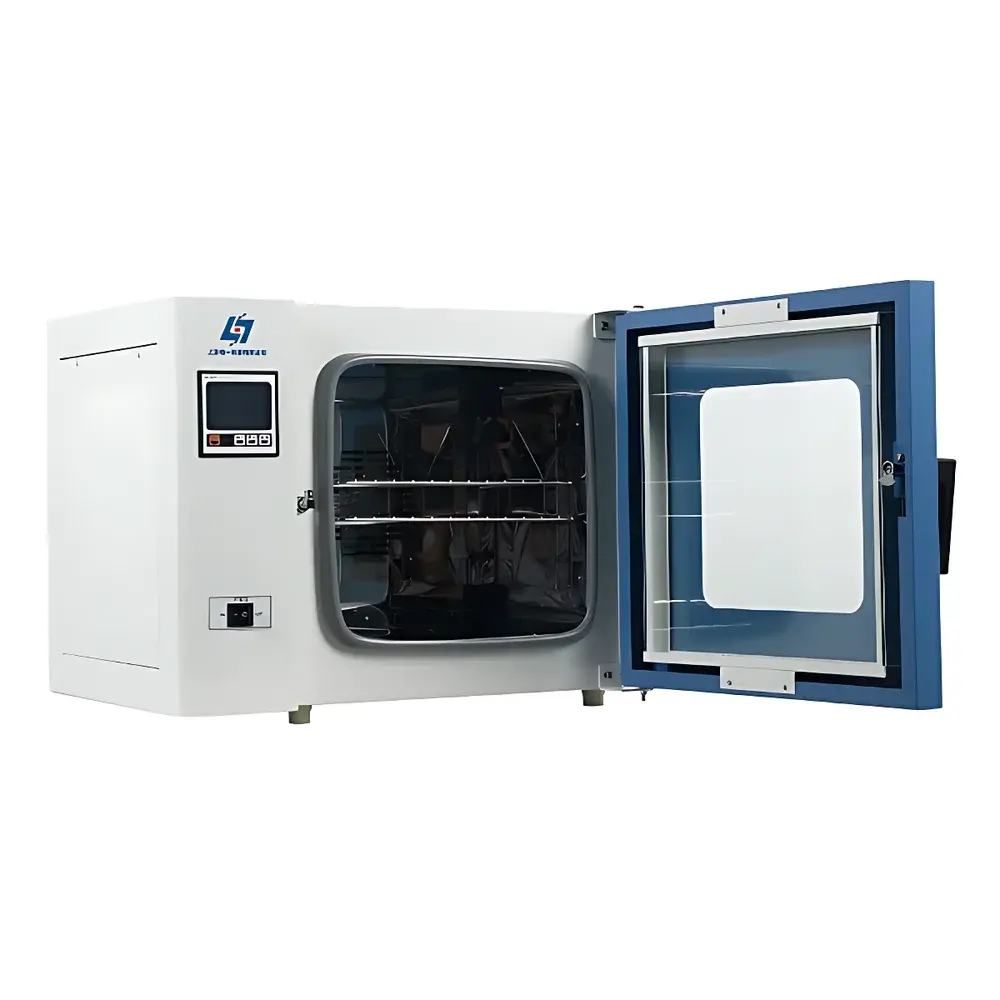
Yoyi DHG-9203A Forced-Air Constant-Temperature Drying Oven
| Brand | Yoyi |
|---|---|
| Origin | Shanghai, China |
| Manufacturer Type | Direct Manufacturer |
| Product Category | Domestic |
| Model | DHG-9203A |
| Instrument Type | General-Purpose Drying Oven |
| Temperature Range | RT+10°C to 280°C |
| Temperature Uniformity | ±2.5% (at 100°C) |
| Temperature Fluctuation | ±1°C |
| Temperature Resolution | 0.1°C |
| External Dimensions (W×D×H) | 880×800×830 mm |
| Internal Chamber Dimensions (W×D×H) | 600×595×650 mm |
| Internal Chamber Material | Mirror-Finish Stainless Steel |
| Heating Method | Electric Resistive Heating |
| Power Input | 2500 W |
| Rated Voltage/Frequency | AC 220 V / 50 Hz |
| Working Environment | 5–40°C ambient, ≤50% RH |
| Standard Compliance | GB/T 30435–2013 |
Overview
The Yoyi DHG-9203A Forced-Air Constant-Temperature Drying Oven is an industrial-grade laboratory drying system engineered for precision thermal processing in research, quality control, and production environments. It operates on the principle of forced convection—using a rear-mounted centrifugal blower and optimized air duct architecture to circulate heated air uniformly throughout the chamber. This design ensures rapid temperature stabilization, minimal thermal gradients, and high reproducibility across repeated cycles—critical for applications requiring strict adherence to thermal protocols such as moisture content determination (per ASTM D2216 or ISO 787-2), polymer curing, pharmaceutical residual solvent removal, and pre-sterilization drying of glassware and instruments. The oven complies with GB/T 30435–2013, the Chinese national standard governing performance, safety, and metrological requirements for electric heating ovens and forced-air drying ovens.
Key Features
- Microprocessor-based PID temperature controller with intuitive LCD menu interface—enabling simultaneous display of setpoint, real-time chamber temperature, and remaining hold time
- Robust thermal architecture: mirror-finish stainless steel interior (SUS304), cold-rolled steel exterior with electrostatic epoxy coating, and high-temperature silicone door gasket for long-term sealing integrity
- Efficient forced-air circulation system with rear-mounted blower and directional airflow channels—achieving ±2.5% temperature uniformity at 100°C (measured per GB/T 30435–2013 test methodology)
- Comprehensive safety safeguards: independent over-temperature cut-off circuit (optional), power-loss data retention with auto-restart functionality, and audible/visual alarm for deviation exceeding ±1°C
- Large dual-layer tempered glass observation window with internal lighting—supporting non-intrusive process monitoring without compromising thermal stability
- Modular shelving system with adjustable stainless steel trays (2 standard included); maximum load capacity optimized for uniform heat transfer
- Integrated rear ventilation ports with automatic exhaust modulation—enabling passive moisture evacuation during extended drying cycles without manual damper adjustment
Sample Compatibility & Compliance
The DHG-9203A accommodates a broad range of sample types—including powders, granules, thin films, coated substrates, biological tissue sections, and metal/plastic components—within its 220 L working volume. Its RT+10°C to 280°C operating range supports common thermal processes such as desiccation (e.g., soil moisture analysis per ISO 11274), annealing of electronic assemblies, pre-baking of PCBs, and accelerated aging of polymeric materials (ASTM D573). All electrical and thermal safety designs conform to IEC 61010-1:2010 for laboratory equipment. While not inherently compliant with FDA 21 CFR Part 11, optional RS485 interface with audit-trail-capable software enables integration into GLP/GMP workflows where electronic record integrity is required.
Software & Data Management
The base unit operates via embedded firmware with local parameter storage and cycle logging (up to 9999 minutes timer). Optional digital enhancements include:
- RS485 serial interface + PC software package for real-time temperature logging, remote setpoint adjustment, and CSV export—compatible with Windows-based LIMS environments
- Embedded thermal printer (optional) for hard-copy validation of critical drying cycles—useful for ISO 17025-accredited labs requiring traceable physical records
- Multi-segment programmable controller (optional) supporting up to 30 ramp-hold steps—suitable for complex thermal profiles in material science R&D
All firmware updates are delivered via USB port; no cloud dependency or proprietary OS required.
Applications
This drying oven serves cross-disciplinary functions across regulated and non-regulated settings:
- Pharmaceutical QC: residual solvent evaporation from APIs prior to HPLC analysis; glass vial depyrogenation support
- Food & Agriculture: moisture content testing per AOAC 950.46; grain drying validation studies
- Materials Science: curing of epoxy resins (ASTM D2555), binder burnout in ceramic green bodies, and thermal aging of elastomers
- Electronics Manufacturing: pre-reflow moisture conditioning of moisture-sensitive devices (per J-STD-033)
- Academic Research: specimen preparation for SEM/TEM, lyophilization pre-drying, and catalyst activation protocols
FAQ
What is the maximum sustainable operating temperature, and how is thermal stability verified?
The DHG-9203A is rated for continuous operation up to 280°C. Stability is validated per GB/T 30435–2013 using nine-point probe mapping in empty chamber conditions at 100°C, confirming ±1°C fluctuation and ±2.5% uniformity.
Can this oven be used for inert-atmosphere drying?
Yes—optional inert gas inlet (with calibrated rotameter) allows nitrogen or argon purging to suppress oxidation during thermal treatment of sensitive metals or battery electrode materials.
Is calibration documentation provided with shipment?
Factory calibration certificate (traceable to CNAS-accredited standards) is available upon request; users are advised to perform periodic verification using NIST-traceable thermocouples per ISO/IEC 17025 guidelines.
How does the airflow system prevent condensation buildup during low-temperature drying?
The rear-mounted automatic exhaust system maintains slight negative pressure and continuously evacuates saturated vapor—eliminating need for manual venting and reducing risk of re-condensation on samples or chamber walls.
Are custom modifications supported for specialized applications?
Yoyi offers OEM and non-standard configuration services—including modified chamber geometry, enhanced insulation, explosion-proof variants (per ATEX directives), and integrated weight-loss monitoring modules—subject to engineering review and lead-time agreement.



