
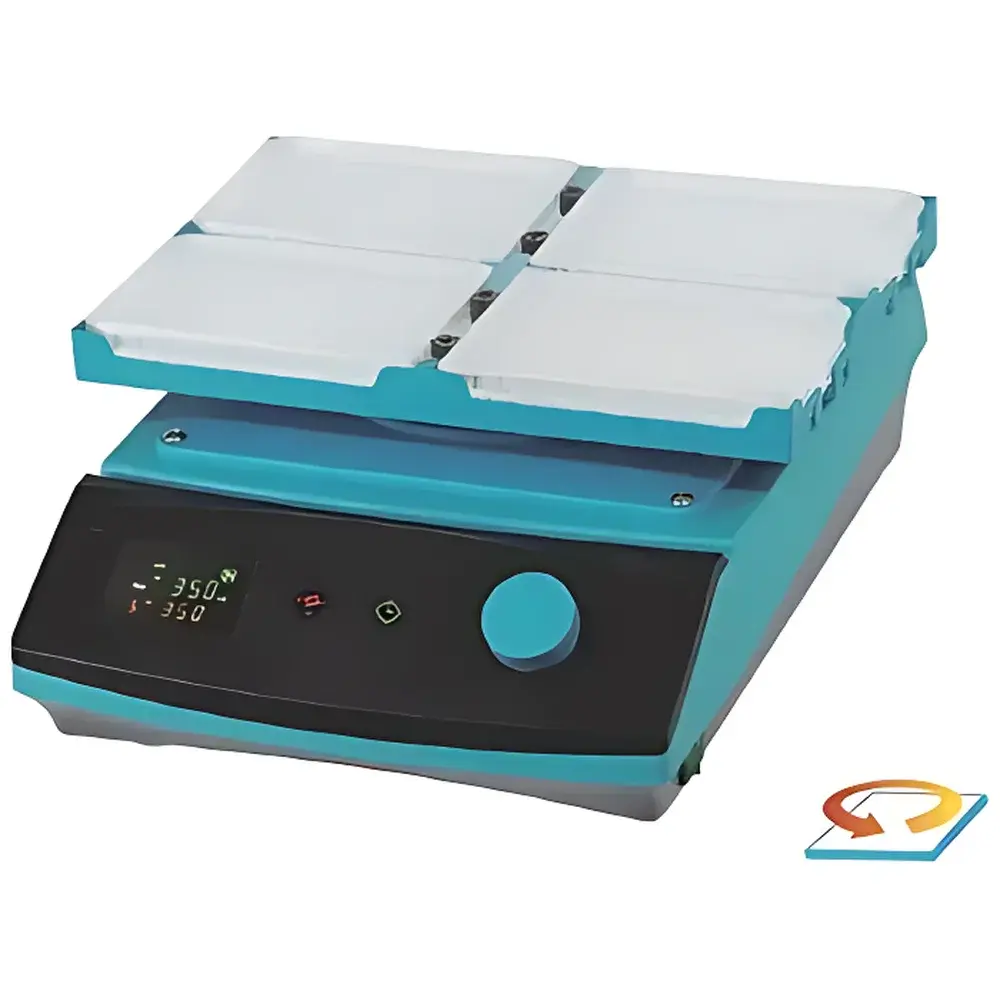
JEIO TECH CPS-350 Microplate Orbital Shaker
| Brand | JEIO TECH |
|---|---|
| Origin | South Korea |
| Model | CPS-350 |
| Instrument Type | Orbital Shaker (Microplate Format) |
| Timing Range | 1 min to 99 h 59 min |
| Speed Range | 150–1200 rpm |
| Orbit Diameter | 3 mm (0.12") |
| Platform Quantity | 1 |
| Operating Temperature Range | 5–40 °C |
| Relative Humidity Limit | ≤80% RH |
| Max Load Capacity | 4 kg (8.8 lbs) |
| Platform Dimensions (W×D) | 269 × 185 mm (10.6 × 7.3 in) |
| External Dimensions (W×D×H) | 269 × 325 × 128 mm (10.6 × 12.8 × 5.0 in) |
| Net Weight | 7.7 kg (17 lbs) |
| Power Supply | AC 100–240 V, 50/60 Hz |
| Motor Type | Brushless DC |
| Display | Vacuum Fluorescent Display (VFD) |
| Control System | PID Feedback Controller |
| Accuracy at 500 rpm | ±15 rpm |
| Housing Material | Polypropylene (PP) |
| Safety Features | Overcurrent Protection, Auto-Diagnostic Function, Error Detection |
Overview
The JEIO TECH CPS-350 Microplate Orbital Shaker is an engineered solution for high-precision, reproducible mixing of microplates in life science laboratories. Designed specifically for 96-well and 384-well formats, it employs a consistent circular orbital motion with a fixed 3 mm diameter orbit—optimized to minimize sample splashing while ensuring uniform suspension of cells, reagents, or immunoassay components. Unlike linear or reciprocating shakers, the CPS-350’s orbital mechanism generates laminar fluid dynamics ideal for delicate biological samples, including enzyme-linked immunosorbent assays (ELISA), cell-based assays, nucleic acid hybridization, and plate-based binding kinetics. Its brushless DC motor delivers stable rotational torque across the full speed range (150–1200 rpm), eliminating mechanical wear and electromagnetic interference common in brushed motors—critical for long-duration incubation-compatible operation inside environmental chambers, refrigerated cabinets, or CO₂ incubators.
Key Features
- Single-platform design accommodating standard SBS-format microplates (up to 4 plates simultaneously when using optional stacking accessories)
- PID feedback-controlled speed regulation ensures ±15 rpm accuracy at 500 rpm, supporting GLP-compliant assay repeatability
- Vacuum fluorescent display (VFD) with intuitive touch-sensitive interface enables real-time parameter monitoring and rapid configuration—even with gloves
- Soft-start acceleration profile prevents abrupt motion that could dislodge adherent cells or disrupt gradient layers in density-based separations
- Polypropylene (PP) housing provides chemical resistance against common laboratory solvents (e.g., ethanol, isopropanol, dilute acids/bases) and facilitates wipe-down decontamination
- Integrated overcurrent protection and self-diagnostic firmware detect operational anomalies—including platform imbalance, motor stall, or power fluctuation—and halt output before hardware damage occurs
- Compact footprint (269 × 325 × 128 mm) and low mass (7.7 kg) allow seamless integration into confined spaces such as cold rooms, anaerobic chambers, or multi-tiered incubator racks
Sample Compatibility & Compliance
The CPS-350 supports standardized microplate formats per ANSI/SBS specifications and accommodates auxiliary fixtures for tube-based workflows via optional clamping kits: 1.5 mL microtubes (80-position), 15 mL conical tubes (30-position), and 50 mL conical tubes (12-position). All accessories are mechanically secured to the platform without adhesives or tools, ensuring traceable setup configurations. The unit operates within ISO 13485-aligned environmental conditions (5–40 °C, ≤80% RH non-condensing) and complies with IEC 61010-1:2010 safety standards for laboratory electrical equipment. While not intrinsically rated for Class II biosafety cabinets, its low acoustic emission (<45 dB[A] at 1 m) and absence of airflow disruption make it suitable for use adjacent to laminar flow workstations during sterile processing.
Software & Data Management
The CPS-350 operates as a standalone instrument with no embedded software or network connectivity—intentionally designed to reduce validation burden in regulated environments. All timing and speed parameters are set locally via the VFD interface; no external PC connection or proprietary drivers are required. This architecture aligns with FDA 21 CFR Part 11 principles for electronic records where audit trails are maintained manually via lab notebook entries. For laboratories requiring automated logging, third-party data acquisition systems may interface via analog voltage output (0–10 V) proportional to actual RPM—enabling integration into existing LIMS or ELN platforms without firmware modification.
Applications
- ELISA and multiplex immunoassays requiring consistent antigen–antibody binding kinetics
- Cell culture maintenance during transfection or drug screening protocols
- Nucleic acid hybridization in microarray and Southern/Northern blot workflows
- Enzymatic reaction optimization under controlled thermal and agitation conditions
- Sample homogenization prior to HPLC or mass spectrometry analysis
- High-throughput screening (HTS) plate conditioning in pharmaceutical QC labs
FAQ
Can the CPS-350 be used inside a CO₂ incubator?
Yes—its compact dimensions, low heat dissipation, and brushless motor design enable safe operation in standard humidified CO₂ incubators (5–40 °C ambient). Ensure adequate clearance around ventilation grilles.
Is the 3 mm orbit diameter adjustable?
No—the orbit is mechanically fixed to maintain calibration integrity and eliminate user-induced variability across experiments.
Does the shaker support programmable multi-step protocols?
No—it features single-stage timing only (1 min to 99 h 59 min). For sequential ramping, external programmable timers or PLC controllers must be used.
What is the maximum load tolerance for non-microplate configurations?
When using the 50 mL conical tube clamp (CPS0012JT), total mass must not exceed 4 kg—including fixture weight and liquid volume.
How is speed accuracy verified during IQ/OQ qualification?
Use a calibrated handheld tachometer (traceable to NIST standards) to measure actual RPM at three setpoints (e.g., 300, 600, 900 rpm) across three consecutive runs; acceptance criterion is ±15 rpm at mid-range (500 rpm) per manufacturer specification.
Related Products



