
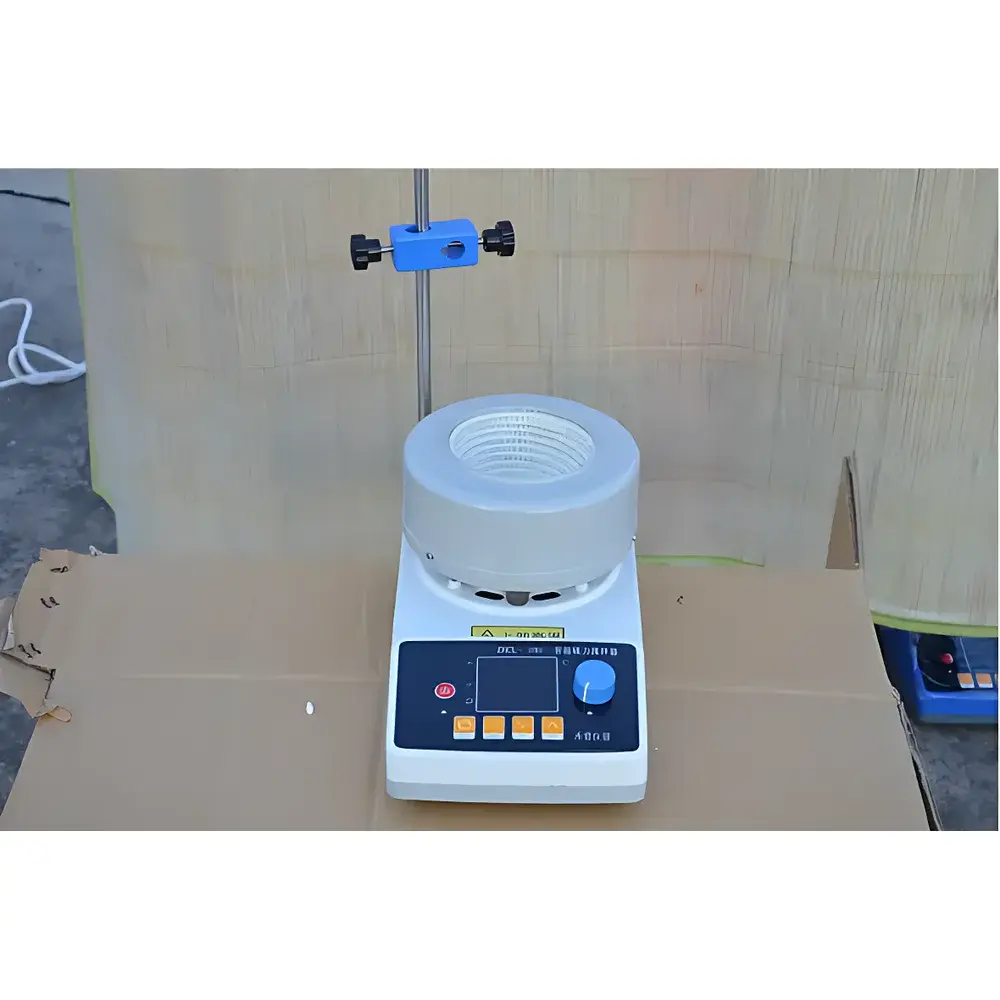
Jihepu ZNCL-T-C Intelligent Magnetic Stirrer with Heating Mantle
| Brand | Jihepu |
|---|---|
| Origin | Shandong, China |
| Model | ZNCL-T-C |
| Stirring Capacity | Up to 5 L |
| Speed Range | 50–2000 rpm |
| Temperature Control Range | Ambient to 380 °C |
| Heating Method | Integrated Ceramic-Coated Heating Mantle |
| Motor Type | Brushless DC Motor |
| Temperature Display | LCD with Dual Thermocouple Input (Internal & External) |
| Control Algorithm | Self-Tuning Fuzzy PID |
| Safety Features | Over-Temperature Cutoff, Thermocouple Break Protection, Ground Fault Awareness |
| Power Supply | 160–240 V AC, 50/60 Hz |
Overview
The Jihepu ZNCL-T-C Intelligent Magnetic Stirrer with Heating Mantle is an integrated laboratory instrument engineered for precise, reproducible heating and stirring of liquid-phase reaction mixtures in glass vessels ranging from 50 mL to 5 L. Unlike conventional hotplate stirrers, the ZNCL-T-C employs a high-efficiency ceramic-coated heating mantle—providing uniform radial heat distribution across round-bottom flasks and non-standard containers. Its core operation relies on permanent magnetic coupling between the internal rotating magnet assembly and PTFE- or glass-coated magnetic stir bars, eliminating mechanical shaft penetration and ensuring leak-tight containment. The system operates under closed-loop temperature regulation via dual thermocouple feedback (internal mantle sensor + optional external immersion probe), enabling accurate thermal management even during exothermic or viscous reactions. Designed for routine synthesis, dissolution testing, and sample preparation workflows, the unit meets fundamental functional requirements for GLP-compliant laboratories where traceable temperature setpoint accuracy and rotational stability are essential.
Key Features
- Brushless DC motor drive ensures continuous low-noise operation (10,000 hours), and zero electrical arcing—critical for use in solvent-rich or explosion-hazard environments.
- Ceramic-insulated heating mantle delivers rapid thermal response and surface temperatures up to 380 °C with ±2 °C stability at setpoint (measured at mantle surface, load-dependent).
- Human-centered 30° inclined control panel with tactile rotary knobs and dual LCD displays—one for real-time speed (rpm), one for measured temperature (°C)—enables intuitive operation from seated or standing positions.
- Fuzzy PID temperature controller includes auto-tuning functionality: initiated via 8-second press of the “AT” key, it dynamically optimizes proportional, integral, and derivative gains based on thermal load inertia and ambient conditions.
- Dual thermocouple support (Type K standard) allows simultaneous monitoring of mantle temperature (internal) and solution temperature (external probe), enhancing process fidelity during kinetic studies or crystallization protocols.
- Integrated safety architecture includes over-temperature cutoff (hardware-limited at 400 °C), thermocouple break detection (display shows “HHHH” and disables heating), and grounded chassis design compliant with IEC 61010-1:2010 safety standards.
Sample Compatibility & Compliance
The ZNCL-T-C accommodates standard and custom glassware—including 25 mL to 5 L round-bottom flasks, flat-bottom beakers, and jacketed reactors—via adjustable universal clamps and vertical support rods. Its open-frame mechanical design permits unobstructed access for condenser attachment, nitrogen inlet lines, or pH electrode insertion. While not certified to ISO/IEC 17025 or FDA 21 CFR Part 11 out-of-the-box, the device supports audit-ready operation when paired with external electronic lab notebooks (ELNs) that log timestamped rpm and °C values. It conforms to general-purpose laboratory equipment requirements per ASTM E2915-21 (Standard Practice for Thermal Stability Evaluation) for preliminary thermal screening applications. CE marking is pending; users operating in EU-regulated environments must verify local conformity assessment pathways.
Software & Data Management
The ZNCL-T-C operates as a standalone analog-digital hybrid instrument without embedded data logging or USB/RS-232 connectivity. All operational parameters—including speed setpoint, temperature setpoint, real-time rpm, and measured °C—are displayed locally and retained only during active power supply. For traceable recordkeeping, integration with third-party data acquisition systems is achievable via optional analog voltage output modules (0–5 V corresponding to 0–2000 rpm and 0–400 °C ranges). When used in validated environments, documented procedures must define calibration intervals for both speed (using optical tachometer) and temperature (NIST-traceable dry-block calibrator), with records archived per institutional GLP/GMP documentation policies.
Applications
- Organic synthesis requiring controlled reflux or gradient heating (e.g., Grignard formation, esterification, Suzuki coupling).
- Pharmaceutical dissolution testing (USP Apparatus II) where bath temperature uniformity and rotational consistency directly impact release profile reproducibility.
- Materials science dispersion protocols—including nanoparticle suspension in polymer matrices or catalyst slurry homogenization prior to filtration.
- Environmental sample digestion (EPA Method 3050B) involving HNO₃/HF mixtures at elevated temperatures under inert atmosphere.
- Quality control labs performing viscosity-temperature profiling of lubricants or adhesives using standardized spindle geometries.
FAQ
Can the ZNCL-T-C operate without a magnetic stir bar?
No. The unit requires a compatible magnetic stir bar (diameter ≥6 mm, length ≥30 mm) placed inside the vessel. Rotation ceases if the bar decouples due to excessive viscosity or vortexing.
Is external temperature probing mandatory for accurate solution control?
Not mandatory—but strongly recommended. Internal mantle sensing alone cannot compensate for thermal lag in thick-walled or large-volume vessels; external immersion probes reduce steady-state error by >50% in typical aqueous loads.
What maintenance is required for long-term reliability?
Annual inspection of heating mantle insulation resistance (>2 MΩ at 500 V DC), visual check for ceramic coating cracks, and cleaning of control panel vents with dry compressed air. Do not immerse base unit in liquids.
Does the unit support programmable ramp-soak temperature profiles?
No. It provides only manual setpoint control and auto-tuned static regulation. For multi-step thermal protocols, external programmable power controllers or PLC integration is necessary.
Can it be used under inert gas or vacuum conditions?
Yes—provided the reaction vessel is properly sealed and rated for the intended pressure differential. Note: prolonged vacuum operation may accelerate thermal insulation degradation in the mantle housing.



