
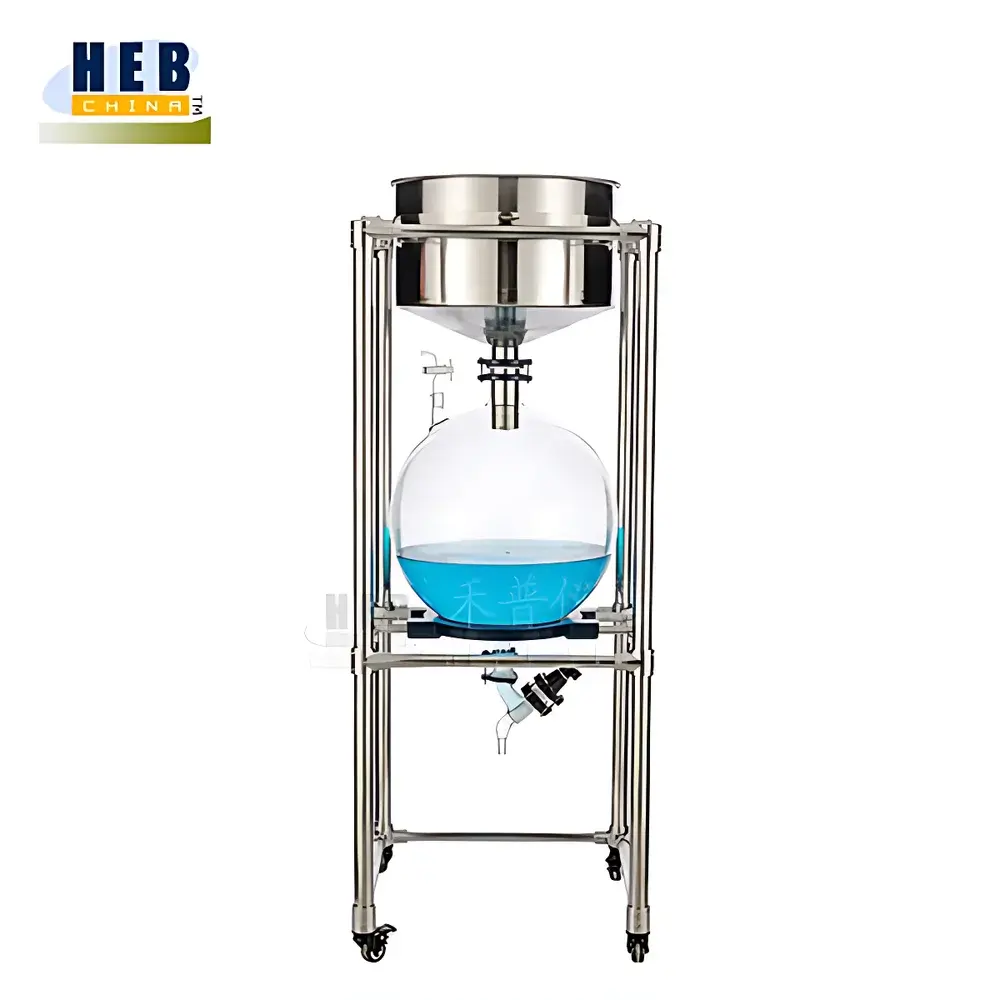
English Product Name
| Brand | Jihepu |
|---|---|
| Origin | Shandong, China |
| Model | ZF-10L |
| Capacity | 10 L |
| Construction Material | Borosilicate glass (3.3 expansion coefficient), 304 stainless steel, aluminum alloy frame |
| Operating Pressure Range | Low vacuum |
| Ultimate Vacuum Level | 0.098 MPa (≈740 mmHg) |
| Filtration Funnel Diameter | Φ350 mm × 220 mm H |
| Filtration Bottle Dimensions | Φ280 mm spherical body, three-necked with 24/29 standard taper joints |
| Vacuum Port | 24# standard ground-glass joint |
| Drain Valve | Φ45 ball-type glass valve with PTFE core (C-type) |
| Footprint | 500 × 520 × 1230 mm (W × D × H) |
| Net Weight | 24 kg |
| Packing | Wooden crate, 1300 × 560 × 640 mm, 50 kg |
Overview
The Jihepu ZF-10L Vacuum Filtration System is a benchtop-scale, manually operated vacuum-assisted solid–liquid separation apparatus engineered for reproducible filtration, solvent removal, and post-reaction workup in synthetic chemistry, pharmaceutical development, and materials science laboratories. It operates on the principle of pressure differential-driven flow: a connected external vacuum source (e.g., diaphragm or oil-free rotary vane pump) establishes negative pressure inside the borosilicate glass filtration bottle, inducing rapid passage of liquid phase through a user-selected filter medium (e.g., sintered glass frits, polymeric membranes, or woven filter cloths) seated in the 304 stainless steel funnel. The system’s design emphasizes chemical compatibility, thermal stability, and mechanical rigidity—critical for handling corrosive reagents, elevated temperature filtrates, or crystalline slurries without structural compromise.
Key Features
- Borosilicate glass (3.3) filtration bottle with spherical geometry and triple standard-taper necks (24/29), enabling simultaneous connection to vacuum line, pressure relief valve, and optional inert gas inlet for controlled atmosphere filtration.
- 304 stainless steel filtration funnel (Φ350 × 220 mm H) featuring uniformly distributed 4 mm diameter perforations and smooth electropolished interior surface to minimize sample adhesion and facilitate cleaning.
- Modular aluminum–stainless steel support frame with integrated leveling feet and locking casters (φ100 mm, brake-equipped), allowing stable operation on uneven surfaces and safe relocation within shared lab spaces.
- C-type glass drain valve (Φ45 mm ball joint) with PTFE-sealed core, rated for continuous use under vacuum and compatible with organic solvents, aqueous bases, and mild acids.
- Vacuum interface via 24# standard taper joint and reinforced rubber vacuum hose connector (12 mm OD), ensuring leak-tight coupling and resistance to repeated disassembly/reassembly cycles.
Sample Compatibility & Compliance
The ZF-10L accommodates heterogeneous mixtures including crystalline precipitates, metal hydride suspensions, polymer gels, and fine particulate catalysts. Its all-glass wetted path meets ASTM E438 Type I Class A specifications for laboratory glassware dimensional accuracy and thermal shock resistance. The 304 stainless steel funnel complies with ISO 8420 for corrosion resistance in chloride-containing environments up to 60 °C. While not certified for GMP manufacturing, the system supports GLP-aligned documentation practices—including equipment logbooks, calibration records for associated vacuum gauges, and traceable filter lot number logging—when deployed in regulated R&D workflows. No electrical components are integrated, eliminating spark hazards in flammable solvent applications.
Software & Data Management
As a purely mechanical vacuum filtration platform, the ZF-10L requires no embedded firmware, drivers, or software. All operational parameters—including applied vacuum level, filtration duration, and filtrate volume—are recorded manually or via external instrumentation (e.g., digital vacuum gauge with data-logging output). For laboratories operating under FDA 21 CFR Part 11 requirements, integration with validated electronic lab notebooks (ELNs) such as LabArchives or Benchling enables secure, time-stamped entry of filtration conditions, operator ID, and batch-specific observations. Audit trails remain fully attributable when paired with calibrated vacuum measurement tools traceable to NIST standards.
Applications
- Isolation of reaction products after Grignard, Suzuki, or Heck couplings, particularly where air-sensitive intermediates require inert-atmosphere transfer.
- Removal of heterogeneous catalysts (e.g., Pd/C, Raney Ni) from hydrogenation or reduction filtrates prior to concentration or chromatography.
- Preparative-scale crystallization workups involving hot filtration to eliminate insoluble impurities before recrystallization.
- Dehydration of hydrated salts or coordination complexes using low-temperature vacuum drying post-filtration.
- Clarification of microbial fermentation broths or cell lysates prior to downstream purification steps.
FAQ
What filter media are compatible with the ZF-10L funnel?
Standard options include sintered glass frits (porosity grades G3–G5), nylon or PVDF membrane filters (0.22–5.0 µm), and reusable stainless steel mesh inserts. Custom-cut filter papers may be used with appropriate support rings.
Can the system operate under nitrogen or argon blanket?
Yes—the three-neck bottle configuration permits simultaneous vacuum draw, inert gas purge via septum-sealed port, and filtrate collection, enabling oxygen-sensitive filtrations.
Is the glass bottle resistant to thermal shock during hot filtrations?
Borosilicate 3.3 glass withstands ΔT ≥ 160 °C; pre-warming the bottle to ~60 °C before introducing >80 °C filtrates is recommended to prevent stress fracture.
What vacuum pump specifications are recommended?
A two-stage diaphragm pump achieving ≤10 mbar ultimate vacuum and ≥30 L/min free-air displacement ensures optimal throughput for 10 L capacity without excessive foaming or bumping.
How is maintenance performed on the C-type drain valve?
The PTFE core is field-replaceable using standard 4 mm hex key; periodic inspection for scoring or swelling after exposure to strong oxidizers (e.g., peracids) is advised.
Related Products



