
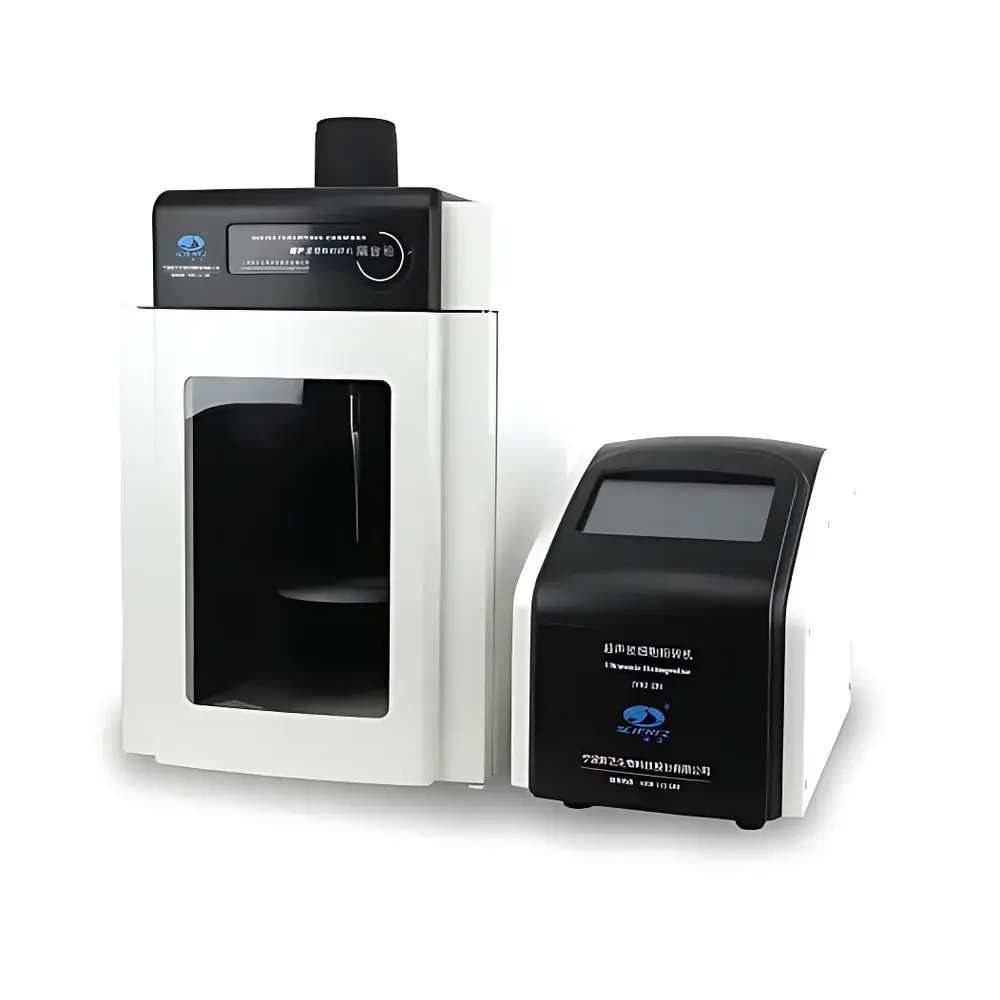
JY96-IIN Ultrasonic Cell Disruptor
| Origin | Zhejiang, China |
|---|---|
| Manufacturer Type | Distributor |
| Origin Category | Domestic (China) |
| Model | JY96-IIN |
| Price | ¥11,000 |
| Instrument Type | Ultrasonic Disruptor |
| Sample Suitability | Soft biological samples |
| Output Particle Size | 0.01–0.5 mm |
| Maximum Feed Particle Size | <15 mm |
| Sieve Cut-Off | 40 mesh |
| Batch Processing Volume | 10–100 mL |
| Frequency Range | 20–25 kHz |
| Display | Backlit LCD |
| Power Output | 150 W (adjustable from 5% to 99%) |
| Standard Probe Diameter | 6 mm |
| Optional Probe Diameters | 3 mm |
| Duty Cycle | 1–99% |
| Timing Resolution | 0.1 s (ultrasonication time, interval time, total time) |
| Input Voltage | 220 V / 110 V, 50 Hz / 60 Hz |
| Dimensions (main unit) | 400 × 280 × 220 mm |
| Net Weight (unit only) | 7 kg |
| Unit + Transducer Weight | 9.3 kg |
| Packaging Dimensions | 534 × 295 × 435 mm |
| Temperature Monitoring | None |
| Overload Protection | Yes |
Overview
The JY96-IIN Ultrasonic Cell Disruptor is a benchtop ultrasonic homogenizer engineered for controlled mechanical lysis of biological samples through acoustic cavitation. Operating within a stable frequency range of 20–25 kHz, the device generates high-intensity ultrasonic waves transmitted via a titanium alloy probe into liquid suspensions. These waves induce transient microcavitation—formation, growth, and violent collapse of microscopic vapor bubbles—resulting in localized shear forces, microstreaming, and shockwaves sufficient to disrupt cell membranes, organelles, and soft tissue matrices without significant thermal degradation when operated under pulsed mode. Designed for reproducible, scalable sample preparation, the JY96-IIN serves as a foundational tool in molecular biology workflows requiring efficient extraction of intracellular components such as nucleic acids, proteins, and subcellular fractions.
Key Features
- Microprocessor-controlled operation with backlit LCD interface for real-time monitoring of parameters including power level, elapsed time, and duty cycle
- Continuous 1–99% adjustable output power (5–148.5 W nominal at 150 W max), enabling precise energy delivery calibrated to sample viscosity and sensitivity
- Pulse mode functionality with independent control over sonication duration, rest interval, and total cycle count—each adjustable to 0.1-second resolution for optimized thermal management
- Interchangeable titanium probes: standard 6 mm diameter probe included; optional 3 mm probe available for low-volume or high-sensitivity applications (e.g., single-cell lysates)
- Robust aluminum-alloy chassis with integrated cooling fins and overload protection circuitry to ensure operational stability during extended runs
- Compliance-ready design supporting documentation traceability for GLP-aligned lab environments; no built-in temperature sensor but compatible with external PT100 probes or chilled sample baths
Sample Compatibility & Compliance
The JY96-IIN is validated for use with soft biological matrices—including cultured mammalian and bacterial cells, plant leaf tissues, yeast suspensions, viral particles, and soft animal organs—provided feed particle size remains below 15 mm and suspension volume falls within the 10–100 mL operational window. It is not intended for hard or fibrous materials (e.g., bone, seeds, or polymer composites) nor for continuous-flow processing. While the instrument itself carries no CE, UL, or FDA clearance, its operational parameters align with common method development frameworks referenced in ISO 11348 (toxicity testing), USP (cell culture reagents), and ASTM E2875 (ultrasonic cleaning validation). Users are responsible for establishing in-house SOPs verifying lysis efficiency, nucleic acid integrity, and protein recovery consistency per batch.
Software & Data Management
The JY96-IIN operates via embedded firmware without external PC dependency. All settings—including power percentage, pulse timing sequence, and total run duration—are stored in non-volatile memory and recalled at power-on. Though it lacks USB or Ethernet connectivity, the 0.1-second timing granularity and repeatable probe coupling enable high inter-run reproducibility essential for comparative studies. For audit-trail requirements under 21 CFR Part 11, laboratories may integrate manual log entries synchronized with timestamped imaging or spectrophotometric quantification (e.g., A260/A280 post-lysis). The absence of automated data export necessitates procedural controls for metadata capture during routine QC.
Applications
- Pre-analytical lysis for RNA/DNA isolation protocols prior to qPCR, NGS library prep, or microarray analysis
- Preparation of antigen extracts and whole-cell lysates for ELISA, Western blotting, and mass spectrometry
- Nanoparticle dispersion and stabilization in aqueous colloidal systems (e.g., liposome formulation, polymeric micelle generation)
- Accelerated solvent extraction of phytochemicals and secondary metabolites from plant tissues
- Inactivation and fragmentation of enveloped viruses for vaccine development or diagnostic antigen production
- Homogenization of soft hydrogels and biopolymer solutions for rheological characterization
FAQ
What is the maximum recommended operating time per cycle to avoid probe overheating?
For sustained reliability, limit continuous mode to ≤5 minutes; use pulse mode (e.g., 5 s on / 5 s off) for sessions exceeding 10 minutes.
Can the JY96-IIN be used with corrosive solvents such as chloroform or phenol?
Titanium probes resist mild aqueous corrosion but are not rated for prolonged exposure to halogenated organics; stainless-steel or custom-coated probes must be sourced separately.
Is calibration traceable to national standards?
No factory calibration certificate is provided; users should verify acoustic output using calorimetric methods per ASTM E2875 or employ reference standards like polystyrene latex suspensions.
Does the unit support regulatory-compliant electronic records?
No native e-record capability exists; compliance with ALCOA+ principles requires manual entry into LIMS or ELN systems with operator signature and timestamp.
What maintenance is required to sustain probe performance?
Inspect probe tip for pitting or erosion before each use; clean with ethanol and soft lint-free cloth; replace if surface irregularities exceed 0.1 mm depth.



