
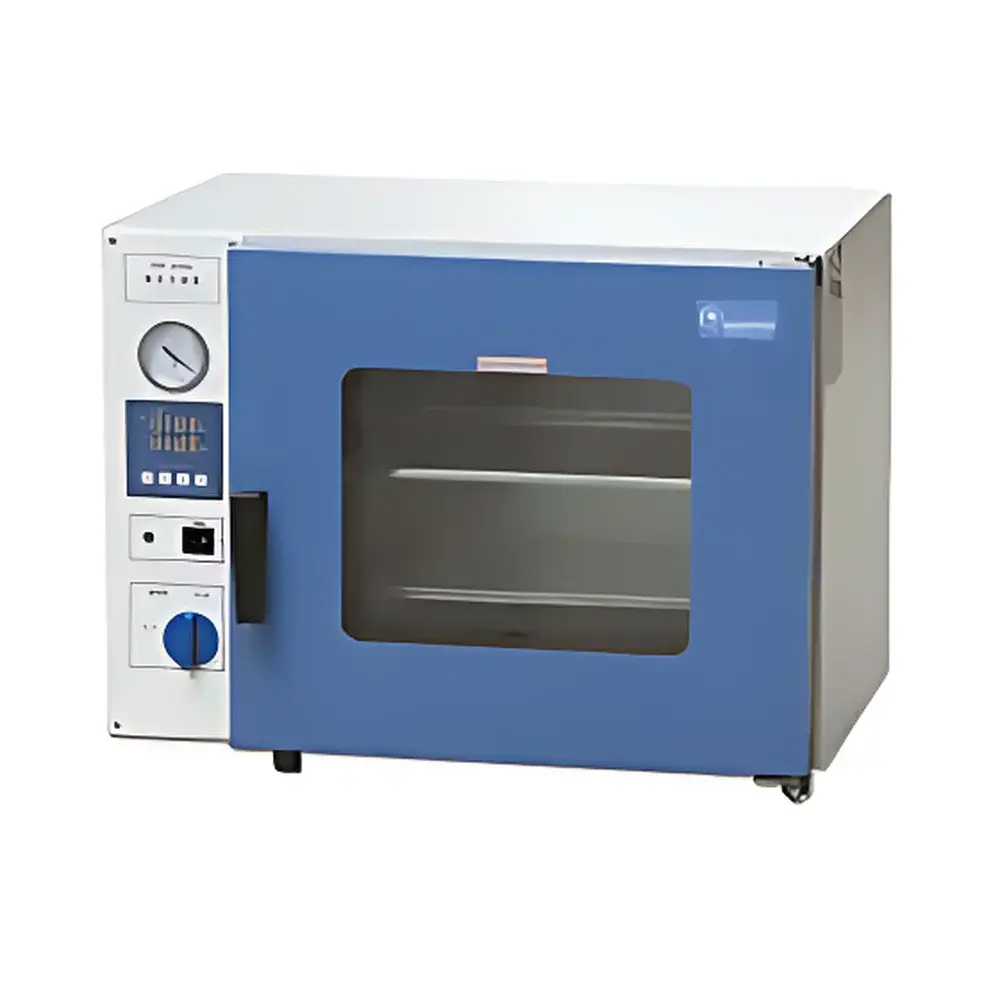
HePu DZF-6020 Vacuum Drying Oven
| [Brand | HePu |
|---|---|
| Origin | Shandong, China |
| Model | DZF-6020 |
| Type | Vacuum Oven |
| Temperature Range | RT+10°C to 200°C |
| Temperature Uniformity | ±1°C |
| Chamber Dimensions (W×D×H) | 300×300×275 mm |
| External Dimensions (W×D×H) | 605×490×450 mm |
| Chamber Material | Stainless Steel or Galvanized Steel |
| Heating Method | Forced Air Circulation |
| Vacuum Level | <133 Pa |
| Power Supply | 220 V, 50 Hz |
| Input Power | 350 W |
| Timer Range | 1–9999 minutes |
| Control System | Digital Microcomputer Controller with Programmable 10-Stage Profile (D-Series) |
Overview
The HePu DZF-6020 Vacuum Drying Oven is an engineered solution for precise, low-temperature moisture removal under reduced pressure—ideal for thermally sensitive, oxidation-prone, or chemically unstable samples. Operating on the principle of vacuum-assisted evaporation, it lowers the boiling point of solvents and water, enabling effective drying at temperatures significantly below atmospheric boiling points. This mitigates thermal degradation, preserves structural integrity of biomolecules, active pharmaceutical ingredients (APIs), and nanomaterial precursors, and eliminates residual solvent traces critical in GMP-compliant manufacturing environments. Designed for routine use in QC laboratories, R&D facilities, and pilot-scale production lines, the DZF-6020 conforms to fundamental operational requirements outlined in ISO 17025 for equipment validation and supports traceable process documentation when integrated with compliant data management protocols.
Key Features
- Digital microcomputer temperature controller with 0.1°C resolution and ±1°C uniformity across the chamber—validated under no-load conditions per IEC 61000-4-30 environmental test standards.
- Rectangular stainless steel or galvanized steel working chamber (300 × 300 × 275 mm) optimized for volumetric efficiency and mechanical durability; seamless construction minimizes crevices for simplified cleaning and contamination control.
- Double-layer tempered glass observation door with anti-scratch coating and integrated silicone gasket—ensures visual monitoring without compromising vacuum integrity (leak rate ≤ 5 × 10⁻³ Pa·m³/s).
- Adjustable door-latching mechanism with compression-tuned sealing force—maintains stable vacuum levels down to <133 Pa during extended operation cycles.
- Forced air circulation system with rear-mounted heating element and tangential fan—promotes uniform heat distribution and accelerates drying kinetics without localized overheating.
- Programmable 10-segment temperature/time profile capability (D-series controller)—enables multi-stage drying protocols for complex matrices such as lyophilized formulations or polymer-coated particles.
- Integrated timer with 1–9999 minute range and auto-shutdown function—supports unattended overnight operation while meeting electrical safety requirements per UL 61010-1 and GB 4793.1.
Sample Compatibility & Compliance
The DZF-6020 accommodates a broad spectrum of sample formats—including Petri dishes, weighing boats, glass vials, aluminum pans, and custom fixtures—within its 24.3 L chamber volume. Its low-temperature vacuum environment is particularly suited for drying antibiotics, enzyme preparations, herbal extracts, thin-film coatings, lithium-ion battery cathode slurries, and printed electronics substrates. While not certified to specific regulatory standards out-of-the-box, the instrument’s design aligns with foundational elements of FDA 21 CFR Part 11 (when paired with audit-trail-capable software), ISO 14644-1 (cleanroom-compatible surface finish), and USP for drying process validation. Users are advised to perform IQ/OQ/PQ qualification per their internal SOPs and applicable regional guidelines (e.g., EU Annex 15, PIC/S PI 007-05).
Software & Data Management
The DZF-6020 operates via standalone hardware-based control; no proprietary software is bundled. However, analog output (0–5 V or 4–20 mA) and RS485 communication interface (optional) enable integration with third-party SCADA systems, LabVIEW, or MES platforms for real-time temperature logging and alarm triggering. When used with validated external data acquisition tools, the unit supports ALCOA+ principles—ensuring data Attributable, Legible, Contemporaneous, Original, Accurate, Complete, Consistent, Enduring, and Available. For GLP/GMP workflows, users may implement electronic batch records using compliant time-stamped CSV exports or configure external PLCs for full audit trail generation.
Applications
- Pharmaceutical: Residual solvent removal from granules prior to tableting; moisture reduction in sterile powder blends; pre-lyophilization conditioning of biologics.
- Materials Science: Degassing of ceramic green bodies; binder burnout in metal injection molding feedstocks; moisture elimination from MOF precursors.
- Electronics: Desiccation of PCB assemblies prior to conformal coating; drying of OLED substrate layers; humidity-sensitive component storage conditioning.
- Academic Research: Accelerated aging studies of polymers under controlled vacuum/temperature stress; preparation of anhydrous reagents for organometallic synthesis.
- Food & Agriculture: Low-temperature dehydration of probiotic cultures; moisture analysis of botanicals per AOAC 950.46; stabilization of enzyme powders for shelf-life testing.
FAQ
Does the DZF-6020 include a vacuum pump?
No—the DZF-6020 requires an externally connected vacuum pump (e.g., two-stage rotary vane or dry scroll type). Pump selection must ensure ultimate vacuum ≤ 100 Pa and pumping speed ≥ 2 L/s for optimal performance.
What vacuum gauge options are available?
The base model supports analog vacuum gauge connection; optional LC-series configurations integrate digital vacuum display modules compatible with Pirani or capacitance manometer sensors.
Can the chamber be purged with inert gas?
Yes—standard models feature a dedicated inert gas inlet port (typically 1/4″ NPT) allowing nitrogen or argon purging before or during vacuum cycles to suppress oxidation.
Is the stainless steel chamber electropolished?
Standard configuration uses brushed or mirror-finished 304 stainless steel (1Gr18Ni9Ti equivalent); electropolishing is available as a customization option upon request.
What calibration documentation is provided?
Each unit ships with a factory calibration certificate for temperature sensor (NIST-traceable reference), valid at 100°C and 150°C. On-site recalibration services and IQ/OQ templates can be arranged through authorized HePu service partners.



