
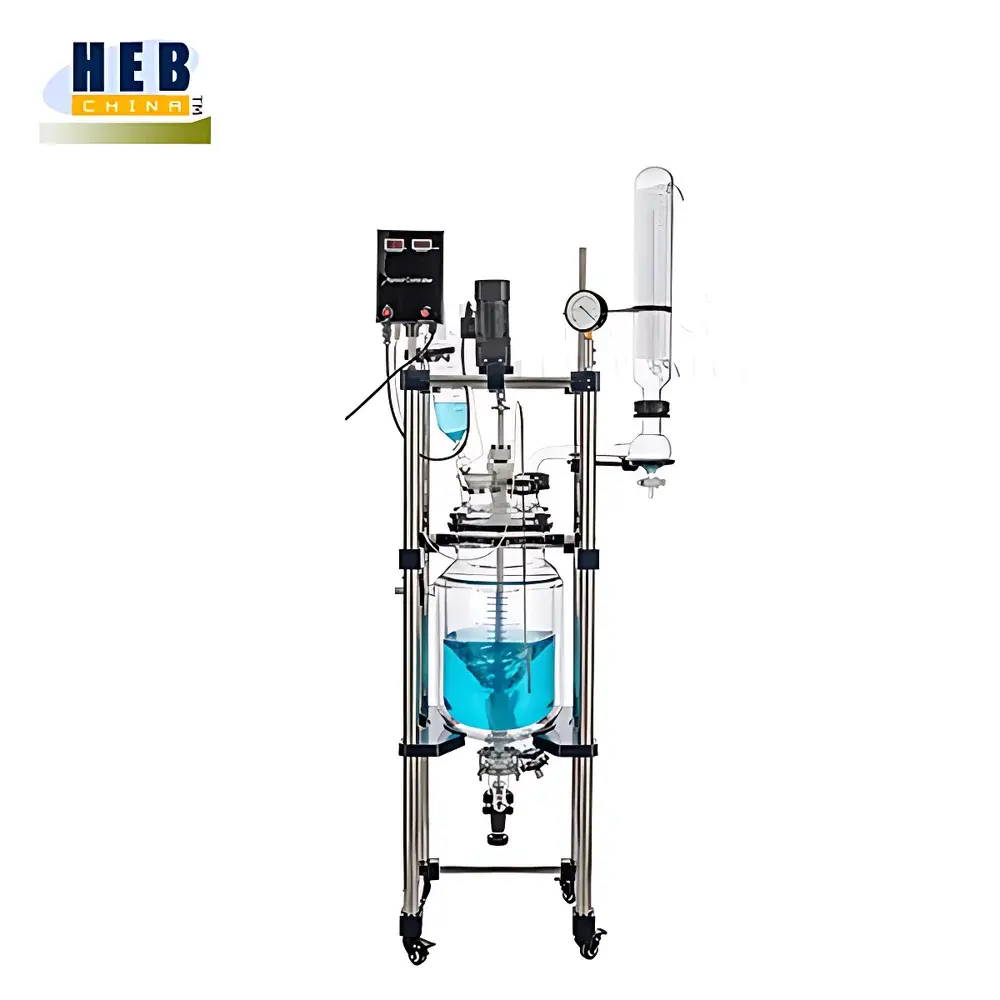
HEB-20L Dual-Jacketed Glass Reactor by Jihepu (Jinan Hopu)
| Brand | Jihepu (Jinan Hopu) |
|---|---|
| Origin | Shandong, China |
| Manufacturer Type | Authorized Distributor |
| Origin Category | Domestic (China) |
| Model | HEB-20L |
| Price | USD 2,350 (approx.) |
| Usable Volume | 20 L (Medium-Scale) |
| Construction Material | Borosilicate Glass 3.3 (GG-17) |
| Operating Pressure | Low-Pressure / Vacuum-Compatible |
| Vacuum Level | −0.098 MPa (≈ 20 mbar abs) |
| Jacket Capacity | 8 L |
| Stirring Speed Range | 0–450 rpm |
| Motor Power | 90 W |
| Temperature Range (Jacket) | −80 °C to +250 °C |
| Stirrer Shaft Diameter | 12 mm |
| Base-to-Discharge-Port Height | 450 mm |
| Overall Dimensions (L×W×H) | 560 × 560 × 2100 mm |
| Net Weight | 80 kg |
| Electrical Supply | 220 V / 50 Hz |
| Lid Configuration | 6-Port Standard |
| Condenser & Vacuum Port | 10 mm inner diameter (ID), compatible with 12 × 8 mm tubing |
| Jacket Inlet/Outlet | 12 mm OD, supports plug-in, threaded, or sanitary clamp connections |
| Temperature Sensor | PT100 embedded probe (internal vessel monitoring) |
| Drive System | Explosion-Proof AC motor with frequency-controlled variable speed drive |
| Sealing System | PTFE-faced mechanical seal with ceramic bearing |
| Discharge Valve | Zero-dead-volume inclined glass valve with PTFE seat |
Overview
The HEB-20L Dual-Jacketed Glass Reactor is an engineered laboratory-scale synthesis platform designed for precise thermal control, vacuum-enabled reaction management, and reproducible mechanical agitation under chemically aggressive conditions. Based on the principle of jacketed heat transfer—where a circulating thermal fluid (e.g., silicone oil, ethylene glycol/water mix, or liquid nitrogen coolant) flows through the annular space between two concentric borosilicate glass walls—the system enables accurate temperature regulation of the reaction mass from −80 °C to +250 °C. This architecture supports exothermic and endothermic processes, solvent reflux, fractional distillation, vacuum concentration, and controlled crystallization. Its all-glass wetted path—fabricated from GG-17 borosilicate glass (compliant with ISO 3585)—ensures optical clarity for real-time visual monitoring, high chemical resistance (including to strong acids, alkalis, and halogenated solvents), and negligible leaching. The reactor integrates a sealed, low-torque stirring mechanism with explosion-proof operation, making it suitable for use in Class I, Division 2 hazardous locations per NEC standards when installed with appropriate ancillary controls.
Key Features
- Borosilicate glass 3.3 (GG-17) vessel body and lid—certified to withstand thermal shock up to ΔT = 120 °C and internal pressure differentials up to 0.1 MPa.
- Stainless steel support frame with anodized aluminum structural components—corrosion-resistant, non-magnetic, and compliant with ISO 7243 for laboratory equipment ergonomics.
- PTFE-sheathed stainless steel stirrer shaft and impeller—chemically inert across pH 0–14; compatible with magnetic coupling alternatives upon request.
- Explosion-proof, brushless AC motor with integrated frequency converter—provides smooth torque delivery (up to 3.1 N·m at 100 rpm), zero sparking, and <0.5% speed deviation across full 0–450 rpm range.
- Double-seal mechanical assembly: primary PTFE–ceramic face seal with secondary O-ring backup—rated for continuous operation at −0.098 MPa vacuum and validated per ASTM F2391 for leak integrity.
- Dual digital display controller: simultaneous real-time readout of setpoint/stirring speed (rpm) and internal bath temperature (via embedded PT100 sensor, ±0.3 °C accuracy).
- Zero-dead-volume inclined discharge valve with reinforced PTFE seating—enables complete, residue-free emptying without disassembly; validated for ≥10,000 cycles per ISO 15883-5.
- Modular port configuration (6 standard NS29/32 joints)—supports simultaneous connection of condensers, dropping funnels (1 L capacity), thermowells, gas inlets, and vacuum lines using industry-standard ground glass or sanitary fittings.
Sample Compatibility & Compliance
The HEB-20L is routinely deployed in synthetic organic chemistry, pharmaceutical process development (including DOE studies under ICH Q5/Q7), and polymerization screening where material compatibility, trace metal control, and batch-to-batch consistency are critical. Its GG-17 glass construction meets USP , ISO 10993-1 (biocompatibility screening), and DIN 7080 for laboratory glassware. Vacuum performance (−0.098 MPa) satisfies ASTM D1298 (density determination), ASTM E2018 (solvent recovery), and ISO 2556 (vacuum drying protocols). All electrical components comply with IEC 61010-1:2010 (Safety Requirements for Electrical Equipment for Measurement, Control, and Laboratory Use) and carry CE marking. Optional documentation packages include Factory Acceptance Test (FAT) reports, material traceability certificates (MTRs) for metallic parts, and calibration records for integrated PT100 sensors.
Software & Data Management
While the base unit operates via standalone analog/digital controls, optional RS485 Modbus RTU interface enables integration into centralized lab automation systems (e.g., DeltaV, LabWare LIMS, or custom SCADA). When paired with third-party data loggers (e.g., Omega OM-DAQPRO-5300), time-stamped records of stir speed, jacket temperature, and internal probe temperature can be exported in CSV format—supporting 21 CFR Part 11 compliance when deployed with audit-trail-enabled software and role-based user authentication. All firmware updates are delivered via secure USB protocol; no cloud connectivity is embedded, preserving network isolation requirements common in GMP environments.
Applications
- Batch-wise synthesis of active pharmaceutical ingredients (APIs) under controlled exotherm conditions (e.g., Grignard additions, nitration, hydrogenation precursors).
- Solvent-free or low-solvent esterification and transesterification reactions requiring vacuum-assisted water removal.
- Thermal stability assessment of novel electrolytes for lithium-ion batteries (operating at elevated T under inert gas blanket).
- Extraction and purification of natural products via Soxhlet-assisted reflux or vacuum rotary evaporation pre-concentration.
- Photocatalytic reaction screening using externally mounted LED arrays (ports accommodate quartz viewports).
- Scale-up studies bridging from 500 mL to 5 L pilot reactors—geometric similarity maintained via fixed D/T ratio (0.62) and constant P/V power input density.
FAQ
What temperature control fluids are compatible with the jacket system?
Silicone oils (up to 250 °C), 50/50 ethylene glycol–water (−30 °C to 120 °C), and specialized low-temperature heat transfer fluids (e.g., Therminol LT) are validated. Avoid chlorinated solvents due to potential stress cracking of GG-17.
Can the reactor be operated under positive pressure?
No—it is rated exclusively for low-pressure and vacuum service (max working pressure: 0.1 MPa gauge). Positive pressure operation requires ASME-coded metal reactors.
Is the mechanical seal maintenance-free?
The PTFE/ceramic seal requires no lubrication and is rated for >12 months continuous operation under typical lab usage; replacement kits (including spring-loaded cartridge assembly) are available with full dimensional drawings.
How is temperature uniformity verified within the vessel?
Calibration is performed using three independent PT100 probes positioned at top/mid/bottom zones during FAT; radial uniformity remains within ±1.5 °C at steady state (per ISO/IEC 17025-accredited validation protocol).
Does the system support GLP-compliant electronic record keeping?
Yes—when interfaced with validated third-party data acquisition hardware and software meeting Annex 11 and ALCOA+ principles, full electronic batch records—including signature, timestamp, and change history—can be generated and archived.



