
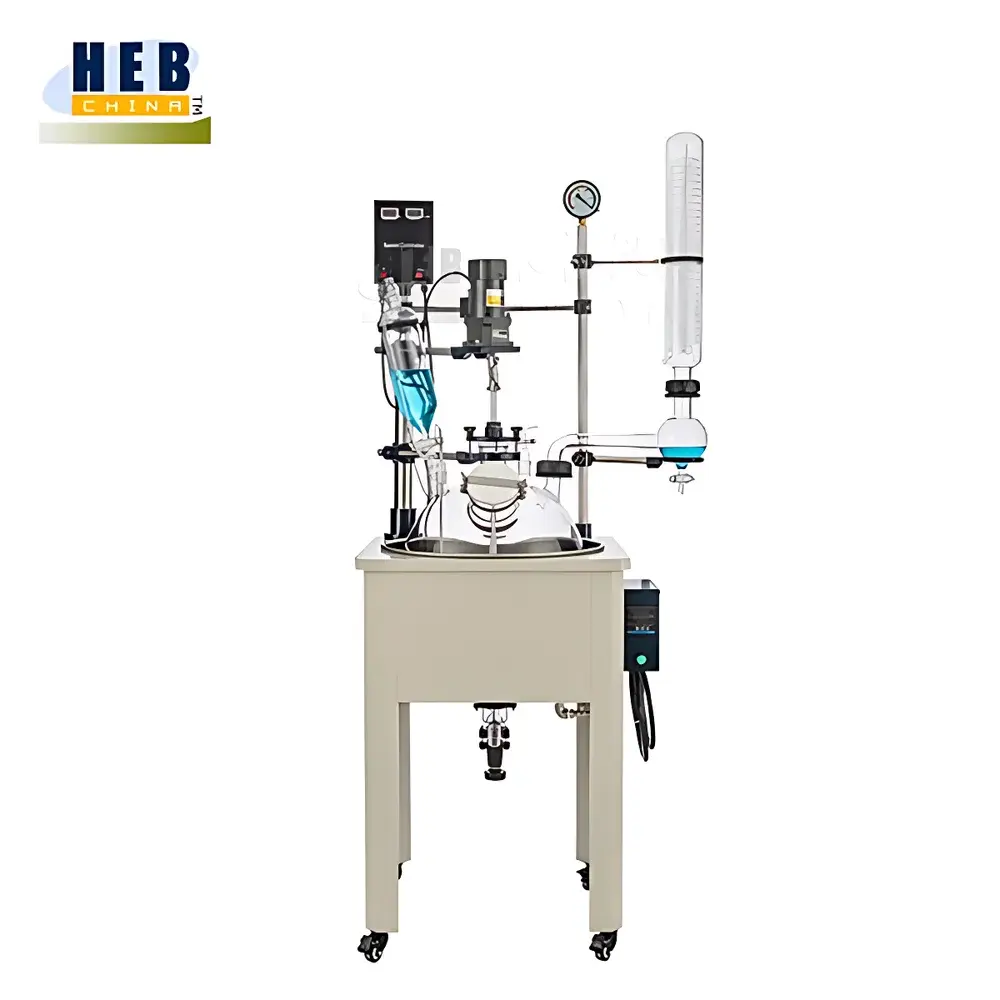
HePu F-50L Single-Layer Glass Reactor
| [Brand | HePu (Jihepu) |
|---|---|
| Origin | Shandong, China |
| Model | F-50L |
| Capacity | 50 L |
| Material | Borosilicate Glass (GG-17) |
| Working Pressure | Low-pressure |
| Vacuum Degree | 0.098 MPa |
| Temperature Range | –80 °C to +250 °C |
| Stirring Speed | 0–450 rpm |
| Stirring Power | 120 W, 220 V / 50 Hz |
| Heating Power | 8 kW, 380 V / 50 Hz |
| Overall Dimensions (W×D×H) | 800 × 640 × 2200 mm |
| Net Weight | 90 kg |
| Sealing | PTFE-Faced Flange (Φ80 mm) |
| Stirring Shaft Diameter | 15 mm |
| Motor Type | Low-Speed High-Torque Gearmotor (3:1 Ratio) |
| Temperature Sensor | PT100 Digital Display |
| Vacuum Gauge | Analog Dial Gauge |
| Cooling/Heating Options | Optional Electric Heating Jacket or Copper Cooling Coil |
| Mobility | Casters with Brakes |
| Compliance | Designed for GLP-aligned laboratory operation] |
Overview
The HePu F-50L Single-Layer Glass Reactor is a modular, bench-to-pilot-scale chemical reaction system engineered for controlled synthesis, reflux, distillation, and solvent recovery under ambient to elevated temperatures and reduced pressure. Its core architecture leverages the optical clarity, thermal shock resistance, and chemical inertness of borosilicate glass (GG-17), enabling real-time visual monitoring of reaction progress, phase separation, crystallization, or emulsification without compromising process integrity. Unlike jacketed reactors requiring external circulators, the F-50L supports direct heating via an optional 8 kW electric heating mantle and active cooling through an integrated copper coil—making it suitable for exothermic batch reactions, temperature-programmed crystallizations, and low-boiling-point solvent removal. The reactor operates within a validated temperature range of –80 °C to +250 °C when paired with compatible thermal management systems, and maintains vacuum stability up to 0.098 MPa (≈98 kPa absolute), sufficient for most rotary evaporation–level applications and mild vacuum drying protocols.
Key Features
- Borosilicate glass (GG-17) vessel with spherical 50 L geometry, optimized for uniform heat transfer and minimal dead volume
- PTFE-faced flange sealing system (Φ80 mm) ensuring high-vacuum integrity, corrosion resistance, and extended service life under aggressive reagents (e.g., halogenated solvents, strong acids/bases)
- Low-speed, high-torque gearmotor (120 W, 3:1 reduction ratio) delivering smooth, spark-free stirring from 0–450 rpm with digital LCD speed readout
- Stainless steel stirrer shaft (15 mm diameter) fitted with PTFE-coated anchor-type impeller for efficient mixing across heterogeneous slurries and viscous media
- Seven standardized ground-glass ports (34/50 standard taper) accommodating condensers, dropping funnels, thermowells, vacuum lines, and inert gas inlets
- Large-diameter (Φ120 mm) top access port with PTFE lid for solid charging, catalyst addition, or post-reaction cleaning—minimizing manual handling risks
- Angled bottom discharge valve with full-bore PTFE-lined glass body (Φ80 mm) enabling complete, residue-free emptying of solids and suspensions
- Stainless steel (304) outer support frame with powder-coated finish and locking casters for stable positioning and safe relocation within fume hoods or utility rooms
Sample Compatibility & Compliance
The F-50L is routinely deployed in organic synthesis, pharmaceutical intermediate preparation, polymerization initiation, and fine chemical purification workflows. Its GG-17 glass construction complies with ISO 3585 specifications for laboratory borosilicate glassware, while PTFE components meet USP Class VI biocompatibility requirements. The reactor’s design accommodates both aqueous and anhydrous systems—including LiAlH4, n-BuLi, and Grignard reagents—provided appropriate inertization (N2/Ar purge) and moisture exclusion are maintained. Though not intrinsically explosion-proof, optional EX-rated motors (180 W, 0–1400 rpm) and frequency inverters are available for ATEX Zone 2 environments. All electrical interfaces conform to IEC 61000-6-3 EMC standards; thermal controls incorporate overtemperature cutoff and ground-fault protection per IEC 61010-1.
Software & Data Management
The F-50L operates as a standalone analog-digital hybrid system. Temperature is monitored continuously via a calibrated PT100 sensor with ±0.5 °C accuracy and displayed on a front-panel digital indicator. Stirring speed is adjusted via potentiometer-based electronic variable-frequency control, eliminating mechanical wear associated with carbon brushes. While the base configuration does not include PC connectivity or data logging, optional RS-485 interface modules enable integration into centralized lab automation platforms compliant with ASTM E2500 and FDA 21 CFR Part 11 guidelines—supporting audit-trail generation, user-level access control, and electronic signature capture for GMP/GLP documentation.
Applications
- Batch synthesis of APIs and chiral intermediates under nitrogen or argon atmosphere
- Controlled hydrolysis, esterification, and transesterification reactions with real-time visual endpoint detection
- Solvent removal via vacuum-assisted distillation using the integrated dual-path condenser (Φ60 mm, 640 mm length)
- Catalytic hydrogenation pre-screening using palladium-on-carbon or Raney nickel slurries
- Polymer initiation studies requiring precise thermal ramping and shear-sensitive monomer addition
- Extraction and concentration of natural product isolates (e.g., alkaloids, terpenes) from botanical matrices
- Crystallization kinetics experiments leveraging rapid quench capability and in-situ nucleation observation
FAQ
Can the F-50L be used for high-vacuum applications such as molecular distillation?
No—the reactor’s maximum vacuum rating of 0.098 MPa (≈20 Torr) is suitable for standard rotary evaporation but insufficient for high-vacuum (<0.01 Torr) molecular distillation. For such use cases, a dedicated short-path distillation apparatus with diffusion pump integration is recommended.
Is the glass vessel certified to withstand thermal cycling between –80 °C and +250 °C?
GG-17 borosilicate glass has a coefficient of thermal expansion of 3.3 × 10⁻⁶ K–1, enabling repeated thermal cycling within this range provided ramp rates do not exceed 5 °C/min and no mechanical stress (e.g., sudden cold quenching of hot glass) is applied.
What maintenance is required for the PTFE sealing components?
PTFE gaskets should be inspected for compression set or extrusion after every 50 operating hours under vacuum; replacement is advised every 6 months under continuous use. Flange surfaces must remain free of scratches or particulate contamination to preserve seal integrity.
Does the reactor support automated temperature ramping or programmable stirring profiles?
Not natively—the F-50L uses manual analog controls. However, third-party PID controllers with SSR outputs can be retrofitted to the heating jacket and motor driver to implement multi-step temperature/stirring sequences.
Can custom port configurations or non-standard flask geometries be fabricated?
Yes. HePu offers OEM engineering services for modified neck arrangements, side-arm additions, or bespoke vessel shapes—subject to minimum order quantities and validation testing per ISO 17025-compliant procedures.



